Starbucks and the Economic Crisis

by Richard Florida

The Seattle Times Jon Talton suggests the coffee-maker's ongoing financial problems may be an "artifact" of deeper economic troubles:

What if Starbucks is an artifact of an economy that's not coming back? A time of rising, if fleeting, American affluence as we moved from dot-coms and telecoms, to day trading and house flipping, all based on the biggest run-up of debt in the history of the world. For this venti, triple-shot America, it might have been the quintessential bubble drink.

Why Does Healthcare Cost So Much, Ctd

by Patrick Appel

Dustin Chambers, writing at the AEI's website, argues against Obama's healthcare plan (I should restate that my linking to articles does not necessarily denote agreement):

Health insurance should not cover basic or routine medical services, but instead should cover major illnesses, surgeries, etc. Moreover, the government should require that healthcare providers charge all patients the same fees for out-of-pocket medical procedures (insurance companies and the government should be free to negotiate discounted prices for the services for which they directly pay, but these preferred rates would not apply to the services paid out-of-pocket by their members).

This would bring normal, competitive market forces to bear on the provision of routine medical services. Insurance would then provide (as it is properly intended) coverage against significant and expensive maladies. This helps the poor in two ways. First, routine services would be much cheaper, and so the poor and uninsured would be able to afford (out-of-pocket) basic services. Second, the price of catastrophic medical insurance would be within reach of many more Americans. While high-deductible insurance plans already exist (in which the insured pays the first $1,500 to $2,000 in medical expenses and the insurer pays everything above this amount), what is really needed is for Medicare and Medicaid along with most employer-provided plans to adopt this high-deductible model. Although the current system epitomizes the overuse or misuse of insurance, the Obama plan fails to recognize this, and instead seeks to expand the size and scope of this distorted system.

How It’s Playing In The Middle East

by Patrick Appel

Marc Lynch analyzes yesterday's meeting between Obama and Netanyahu:

…the Arab media is highlighting the wide chasm between Obama's and Netanyahu's position on Palestinian issues, to Obama's benefit, and not any supposed convergence on Iran.  That will only last until the first serious test, of course — over settlements most likely. His response to that first test will crystallize Arab views of his seriousness and credibility.

We Are All Socialists Now

Biggergov

by Patrick Appel

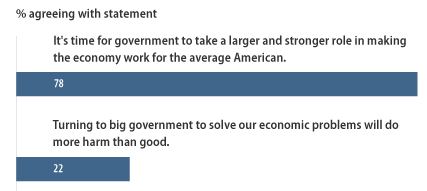
Millennials are not afraid of big government. Derek Thompson notes:

What I find interesting, if not entirely revelatory, is that Millennials are stoked about the goals of liberal government (more than two-thirds support sustainable eco-solutions, universal health care, alternative energies) but pretty ambivalent about the means…Of course we don't have strong opinions about economic strategy: We're waiting to see if Obama's tactics work first. And if they don't, the big government generation could slow its leftish shift.

After all, let's remember: about two-thirds of this group once supported the Iraq War.

Palin-Clinton Alliance?

by Chris Bodenner

Andrew's worst nightmare, I know. But despite the tantalizing Politico headline, there is not much to the story other than Coale proposing that his new friend, Sarah, help pay the debt of his old friend, Hillary, in an attempt to garner cred with women and Independents. But no one bit, least of all Palin. The whole episode just shows how politically tone deaf Coale was – and, of course, how the Palin-Susteren-Coale alliance is even more evident. Allahpundit elaborates:

Believe it or not, the most important part of this story isn’t the Hillary scoop but the stuff near the end about how desperately Sarahcuda needs help managing her new national profile. This is what I meant the other day when I said it bodes ill that so many party insiders seem to have given up on her; some of you sneered at me for that but it helps to have practiced hands on your team who know how to deal with this sort of thing. What happened to Fred Barnes and Bill Kristol and all the other GOP bigwigs whom she charmed before she was named VP? No help for Sarah from Alaska now when she needs it?

A Failure of Capitalism (III)–Blame the Fed, the Government in General, and the Economists

by Richard A. Posner

To understand the role of the Federal Reserve in the causation of the current depression, we must understand its influence on interest rates, and how interest rates influence economic activity.

The Treasury Department borrows money to finance government activities by issuing bonds, which are bought by banks and other investors, and also by the Federal Reserve. When the Fed wants to stimulate economic activity, it buys Treasury bonds from banks and other investors, paying cash, which increases the balances in bank accounts and by doing so provides more money for lending and spending. (The process is actually somewhat different and more complicated, but I am presenting an intuitive version that will be easier for readers who are not experts to understand.) As the supply of money for loans rises, interest rates fall (the larger the supply of a good, including loans, the lower the price, which in the case of a loan is the interest rate). As interest rates fall, borrowing becomes cheaper, and people borrow more and go deeper into debt, rather than saving. With more borrowing, banks need more money to lend, so they borrow too; as it is cheaper to borrow capital than to raise it by issuing more stock (because interest is deductible from income tax and the compensation that providers of equity capital to firms receive from those firms is not) banks become more indebted too, and hence more risky. And because houses are a product bought mainly with debt (for example, an 80 percent or 90 percent or even 100 percent mortgage), the demand for houses rise. So more houses are built, but in addition, because the overall stock of housing is so durable and is therefore not replaced frequently, the increase in demand pushes up prices. If nothing else besides low interest rates is pushing up housing prices, we have a bubble, in the sense that, as soon as the crutch of low interest rates is withdrawn, prices are likely to fall, as houses become more expensive to buy, the higher interest rates are. It was the collapse of the housing bubble when interest rates rose (mainly in 2005 and 2006) that started the economic collapse, and because banks were so heavily invested in housing through their role in issuing mortgages, they came near to collapse as well, triggering the depression.

The Federal Reserve pushed interest rates way down at the end of 2000 and kept them there until 2005 and during this period of low interest rates (in part of the period, the short-term interest was negative in real terms, because it was lower than the inflation rate). This was the decisive error that put too much risk into the economy, against a background of deregulation that allowed the banking industry to take whatever level of risk was profit maximizing given interest rates. The Fed was fooled by the fact that the usual indices of inflation, such as the Consumer Price Index, did not indicate a high rate of inflation. But the reason was that low-cost imports from China and other East Asian countries kept prices of most goods and services down. Inflationary pressures caused by an overheated economy flooded with lending were deflected into assets such as houses and common stocks.

The Federal Reserve missed all this. As late as October 2005, as the housing bubble was beginning to leak air, Ben Bernanke, the chairman of the President's Council of Economic Advisers–and about to be appointed the chairman of the Federal Reserve–stated publicly that the rapidly rising housing prices were not the product of a bubble. And so the finance industry, reassured, continued making risky mortgage loans and selling risky securities backed by those loans.

There were plenting of warnings of a housing bubble, going back to 2002 and found even in local newspapers. But most economists missed the bubble, and so it was easy to dismiss the few who warned as Cassandras and sourpusses. I do not fault the Federal Reserve for following the conventional wisdom. I do fault it for having failed either to take the warnings seriously enough to evaluate them in depth (the Fed has 250 Ph.D. economists), or to prepare contingency plans in the event that the ascent of housing prices proved to indeed be a bubble and the bubble collapses and brought the banking industry (so heavily invested in housing) down with it. As a result of the Fed's unpreparedness, when the banks began collapsing in September of last year the government was caught by surprise, improvised spasmodically, failed critically to prevent the bankruptcy of Lehman Brothers, and by its pratfalls deepened the downturn.

I read recently the statement by one business economist that if there is any hero in this mess we find ourselves in, it is Ben Bernanke. As far as I can judge, he has since last October managed the response to the crisis competently–perhaps more competently than his predecessor Greenspan would have done, or other possible replacements for Bernanke. But he is like a general who having been defeated in battle because of his errors manages the retreat of his army competently. He does not thereby escape blame for the defeat, and should not be permitted to shift blame to the soldiers under his command who gave way under attack.
The Future Is Not The 1980s

by Patrick Appel

Michael Steele isn't looking back, he swears:

The Republican Party has turned a corner, and as we move forward Republicans should take a lesson from Ronald Reagan. Again, we’re not looking back – if President Reagan were here today he would have no patience for Americans who looked backward. Ronald Reagan always believed Republicans should apply our conservative principles to current and future challenges facing America. For Reagan’s conservatism to take root in the next generation we must offer genuine solutions that are relevant to this age.

That is one tortured paragraph.

Steele doesn't discuss his "solutions that are relevant to this age." Instead we get the same boilerplate and a few allusions to Reagan. Greg Sargent questions whether the GOP has in fact "turned a corner" by looking at the latest polling:

…how can Steele project the sort of optimism expected from a party chair without coming across as increasingly out of touch with reality, or worse, as more and more of a figure of fun?

Dave Weigel has been tracking these declarations of Republican revival.