Huntsman, 2016?

by Patrick Appel

After the surprising coup this weekend, Christian Brose throws this out there:

[Utah Gov. Jon Huntsman] probably assumes that the GOP will spend the next few years banging rocks together in the wilderness, throwing moderates like Colin Powell out of the party, and trying to wind the clock back to the early 1980s while the rest of the country moves on. He probably assumes that he's already established himself as "a different kind of conservative," that the domestic policy fights he'll face as governor will be frustrating and possibly fruitless, and that the GOP will need a few more electoral thrashings before it is ready to buy what he's selling.

What's more, he probably assumes that, while the rest of the GOP tears itself apart in naval-gazing fights about the meaning of "true conservatism," he can go off and pad his resume with several years of experience managing America's largest (and increasingly, its most important) bilateral relationship, and that when he returns in, say, 2014, not only will the GOP primary voters not punish him, they'll welcome him as a practical, reform-minded leader, attuned to the problems of the 21st century, who puts the national interest above partisan politics — that is, just the kind of guy to lead them to victory in 2016.

Beyond Banking

by Patrick Appel

Ryan Avent explains why banks are only part of the economic problem:

Paul Krugman, for all his insistence on nationalization, has argued quite forcefully that it was an export boom rather than a banking fix that finally saved Japan. The worrying thing for most economists is that America is unlikely to export its way out of recession — that's just not how our economy is structured at present — and it isn't clear where else growth might sprout. Consumption has traditionally been our main engine of growth, but consumers remain saddled with debt and are unlikely to pull the economy out of its doldrums.

In our story, the banks are largely a side issue, dependent on margins to recapitalize themselves which they can only enjoy if the economy begins growing strongly again. But after decades of neglect of the real economy, it's just not clear how strong growth might quickly resume; too many workers simply aren't prepared to find employment outside of manufacturing or construction.

It's important to understand this, because there are ways the government can address structural issues. It will be politically difficult to spend money on the appropriate policies, however, so long as there are economists out there loudly demanding that we keep our powder [dry] for the bank nationalizations that will eventually be necessary.

In Defense of the Liberal Arts

By Lane Wallace We're entering commencement time, which means all kinds of notable people (the President and First Lady included) will be giving well-crafted speeches about the importance of education and a college degree. But is one kind of degree better than another? Much has been said about the importance of science and technology degrees in terms of keeping the U.S. competitive with the rest of the world. And as the economy has worsened, and fears of joblessness have risen, the voices advocating pursuit of more "practical" degrees have grown in both number and volume. 

A recent New York Times article noted that Humanities now account for only 8% of all college degrees, and that proponents are having to work harder than ever to justify the worth of a humanities, or liberal arts, course of study. The article quotes Anthony T. Kronman, a Yale law professor, as saying, reluctantly, that the essence of a humanities education may become "a great luxury that many cannot afford."

I passionately disagree.

 (Full disclosure: I graduated from an Ivy League university with a liberal arts degree in Semiotics, which most people would consider a highly frivolous subject. Although I have to say, the degree did turn out to be useful in getting me job interviews in all kinds of fields, simply because nobody knew what the word meant.)

However. Three points worth considering in the debate:

First I figured out the true value of a college degree not in the lofty halls of Brown University, but in a corrugated cardboard factory in New Zealand. I'd taken a "leave of absence" as they call it, after my sophomore year, to figure out if I really wanted to pay all that money learn things that seemed, well … a tad non-essential, at best. I packed a backpack and took off for the romantic frontier-land of New Zealand with nothing but $500 and a working visa in my pocket. The six months I spent there were a far cry from what I thought the adventure would be, but it was educational. Culminating in my job at the cardboard factory–where I was surrounded by people who hated their jobs but had no other viable option. 

In a flash, I grasped the true value of a college degree. It didn't matter what I majored in. It didn't even matter all that much what my grades were. What mattered was that I got that rectangular piece of paper that said, "Lane Wallace never has to work in a corrugated cardboard factory again." A piece of paper that was proof to any potential future employer that I could stick with a project and complete it successfully, even if parts of it weren't all that much fun. A piece of paper that said I had learned how to process an overload of information, prioritize, sort through it intelligently, and distill all that into a coherent end product … all while coping with stress and deadlines without imploding. 

I also realized that I'd do far better at all that if I studied what I was most passionate about learning, practicality be damned. Hence my switch to Semiotics (which, for anyone wondering, is a four-dollar word for communication). If you want to be an engineer or physicist, you'd better major in the subject. But only if that's what you truly want to study and do. Pro forma dedication is discernible from 100 paces away. 

Second … In an increasingly global economy and world, more than just technical skill is required. Far more challenging is the ability to work with a multitude of viewpoints and cultures. And the liberal arts are particularly good at teaching how different arguments on the same point can be equally valid, depending on what presumptions or values you bring to the subject. The liberal arts canvas is painted not in reassuring black-and-white tones, but in maddening shades of gray. 

What's the "right" solution to the conflict in Sudan? What was Shakespeare's most important work and why? Was John Locke right in his arguments about personal property? Get comfortable with the ambiguities inherent in a liberal arts education, and you're far better equipped to face the ambiguities and differing viewpoints in a complex, global world. (The late David Foster Wallace expanded on this point in his acclaimed 2005 Kenyon College commencement address, which, if you missed it at the time, is worth taking the time to read.)

Third … Yes, the U.S. needs technical expertise to keep pace, economically and technologically. But we also need innovators and entrepreneurs creating break-through concepts and businesses. And while knowledge in an area is important, I'd argue that the most important trait a pioneering entrepreneur needs is the confidence to buck convention; to believe he or she is right, despite what all the experts say.  
Last year, I interviewed Alan Klapmeier, founder and CEO of the Cirrus Design Corporation, which revolutionized the piston-airplane manufacturing industry with its composite Cirrus aircraft (discussed at length by James Fallows both here at The Atlantic, and in his book Free Flight). I asked Klapmeier what gave him the idea, back in the mid-1980s, that he could take on an industry as conservative and entrenched as general aviation. His answer:

"I think it was my college education. I went to Ripon College, which was a liberal arts school. And that kind of school teaches you how to think for yourself. My professors didn't tell you you were wrong. They convinced you you were wrong. And if they couldn't, you might end up changing their minds on something. Figuring out for yourself what right and wrong is builds a huge bit of confidence. The kind that makes you think maybe we can take on an industry." 

Worth thinking about. 
The Nature Of Bankers

by Patrick Appel

A reader writes:

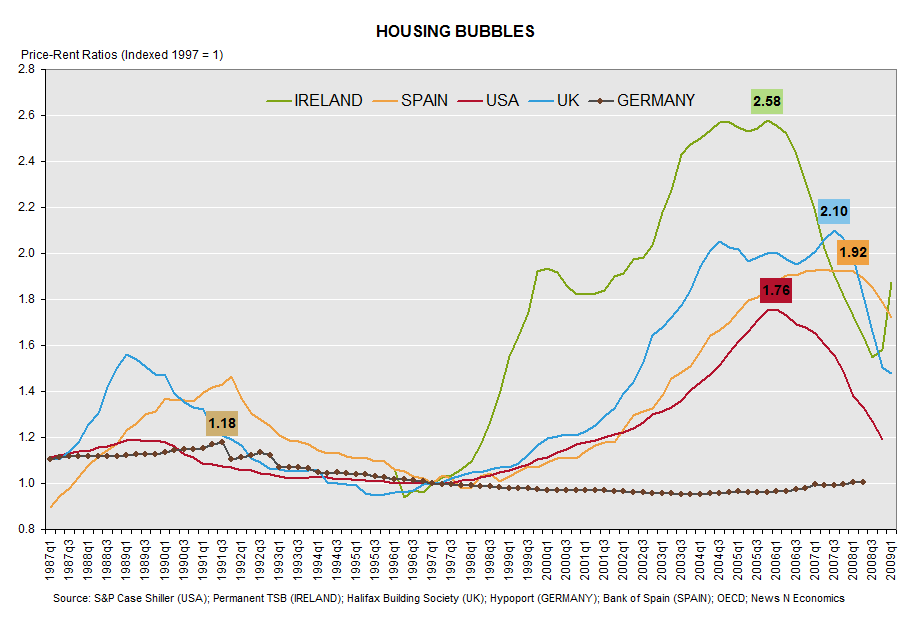
To play off of Richard Posner's comments, it's worth considering that consumers and bankers are fundamentally the same creatures they've been since the early 20th century.  They did not become spontaneously less competent, riskier, or greedier than their predecessors.  It's not the people who changed, but rather the regulatory environment they operated in. 

Back in the 60's nobody was taking out sub-prime mortgages without any money down or any documentation to prove they could pay off the loan.  This is not because they were smarter with their money, but rather that kind of mortgage simply did not exist.  Those types of mortgages came into being because the rules of the game changed.  Ultimately the financial system operates within the parameters we choose to set for it, and if we create incentives to take tremendous risks, then that's what the system does. 

Certainly in all things we need to consider individual responsibility, but we have to have a regulatory system that assumes a certain amount of irresponsibility.  We should permit one person or a few people to make foolish decisions in the interests of freedom and evolving our society.  But we have to put limitations in to prevent too many people from taking those chances because, when they do, it puts the entire system at risk.

Yves Smith has more along these lines.

“Gourmet” Soup Kitchens, Ctd

by Patrick Appel

A reader writes:

I agreed with Julie Gunlock's article. My mother grew up in an Italian family on the Lower East Side of New York and since they didn't have enough money to buy much meat, their meals consisted of pasta, sauce, soup, salad and occasional seafood – along with peppers & eggs/potatoes & eggs and bread.  She made many of these same meals when my brothers and I were growing up and many of them remain family favorites.  What is wrong with a bowl of good vegetable soup (minestrone), or a filling bowl of stew?  My father always said a meal he dreamed about when hungry was sunny side-up eggs, ham and toast. The above are all good, nutritious, filling and definitely not full of pretentious ingredients;  I think any homeless person would be grateful for (and enjoy) any of them.

There is nothing wrong with simple foods, but many "fancy" foods are not very expensive. What is wrong with serving more extravagant food occasionally if the costs are minimal? Another reader sees this:

Gunlock really misses the point. Mushroom risotto is a cheap, easy and healthy meal to make. Pumpkins are most commonly thrown away after halloween or turned into sugary pies. They're cheap and healthy. Adding a few seasonings to cheap food turns it into something special at little cost. Just because some restaurants can charge $30 for it doesn't mean it costs that much to make.

  One more reader:

My husband worked many years for a high-end restaurant and has told me time ans again that the smallest part of a restaurant's expenses is the actual food. Most of the money goes to labor – aren't the people working at soup kitchens volunteers? I recently heard about a contest on the radio (NPR) where cooks from 4-star restaurants vied to see who could prepare a meal for a family of 4 for the least amount of money, at least $10 or less. I heard some really astounding entries including entree, main course and dessert, for under $10. And if you're preparing larger quantities, the cost per serving goes down.

Talk about food snobbery. Apparently Ms. Gunlock thinks that soup kitchens have to serve spaghetti and sloppy joes every day to be deserving of government funding. Has she taken into account that healthy, balanced meals help save on health care costs in the long run? And that people are more likely to eat and benefit from healthy food choices when they are presented as attractive, well-prepared meals?

Nanny State Watch

by Chris Bodenner

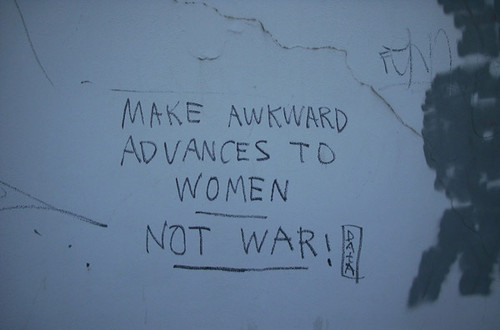
Awkward

South Carolina's AG is threatening Craigslist with prosecution if the company does not completely rid its site of erotic postings. “Some large Internet communities are coming to a controversial conclusion: the Web can’t always police itself," writes the WSJ. Jeff Jarvis pounces:

But the truth is that this episode only shows the gap between the law and the community. Craigslist’s community does police itself against the things that matter to it: fraud, spam, trolls. That’s how craigslist’s founder, Craig Newmark, spends his days, in customer service: policing against the things that bother and matter to his community. But sex? Who gives a damn? Clearly, the community doesn’t think it needs to be protected from that. So who are these cops protecting and from what? … Craigslist is a society and it has its own laws and means of enforcement.

Meanwhile, Craigslist's blog is chronicling examples of sex ads placed in mainstream outlets not being threatened by the state government. (And those ads are even more explicit.)

(Photo via Daily What)

The Death and Life of Great Financial Centers

by Richard Florida

New York and London are consolidating and strengthening their positions atop the global financial system, according to the FT's John Pender.

The latest edition of the Global Financial Centres Index (GFCI) shows these two leading centers to be considerably more "resilient" than others, ranking as the world's only "truly global financial centres."

The GFCI, which is based on surveys of financial experts and professionals, rates financial centers on a point basis. London was on top with a rating of 781, followed by NY with 768. The ratings for these top financial centers fell only 10 and six points respectively since the onset of the crisis.

The next three centers – Singapore, Hong Kong, and Zurich – saw their ratings nosedive by 14, 16, and 17 points respectively. Tokyo has fallen out of the top 10, slipping to 15th place. Chicago is seventh, Boston ninth, San Francisco 17th, and D.C. 21st. Toronto is 11th.

Pender suggests that the only "plausible thesis" is that heightened competition to London and NY can eventually come from Asia. He points specifically to Shanghai, noting that China is running huge surpluses, its banks are well-capitalized, and its government is working hard to turn Shanghai into a global financial center by 2020. 

But Shanghai currently ranks 35th on the GFCI, around the same as the British Virgin Islands and the Bahamas. Never mind it plummeting a whopping 30 ratings points over the course of the crisis. And there is considerable competition within Asia for the top financial spot – pitting Shanghai against Tokyo as well as Hong Kong and Singapore. 

Perhaps a combined Shang-Kong center can emerge over time. Shanghai has the industrial muscle and economic size and scale, while Hong Kong brings openness and attractiveness to global talent.

But major banking centers are extremely resilient.  Even though New York overtook London during the last economic crisis of the Great Depression, London has come roaring back and once again eclipsed the Big Apple.

The real action will be further down the chain, as the economic crisis continues to wreak havoc on second- and third-tier financial centers.