by Patrick Appel
If you haven't read it yet, Andrew's thoughtful post yesterday is worth your time.
by Patrick Appel
If you haven't read it yet, Andrew's thoughtful post yesterday is worth your time.
by Richard Florida
TIME does the future of work.
Clergy and butlers are among the happiest workers; musicians and dentists are fairly happy; roofers and gas station attendants not so much. This interactive graphic tells me I'm happier as a professor than author – I couldn't find blogger on the list…
by Lane Wallace
It's toward a compelling story, period. The photo that's dramatic. The unexpected story that cuts against the grain. The moment that stops people in their tracks and makes them re-think their assumptions. The one photo that tells a story better than 1,000 words.
We know we can't tell the entire story in one article, or one photo. So we try to find something compelling that represents an important aspect of the story. And, hopefully, we get to tell other pieces, in other stories and images. So that over time, we can paint a fuller picture of a complex milieu. Are our efforts flawed, even when we try our best to tell a story representational of the "truth"? Of course. We have to live with that. Truth is elusive. So we tell stories. And we hope, on our best days, that we provide enough pieces of the puzzle for people to: a) get some sense of what the overall image is, and b) realize that it's a complex image that goes beyond any easy categorization or answer.
by Patrick Appel
Yglesias thinks that the GOP is losing the torture debate:
by Patrick Appel
I've neglected to comment on the brouhaha surrounding Dowd lifting a line from Josh Marshall because it felt largely irrelevant, but Greenwald makes a good point:
by Chris Bodenner
US soldiers on suicide watch are often forced to wear orange or red vests to set them apart from their camouflaged brethren. Elspeth Reeve reports:
The purpose of the vest is, ostensibly, to make it easy for others to keep an eye on a suicidal soldier, but forcing a soldier to advertise his own depression creates a powerful stigma. "When you see what happens to someone on suicide watch—the orange vest, the trips to the chaplain, the drill sergeant talking about them when they're not there, saying they can't handle the military. … When you see that, you're going to think twice about speaking up and saying you need some help. … You don't want to be like that guy," the recruit from Benning says.
"I can't think of anything worse in the ethos of the military," says Polly Coe, a therapist who treats soldiers stationed at Fort Campbell, in Kentucky. Singling out suicidal soldiers, she says, "makes them more suicidal."
by Richard Florida
Class is a word that elicits strong, and sometimes strange, reactions from many Americans. Once a powerful construct understanding economies and societies, class has been all but banished from the lexicon of social scientists and from the public conversation.
It's time we put class back in the center of our vocabulary, especially so during this ongoing economic crisis and reset. The impacts of the crisis have been extremely uneven by class – hitting hardest at the industrial working class and their communities.
Over the coming week, I'll be posting on that, and also on the powerful effects of class on the wealth, innovativeness, and happiness of nations, drawing on a variety of statistical analyses conducted with Charlotta Mellander and my Martin Prosperity Institute colleagues.
We define class simply by peoples' position in the economy - not by perceived status, level of income, or what we consume, but by the kind of work we do. Conveniently, the U.S. Bureau of Labor Statistics keeps detailed statistics on the myriad occupations that make up the U.S. economy.
We identify three core classes:
The working class who work in production, transportation, construction, and related jobs.
The service class who work in jobs like food prep, grounds cleaning, building maintenance, personal care, administrative offices, and community, social, and protective services.
The creative class of scientists, engineers, and entrepreneurs; artists, designers, media types, and entertainers; and knowledge-based professionals in management, health care, education, and related fields.
I'll report on the relationship between class and various social and economic outcomes over the next several days, starting with the relationship between class and economic output tomorrow. On Wednesday we turn to class and technological innovation; class and entrepreneurship on Thursday; and class and the happiness of various nations on Friday. Along the way, I'll also post on the uneven ways that recessions impact different classes, and relationship between class and unemployment, among other things.
Stay tuned.
by Patrick Appel
Via Balloon Juice, Julie Gunlock complains that food for the homeless is too fancy.
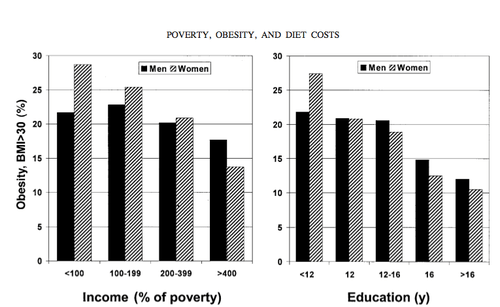
Gunlock is upset because $150 million of stimulus money was given to homeless shelters. Unfortunately for her, MEND doesn't take government money. Regardless, obesity is concentrated among the poor and the uneducated. More healthful food should be a priority. Gunlock acknowledges that "it is certainly a worthy goal for food kitchens to endeavor to provide a healthy meal to those they serve" but then goes on to critique kitchens for throwing anyway donated donuts because it "betrays an expanding food snobbery." Oy.
(Chart from Adam Drewnowski and SE Specter's 2004 article on poverty and obesity)
 The Dish