Ask The Audience: Mental Health

A reader writes:

I appreciate your opening things up to include our questions/concerns especially with Judge Posner in the mix. I work in the field of public mental health as a clinician and ethicist and have serious reservations about the implications of diagnoses of mental "illnesses" like depression, or addictions, for our civil rights. I don't want here to enter the debate about the scientific bases, or lack of, for particular diagnoses but am interested in having a public conversation about what it would mean for someone to either not be held accountable for their actions because of their having been diagnosed as mentally ill, and also for someone to be denied their rights to make choices, as has been suggested in cases where someone who has been diagnosed as depressed is denied their rights to refuse medical treatment. As more people are being diagnosed all the time as parts of public health initiatives in schools and elsewhere, massive campaigns by drug companies, and in wider use by courts of mental health services these issues are starting to reach a critical mass. As they have impacts far beyond the reach of private medical care they should be brought into the realm of public debate.

The best book I have read about this conflict is Crazy by Pete Earley. His book focuses on his inability to get his son treatment for severe mental illness. But the balance between individual autonomy and helping the truly sick is anything but obvious. Give the mentally ill too much freedom and a number of them end up in jail. Give too much power to relatives and relatively healthy people can lose their freedom.

Thoughts?

“To See What Is In Front Of One’s Nose…”

by Chris Bodenner

Check out Fedex
"You would say you have seen it thousand times but just to make you notice an arrow formed between the letters “E” and “X” conveying speed, direction and reliability of this amazing courier service."

And here's Amazon.com:

Amazon-logo

"It says that amazon.com has everything from a to z and it also represents the smile brought to the customer’s face."

Cash For Clunkers

by Patrick Appel

Robert Frank assesses the program (it gives Americans vouchers for buying more fuel efficient cars). He thinks it makes sense even if you don't consider the environmental angle:

Unemployment and idle capacity in the American auto industry are at their highest levels in decades. As the German experience indicates, auto vouchers are likely to produce an immediate surge in auto sales. This would put people to work who would otherwise be doing nothing. A $4,500 voucher that leads to production of an additional $25,000 car would generate $25,000 of additional income along the value added chain, which in turn would generate more than enough tax revenue to pay for the voucher.

Playing Their Cards

by Patrick Appel

Josh Marshall previews Obama's meeting today with Israeli Prime Minister Binyamin Netanyahu:

…both men have strong domestic imperatives to limit any appearance of disagreement. But each also wants to follow a policy that is completely in conflict with the one the other wants to pursue. My hunch (and my hope — and hopefully I'm not confusing the two) here is that Obama has many more cards than Netanyahu but that Netanyahu doesn't fully grasp that and that over time he'll overplay his hand and find himself out of office like he did a decade ago. But at some point, and probably soon (remember, he's got the speech in Cairo early next month) Obama will start having to put his own cards on the table and putting clear limits on what he'll accept.

Winningest Sports Towns

by Richard Florida

Indianapolis takes first place and Boston second (so much for the curse of the Bambino). New York is 12th, D.C. 35th, L.A. 14th, Chicago 23rd. The ranking, by the Toronto Star, calculates the winning percentages since 2000 for the 37 U.S. and Canadian cities with at least two professional sports teams.
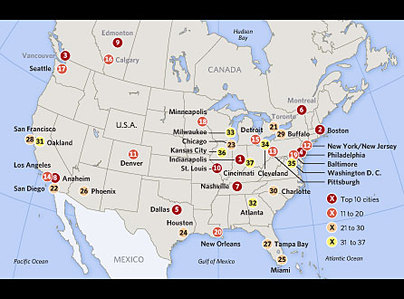
Map from the Toronto Star.

Banking – Shadow and Real

by Richard Florida

Tyler Cowen points to a new NBER study that concludes that the shadow banking system is misnamed: it's part of the real banking system and at the heart of the financial crisis:

The 'shadow banking system' at the heart of the current credit crisis is, in fact, a real banking system – and is vulnerable to a banking panic. Indeed, the events starting in August 2007 are a banking panic.

If The Tables Were Turned…

by Patrick Appel

Brian Tamanaha imagines a possible news story:

According to reports out of Kabul, the Taliban announced that they have waterboarded three U.S. soldiers taken prisoner. The Taliban commander asserted that waterboarding is not torture and does not violate the Geneva Convention or U.S. law. He assured everyone that a medical officer monitored all waterboarding sessions to insure that no permanent damage was done to the soldiers. In addition, he said they were careful to follow the directions on waterboarding in a SERE training manual they found posted on the internet.