
How Rummy Spun Bush, Ctd

by Chris Bodenner

The other major scoop to come out of the Draper piece was Rumsfeld's blundering during Katrina, which the Daily Beast summed as follows:

Rumsfeld threw truck-size obstacles in the way of deploying troops to New Orleans in the aftermath of Hurricane Katrina. Claiming that there’d be problems with “unity of command,” Rumsfeld was adamant that only the National Guard be sent out—but they were slow in arriving and did little to stem the chaos. Bush snapped at him for the disorder in a meeting about the situation: “Rumsfeld, what the hell is going on there? Are you watching what’s on television? Is that the United States of America or some Third World nation I’m watching? What the hell are you doing?” Five days after the hurricane hit, Bush told Rumsfeld he had to deploy troops. “If we had put those troops in on Thursday, the narrative of Katrina would be a very different one,” one senior official said.

Also, Hilzoy picks apart another damning revelation: Rummy's obstinacy with Russia over nuclear arms. Benen sighs, "And here I thought Rumsfeld was a nightmare at the Pentagon before reading the Draper piece."

The Huntsman Coup, Ctd

by Patrick Appel

Fallows ponders the pick:

…on first impression a clever choice from American-interest point of view (completely apart from what it means for internal party politics in the US). Will also give the Chinese leadership something to think about: why the new Democratic president has appointed a rising Republican politician. Sign of bipartisan US views toward China?

Joe Klein also praises the pick. Andrew's reaction to the selection is here.

The Indian Elections

by Patrick Appel

A mini-roundup of reaction to the big international news of the weekend. Arvind Subramanian of the Peterson Institute decodes:

Internationally, the Indian election results and the performance of its economy during the crisis raise the question of whether the Indian approach to globalization—not too much foreign finance like the Eastern Europeans and not too export reliant as China—has some merit.  Goldilocks globalization and dynastic democracy is the model that India is offering the world.

Rory Medcalf:

The Indian election results announced at the weekend amount to an unexpected and dramatic win for global stability. Hundreds of millions of Indian voters defied predictions that they would support sectarian, regional and caste-based parties and thus entrench new depths of deadlock in the world's largest democracy. Instead, in a mass act of enlightened self-interest, they returned the secular Congress-led government of Dr Manmohan Singh with a massively increased majority of seats, reversing three decades of worsening atomisation and parochialism in Indian politics.

Chris Devonshire-Ellis:

A government mandate, and a unified party directed by economists and lawyers bent on legal reform are likely to have a huge impact in getting through legislation to open up to competition within India’s domestic markets, encourage foreign direct investment, deal with the legal and investment issues concerning infrastructure development, and place the nation on a fast track to reform much as China was able to achieve in the 1990s.

The implications are going to be huge.

The Trouble With Predators

by Patrick Appel

David Kilcullen's and Andrew Exum's article (in yesterday's NYT) on why we shouldn't use drone attacks in Pakistan is excellent:

The drone campaign is in fact part of a larger strategic error — our insistence on personalizing this conflict with Al Qaeda and the Taliban. Devoting time and resources toward killing or capturing “high-value” targets — not to mention the bounties placed on their heads — distracts us from larger problems, while turning figures like Baitullah Mehsud, leader of the Pakistani Taliban umbrella group, into Robin Hoods. Our experience in Iraq suggests that the capture or killing of high-value targets — Saddam Hussein or Abu Musab al-Zarqawi — has only a slight and fleeting effect on levels of violence. Killing Mr. Zarqawi bought only 18 days of quiet before Al Qaeda returned to operations under new leadership.

Yglesias adds his own two cents. So does Matt Steinglass Andrew's thoughts on Obama, Cheney, and the war in Afghanistan are here.

Best Locations to be Laid Off, Ctd

by Lane Wallace

A follow-up to my last post about places in America where being "secure-job-free" (as a "car-free" Californian might put it) might be easier … both in terms of emotional and cultural support, and in terms of tangible networking and freelance help from experienced independent workers, for those who decide to launch their own business or creative endeavor.

It turns out that last summer, CNNMoney put together short profiles of the 100 best places, in their opinion, to launch your own business. An interesting list to ponder. 

The Weekend Wrap

by Chris Bodenner

Over the weekend the Dish covered Obama witnessing at Notre Dame, his co-opting of Huntsman, Pelosi's plummeting in the polls, Steele's stigmatizing of gays, and Robert Draper's unveiling of Rumsfeld. We also looked at how the government bastardizes web culture, how artists interpret porn, and how coffeemakers create art. We ran a recession view, missives from the end of gay culture and Catholic culture, and a moving paean against homophobes.

Andrew had a busy weekend of blogging before his break; he defended his passion on the torture issue, tore into Kristol's latest hackery, picked apart a Christianist's denial of torture, and reflected upon his conservatism to an inquiring reader. But above all, he composed a sweeping argument for how Obama is slowly but decisively undermining the Dark Side.

And speaking of Cheney, be sure to also check out Andrew's latest column and yesterday's appearance on Chris Matthews.

The Battle Over Detainees

by Chris Bodenner

I second Patrick in my excitement to blog alongside three brilliant minds this week. I hope to supplement their posts as best I can with follow-up links, blog commentary, and reader email.

I do have one particular topic I'd like to highlight this week, one that's flown a bit under the Dish radar lately: detainee transfers. It is a topic I've written about before and now suddenly back in the news. On May 7, the House GOP submitted a bill called the "Keep Terrorists Out Of America Act," which prevents Obama from transferring detainees to a US prison without permission from the governor and the state legislature. Libertarian Steve Chapman makes a good point regarding this sudden shift on executive authority:

It seems like only yesterday conservatives were intent on upholding the powers of the commander-in-chief against encroachment by 535 armchair generals. I'm trying to imagine the reaction if, after the 9/11 attack, Democrats had proposed legislation requiring the president to get a state's consent to send its National Guard troops to Iraq.

The bill is basically a de facto ban, since few elected officials are willing to vote for a transfer and face the kind of fear-mongering, 24-style ads already unleashed by the GOP. In fact, the controversy has already started to roil a Senate race in Kansas and a gubernatorial race in Virginia. And the Senate this week is voting on a war-funding bill that includes $80 million to close Gitmo – money Republicans have threatened to oppose. Such political pressure has even caused some prominent Democrats to back away from the president's policy.

As Andrew noted yesterday, Obama has done a lot to defang Cheneyism; he has postponed an exit in Iraq, retained Gates, increased troop levels in Afghanistan, elevated McChrystal, kept rendition, revived military tribunals, and punted on the torture photos. So what's left for Rove Republicans to latch onto? I think we already got their answer:

Ask The Audience

by Patrick Appel

It's a joy to fill in once again. We have an all-star cast joining Chris and me this week, and it's an honor to blog alongside them. As Andrew mentioned, I will be monitoring the Dish inbox, andrew@theatlantic.com. To kick off the week, I thought we might try an experiment and have readers submit topics for debate. Ideally, these debate prompts will allow readers with special knowledge of a given topic or industry a chance to sound off and/or pose a question to the Dish's readership. I'll keep the threads going back and forth so long as they remain compelling. I'm especially interested in The Dish's blind-spots, ie topics The Dish or the MSM don't cover often or at all. The sum knowledge of Dish readers is enormous and I hope we can use some of that insider knowledge to ferret out under the radar stories and debates. Title your e-mails "Ask The Audience." One to get us started:

How do we reduce the booming prison population? I'm in favor of decriminalizing marijuana and scrapping mandatory minimums but neither of those is very realistic at the moment. What is the ideal balance between stopping crime and restoring sanity in sentencing? How do you treat the rights of a population that is political anathema?

Let's see what this blog can do.

A Breather

Dustysleep1_1

I'm due for a break from the web for a week. Aides de blog Patrick Appel and Chris Bodenner will keep the Dish al dente in my absence. I'm working on an essay for the magazine and catching up on some reading – things I cannot seem to get done when I'm blogging twelve hours a day. Atlantic Correspondents 200906_toc say, being laid off or losing a loved one." On her non-Atlantic blog, "No Map. No Guide. No Limits," she describes her transition into adventure writing thus: "Twenty years ago, I quit a safe and successful corporate career to become a pilot and an adventure writer. In the ensuing years, as if that original cliff leap wasn’t enough, my flying and story assignments have taken me across six continents, from 120 feet below sea level to 70,000 feet above the planet … and have landed me in more uncertain and uncomfortable situations than any truly sane person would choose or endure." Her free e-book can be downloaded here.
Richard Florida, booster of "the creative class," penned the much discussed Atlantic cover story from a few months ago, "How The Crash Will Reshape America." He's director of the Martin Prosperity Institute at the University of Toronto's Rotman School of Management and author of Rise of the Creative Class. Florida is basically the Nate Silver of national demographics and future infrastructure. Here's an interview he did with the Atlantic that explains some of his thinking.

Patrick Appel and Chris Bodenner are over-worked 20-something under-bloggers who are tasked with reading the entire internet everyday and delivering the choicest bits to yours truly. They will keep the Dish well-stocked, maintain the regular features, and make sure no online gem goes unblogged – or I will fire them. I might as well take this opportunity to reiterate how much I owe them, how proud I am that the Dish can now operate without me, and how much I enjoy hanging with them. Seriously, you don't get to work with people as fun and as dedicated as they are very often. You'll see again this week just how integral they are to this blog, its coverage of serious debate of serious topics and its delight in all that makes life worth laughing at as well.

Feel free to e-mail them dissents, insights, and links. Send them to my regular address, andrew@theatlantic.com.

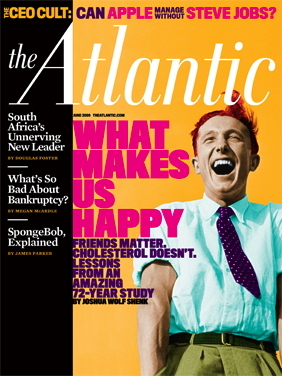
Meanwhile, a genuine, heartfelt plug for the current issue of the magazine, whose new issue is a compulsive read. Ben Schwarz on recession fashion, Michael Hirschorn on the Economist, Josh Shenk's cover-story on the best longitudinal study of human beings ever conducted (JFK was in it), James Parker on SpongeBob, Megan on bankruptcy, and the inimitable Jeffrey Goldberg's advice on Facebook ultimatums: for Pete's sake, subscribe! Someone's got to pay these people, guys.

And see you in a week.

No Scapegoats This Time

Jeff Rosen joins the drumbeat towards a Truth Commission:

[Obama saying] that an independent commission would be politically distracting isn't a good argument for resisting it. The Bush torture policies are the most serious violation of American values since the World War II internment of Japanese-Americans. A closed Senate intelligence committee investigation would be inconsistent with the transparency Obama demanded when he released the memos in the first place. At this point, only a full truth commission-style investigation can allow the Bush lawyers to make clear that they didn't conspire to break the law while focusing public opprobrium on the real architects and abettors of Bush's torture policies: namely, the policymakers–from Bush and Cheney themselves to George Tenet, John Ashcroft, and Condoleezza Rice, not to mention the top leadership in Congress.