Jeffrey Goldberg unpacks the mind of Bibi here. Money quote:
Month: May 2009
Obama’s Long War Against Cheneyism?
Yes, there's been a lot to think about and assimilate this past week. With Obama, the surface decisions – the tactical maneuvers – can often obscure the direction beneath. Has he betrayed the gays? Has he back-tracked on torture? What's he doing deferring to Gates and Odierno on the torture and abuse photos? Why's he keeping the military commissions – even with far more protections for defendants? How does he justify continuing to detain prisoners who are completely innocent but may have been radicalized by living in the Gitmo torture-and-detention camp? And why pick general McChrystal – a man whose history of successes in the terror war remains in the shadows but whose mistakes (Camp Nama, the Tillman debacle) are much more public and brand him as a Bush-Cheney figure?
I cannot answer these questions definitively and readers know I embrace the model of letting my own thoughts and those of readers and fellow bloggers map out the discussion – back and forth – in real time. But I'm beginning to think that the cooptation of Huntsman, the retention of Gates, the choice of McChrystal, and the refusal to be baited by Cheney into leading a legal prosecution of past war crimes (with the option of following through later if he is forced to) reveals a cunning we miss at our peril.
Take McChrystal. The Dish has tried to air as much as we can find out about him. What's undeniable is the awe with which many in the military treat him, Petraeus' support and Gates' enthusiasm. I'm deeply troubled by the legacy of prisoner abuse – but I'm also deeply impressed with the man's obvious talent, service, determination, patriotism and ruthlessness. It seems to me that a man like McChrystal is indeed a huge asset, if used ethically and intelligently, in a war to defeat al Qaeda. A man who successfully located and killed a monster like Zarqawi is the kind of man we need to find and kill Osama bin Laden. His entanglement in abuse of prisoners places him in the forefront of all that went wrong under Bush and Cheney – but if Obama has unequivocally ended that abuse and McChrystal is idling in the Pentagon, it seems to me a shrewd choice to show that such ruthlessness, if clearly divorced from betrayal of our core values, is what we need.
What Obama understands is that the war on terror is real, that we need to win both ideologically and militarily, and that we have lost a lot of ground in Afghanistan and Pakistan. I remain worried that this war has become unwinnable, its goals unclear, its rationale more and more an attempt to prevent the unpreventable. But it remains a fact that Obama campaigned to wage war successfully in Afghanistan and Pakistan – and he cannot exactly withdraw precipitously now. Petraeus, an honorable man whose stance on abuse and torture has long been unequivocally on the side of the angels, backs McChrystal. A combination of better Petraeus-style counter-insurgency strategy with McChrystal special ops' targeting of Qaeda terrorists in Pakistan might be the way to advance. It certainty would be an advance on these drone attacks, which apear to be winning battles and losing the war. I don't know, but I'm perfectly prepared to give the president the benefit of the doubt on this, as I did the last one at this juncture. And I think all of us who supported him last fall should – for the current summer military campaign at the very least.
But look forward and see the potential of Obama's offensive against al Qaeda and the Taliban in Af-Pak. Imagine the political and security impact of actual success in that war. Imagine if a president who eschews torture captures Osama bin Laden, or devastates al Qaeda's infrastructure without succumbing to the pathologies of Cheney. Isn't that in the long run the best way to defang the threat that Cheney and Cheneyism pose to this country's future?
I don't believe we can move forward without accounting for the war crimes of the past. With every passing day, the evidence of real criminality in the past accumulates. But I also understand that so long as Cheney and his ship of macho, torturing fools get to posture as the only ruthless prosecutors of the terror war, they will have a card to play to get back into power. They have no shame and no ethical boundaries. And so the only truly profound way to defeat them and what they represent is to show that a humane ruthlessness is still possible in the fight against al Qaeda – which remains a threat rather than a phantom.
With Gates and Huntsman and Petraeus and McChrystal, Obama is coopting the best of the Bush legacy, while separating it from the callow cynicism of the Cheney-Rove-Kristol axis.
Cheney is taking the torture bait from Obama even as Obama refuses brilliantly to take the terror bait from Cheney. Obama is resisting the red-blue reductionism of the past while forging a new and powerful center. And the more Cheney and Kristol and Limbaugh posture as the future of the GOP, the worse they will do and the more likely it is that more sane and sensible conservatives will eventually fight back.
At least that's one reading of recent developments. I may, of course, be wrong or projecting false hopes onto a new president (which wouldn't be the first time). But if I'm rightly understanding this strategy, and it is followed through with care, it's a very potent one. And if Obama can defuse and defang the Dolschstoss right, if he can outflank them on the terror war, if he can both appeal to the world to look at America in a new light, while also pursuing the covert war on terror with more ruthlessness and focus than Bush – then he will not only destroy the Republican rump, he will help heal this country.
In the end, that's what those of us insistent on the torture issue are saying. We want to undercut and undermine Jihadism as we stymie and forestall terror. And we want to retain our soul as a defender of human rights. Cheney's choice is a false one; and history will damn him for presenting it as true. The path of healing will, of course, not be as simple as some of us once hoped. A polity as polluted as this one will take time to recover, but Obama's continued grace and seriousness are arguably the best option we have.
Know hope.
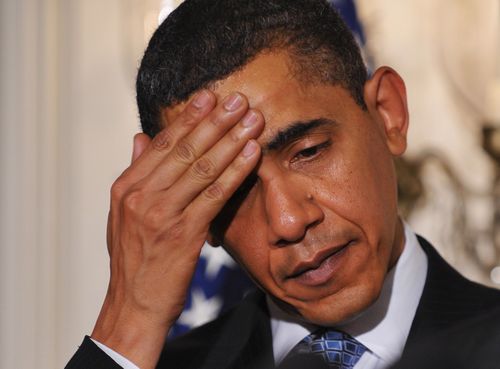
(Photo: the president yesterday. By Mandel Ngan/Getty.)

Face Of The Day
The Denial Of The Christianists
The narrative that still lives in the minds of many Americans about the torture program of Bush and Cheney is exemplified by Pat Boone's simply uninformed column in the Christianist site, WorldNetDaily. Let's unpack it a little, shall we? Item one:
If you read the Senate Armed Services Committee report, you will discover that the torture and abuse techniques we saw in those photos from Abu Ghraib had been approved by the president, tested at Guantanamo Bay and moved to Iraq, as torture became the central intelligence-gathering tool in Bush's war. Far from having been ended by early 2004, they were being entrenched in a forward-looking program in 2005, as the OLC Memos show.
Item two in sentences addressed directly to the president:
Some facts: John McCain disagrees with Boone that waterboarding isn't torture. And McCain broke his bones before captivity. The torture McCain suffered was the Vietnamese refusing to offer medical treatment for his injuries – something George W. Bush directly wanted to do with respect to the wounds of Abu Zubaydah. McCain was beaten repeatedly, also routine for prisoners under George W. Bush. McCain was also subject to solitary confinement – check – and roped stress positions. The stress positions Bush authorized were mainly not ropes, although prisoners were stretched from shackles preventing them from resting. President Bush refrained in his speech backing McCain's nomination in 2008 from describing McCain's treatment as "torture." He couldn't. He used the term "beatings and isolation". If he had used the term "torture", he would have been conceding that he believes the US committed torture under his command.
I do not know the details of Boone's childhood. But my best guess is that he was not stripped naked by strangers, thrown into a dark and cold cell for weeks, shackled so he could never rest, kept awake by insistent deafening noise, doused in water to induce hypothermia, told no one would ever see him again, and strapped to a waterboard and near-drowned scores of times.
And the passion of the resistance to believing the truth is directly related to the gravity of the truth. I understand why Boone is distressed that America is now deemed a country that practiced torture as one of its core values, and that its former vice-president regards this as something of which to be proud. But Boone's issue is not with Obama, who merely has to inherit this disgrace and try to keep fighting a war while ending it. It is with Bush and Cheney, who violated the law of man and the law of God in disgracing this country for ever.
How Rummy Spun Bush
I wonder what's worse: a defense secretary who puts Old Testament quotes on progress updates on an invasion of a Muslim country or a defense secretary who thinks this will add to his president's knowledge and expertise. The lethal combination of a Christianist president and a cynical coterie helped make the Iraq debacle happen. The invaluable Robert Draper provides key background here in an evisceration of the tenure of Donald Rumsfeld – with the help of a few Bushies:
But when the Abu Ghraib scandal broke in the spring of 2004, Bush was upset that the Pentagon had not shared the damning photos with him before 60 Minutes II aired them. He called Rumsfeld on the Oval Office carpet, an incident that the White House leaked to The Washington Post to convey the president’s dissatisfaction to the public. Rumsfeld read the story the next morning, May 6, and promptly drafted a letter of resignation. Bush received the letter with bemusement. Ol’ Rummy had called his bluff. The president took no further action.
The picture Draper paints is of highly dysfunctional defense secretary whom Bush couldn't or wouldn't bring into line until he had no choice. The more you see just how out of it the last president was, the more you wonder just exactly what they told the president about torture:
The Audacity Of Humility
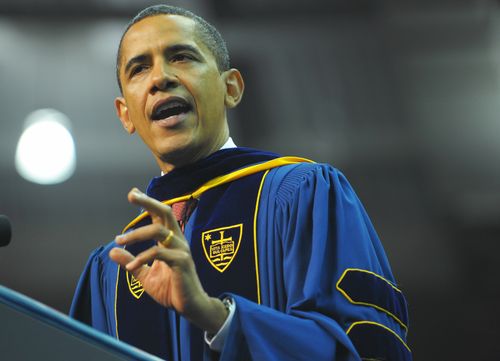
I found his Notre Dame commencement speech deeply Christian. I was struck by two passages. The first a simple statement of fact:
Understand – I do not suggest that the debate surrounding abortion can or should go away. No matter how much we may want to fudge it – indeed, while we know that the views of most Americans on the subject are complex and even contradictory – the fact is that at some level, the views of the two camps are irreconcilable.
The second was a simple statement of faith:
In this world of competing claims about what is right and what is true, have confidence in the values with which you’ve been raised and educated. Be unafraid to speak your mind when those values are at stake. Hold firm to your faith and allow it to guide you on your journey. Stand as a lighthouse.
But remember too that the ultimate irony of faith is that it necessarily admits doubt. It is the belief in things not seen. It is beyond our capacity as human beings to know with certainty what God has planned for us or what He asks of us, and those of us who believe must trust that His wisdom is greater than our own.
This doubt should not push us away from our faith. But it should humble us. It should temper our passions, and cause us to be wary of self-righteousness. It should compel us to remain open, and curious, and eager to continue the moral and spiritual debate that began for so many of you within the walls of Notre Dame. And within our vast democracy, this doubt should remind us to persuade through reason, through an appeal whenever we can to universal rather than parochial principles, and most of all through an abiding example of good works, charity, kindness, and service that moves hearts and minds.
I believe that these sentiments will resonate with all Catholics of good will and serious purpose. When we are called by God to oppose the evils of abortion or torture or terror, we need to remain civil and fair and attuned to the calm that comes from knowing that we fight the good fight. I have not always succeeded in this. But I do know that if we do not try to do better, in the passionate and righteous pursuit of peace and justice, we will advance neither one nor the other.
(Photo: Mandel Ngan/AFP/Getty.)
Travel, The Mind, And Conservatism
A reader writes:
I have been following with interest your sideline on tourism, surprised at the strength of some of my reactions. The upshot is the revealing of a set of ideas that I didn’t know I had.
I was angry at the Chesterton, which was the first revelation. The anger was tied to my feelings about you and your political journey. I grew up in a liberal family and have all my life shied away
from conservatism. Trying to correct for this apparent prejudice, I have read your books, among other strategies (including a good deal of Burke and also Alisdair MacIntyre, as I love theology). You have been important to me because I appreciate the clear sincerity of your approach to politics, and I am trying to emulate in reverse your waking up to the merits of the other side of the political spectrum, at least to the point where I can understand feelingly how someone could be a conservative.
I also happen to have read a great deal of Chesterton, who is an attractive, persuasive writer. The snippet you quoted on tourism, though, crystalized for me why I don’t finally find certain strands of conservatism admirable.
Chesterton, and Buckley most famously, and a great many other conservative figures, have what I experience as a mere love of contrarianism which they mistake for a love of excellence. The proposition that tourism narrows the mind is a foolish debate topic that appeals only to someone who takes delight in his powers of sophistry, and is willing in that name to set up oppositions that do not exist. Inward and outward journeys are simply not opposed, and to pretend that they are in order to adhere stuffily to the superior excellence of the inward journey is just irritating. It doesn’t make people deeper and more thoughtful and more excellent when they consciously seek ways to use delicate perceptions to rise above the unquestioned truisms of the mob; it just makes them irritating. They are irritating in this respect even when–as sometimes happens–I agree with their conclusions.
David Foster Wallace has a far more penetrating take on the question of tourism when he points out how humbling it is. The passage you quoted from him seemed to fit right in with my doubts about so many of the conservative positions I have read. People who take a stand on tradition, seeing it as an island of tested order amid the dangerous chaos of possible futures, are likely to look for sophistical ways to reject that experience of humiliation, since the doubtful new has, in this worldview, a constant, intrinsic strike against it. Furthermore, such people are likely to see their own attitude as a praiseworthy battle against ephemerality and indiscipline. I experience it as fear resulting in an ill-founded pride. Priding themselves on preserving the high beauties of the old ways against the destructive Philistinism of the unruly and uneducated, they patronize and trivialize the past, while refusing the creative future. That seems to me the reverse of excellent. Worse, it leads too easily to a refusal to look critically and humbly at ideas that, in my view, can only stay alive if they are constantly required to converse honestly with reality. The strains of conservatism of which I complain here often fail to look critically at the past and view the future with wariness and a presumption of contempt. The dislike of travel for such a person is the expression of something existential. I can’t admire it.
I’m left unsure of where you are, which leads me to a question I have long wondered about from your work. I know that you like to call your own brand of conservatism a conservatism of doubt. That ambiguous phrase has two radically different possible meanings. When you use that phrase, do you mean, like Buckley and Burke, that doubt should be presumptively applied to whatever changes are proposed for the future? Or do you mean that people should, looking at the new places to which the future inevitably takes us as tourists, doubt the adequacy of past wisdom?
I take the Burkean and Oakeshottian view that conservatism epistemologically means an abandonment of certainty in practical life, which means a skepticism toward both radical change and toward rigid aversion to all change. Conservatives who never want change or who resist it consistently are not conservatives in this sense. They are reactionaries, hewing to an abstract ideology or theology or simply unthinking temperament where true conservatism would allow itself flexibility. Conservatives who embrace all change regardless or without due caution are obviously not conservative at all. What marks the conservative temperament, rather, is a willingness to change, sometimes radically, but never without a deep sense of loss. Conservative change has none of the thrill of liberal “progress”. It has a tragic tincture to it, even as the conservative statesman will sometimes go further than any liberal might. Think Disraeli on suffrage, or Lincoln on war, or Burke on American independence, or Reagan on nuclear weapons.
The proper conservative resistance to travel is not, therefore, a blinkered resistance to the new; it is an understanding that we have never fully absorbed or understood what we already know; that the places we love are still mysterious, and understanding of them should never be mistaken for simple familiarity. Seeking new superficialities at the expense of familiar depths is a neurosis, not an adventure.
The Credit Nudge
Jonah Lehrer cites research that shows the ease of paying with credit cards makes people spend more:
Mental Health Break
For all those who love life and love friendship and love being human – you can tune out the fear if you try:
GAY = SIN from Matthew Brown on Vimeo.
The View From Your Recession
A reader writes:
I am a young professional, living in the Washington, DC area. Housing prices have not fallen much aside from the way distant suburbs. I am in a relatively safe job, but there is no way I can or will be able to own a place in this area for the foreseeable future unless I want to commute to work 2 hours each way.
The recession has hit my family a lot harder. My dad is a software salesman for large-ticket corporate sales. He is currently employed, but business has slowed down for him quite a bit, and of course is worried. My mom is a school nurse, which unfortunately in these times, is one of the first items to get slashed from local education payrolls when the money dries up.
I don't know how to describe the feelings I am currently experiencing. On one hand, I am grateful for the fact I have a stable job and I am investing like crazy in my Roth IRA and my government savings plan. On the other hand, I look at my parents and am amazed at their strength and resilience, while at the same time wondering if I could possibly support them should they lose their means. Throughout life my adolescent and adult life, I always wanted to make sure my parents never had to take care of me. I never imagined that I would be worrying about whether I had the means to support my parents if they needed me to do so.
from conservatism. Trying to correct for this apparent prejudice, I have read your books, among other strategies (including a good deal of Burke and also Alisdair MacIntyre, as I love theology). You have been important to me because I appreciate the clear sincerity of your approach to politics, and I am trying to emulate in reverse your waking up to the merits of the other side of the political spectrum, at least to the point where I can understand feelingly how someone could be a conservative.