FFFFound has some competition.
Month: May 2009
How Safe Is Our Food Supply?
Pretty secure, so long as someone isn't out to get you individually:
What is discussed in terrorist training manuals, and what the CIA is worried about, is the use of contaminated food in targeted assassinations. The quantities involved for mass poisonings are too great, the nature of the food supply too vast and the details of any plot too complicated and unpredictable to be a real threat. That becomes crystal clear as you read the details of the different incidents: it's hard to kill one person, and very hard to kill dozens. Hundreds, thousands: it's just not going to happen any time soon. The fear of bioterror is much greater, and the panic from any bioterror scare will injure more people, than bioterrorism itself.
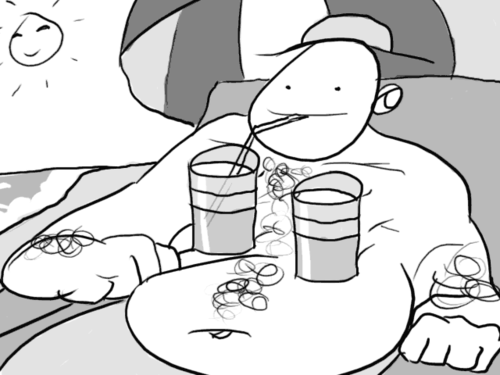
Wish You Had Lager Breasts?

Latte Animals
Laughing Squid features some fascinating footage of a barista artist at work.
Pelosi’s Favorables Plummet
At the inauguration, Nancy Pelosi had a net favorable surplus of 6. She now has a deficit of 16 – a net drop of 22 points in five months. That's almost as bad as … Boehner and McConnell. But they started in negative territory. I didn't watch her presser earlier this week but upon review, it was awful. I don't know the full truth of what she knew and when she knew it – but that makes the case for a Truth Commission into bipartisan failure on torture even stronger.
Obama At Notre Dame
First Things editor Joseph Bottum – surprise! – is outraged by today's presidential address. Damon Linker counters:
Despite what they would like to believe, it is Bottum and his theoconservative allies who stand on the margins of American Catholic life, rallying an embattled, belligerent faction of the Church–a faction so obsessed with abortion that it has become indifferent to other moral issues and incapable of making the elementary distinctions that most of their fellow Americans, Catholic and non-Catholic alike, treat as the commonsense starting-point and touchstone of moral reasoning. Like, for example, the distinctions separating those who perform abortions, those who procure abortions for themselves or others, those who encourage women to have abortions, and those (like the president and many millions of American Catholics) who merely believe abortion should not be prosecuted as a crime.
Praise The Bomb?
Thomas P.M. Bartlett calls nukes "the single best thing that has ever happened in mankind's long history of war":
…we are told that when "irrational" regimes reach for the Bomb, like Tehran's mullahs or Pyongyang's whacked-out Kims, we enter into a new, far more threatening era. And yet history remains clear on this subject: When nuclear monopolies are ended and existing rivalries are nuclearized, stability tends to break out — time and again.
The End Of Catholic Culture
As the hierarchy gets more and more politicized around abortion, Patrick Deneen sees decline:
In my view, the singular focus upon abortion as THE issue over which conservative Catholics will brook no divergence and around which we are called to rally reveals, to my mind, not evidence of robust Catholic culture as much as its absence. It seems to me that – along with the opposition to gay marriage – this issue represents the last stand, the inner-most wall barely keeping the hordes from overrunning the sanctum. The ferocity over this issue – and this issue almost to the exclusion of nearly every other issue that might be part of a rich fabric of Catholic culture – suggests to me that Catholic culture, where it existed, has been largely routed. And, in fact, it suggests further that it is precisely for this reason that this issue has become largely defined politically – and not culturally – with an emphasis on the way that the battle over abortion must be won or lost at the ballot box (and, by extension, Supreme Court appointments).
(hat tip: Upturned Earth)
The View From Your Window

McKenzie, Tennessee, 11 am
How Travel Narrows The Mind, Ctd.
After Chesterton and Emerson, a footnote from David Foster Wallace:
As I see it, it probably really is good for the soul to be a tourist, even if it’s only once in a while. Not good for the soul in a refreshing or enlivening way, though, but rather in a grim, steely-eyed, let’s-look-honestly-at-the-facts-and-find-some-way-to-deal-with-them way.
My personal experience has not been that traveling around the country is broadening or relaxing, or that radical changes in place and context have a salutary effect, but rather that intranational tourism is radically constricting, and humbling in the hardest way—hostile to my fantasy of being a real individual, of living somehow outside and above it all.
To be a mass tourist, for me, is to become a pure late-date American: alien, ignorant, greedy for something you cannot ever have, disappointed in a way you can never admit. It is to spoil, by way of sheer ontology, the very unspoiledness you are there to experience. It is to impose yourself on places that in all noneconomic ways would be better, realer, without you. It is, in lines and gridlock and transaction after transaction, to confront a dimension of yourself that is as inescapable as it is painful:
As a tourist, you become economically significant but existentially loathsome, an insect on a dead thing.
 The Dish