For Love, Not Law

StainedglassNicholasKamm:AFP:Getty

Courtney Martin glances through a recent PEW poll on religious flux:

Americans didn't just reject the politics of the religious right. They rejected the hubris and simplistic nature of strict religion. The "Faith in Flux" report declares:

"About half … became unaffiliated, at least in part, because they think of religious people as hypocritical, judgmental or insincere. Large numbers also say they became unaffiliated because they think that religious organizations focus too much on rules and not enough on spirituality, or that religious leaders are too focused on money and power rather than truth and spirituality."

The Faithful As Customers

A pastor of a small church reports:

In the world of business, it’s all about the numbers. In the world of ministry, it’s all about the numbers as well. Put lots of bodies in the pews and dollars in the plate and everyone loves you. But if things stagnate or decline, someone will say that it’s time for the minister to move on. The same rules that govern the rat race govern the church world. Churches may not fail at the rate of small businesses, but pastors fail at a surprisingly high rate. Twenty-five percent of us will be forced out of a church at least once in our career. And the attrition rate for people leaving the ministry stands around 10 percent. There are a lot of reasons people quit. But at the heart of most of these moves are the numbers. Congregations will forgive a lot if the numbers are up. The rat race is alive and well in small churches.

The Mystery Of Great Prose

Morgan Meis marks the 50th anniversary of William Strunk Jr. and E.B. White's The Elements of Style:

If there is an underlying metaphysical principle guiding The Elements of Style (the one with White's additional chapter) it is something like the following: language is simple, direct, and expressive… except that it's magical, dynamic, and unfettered.

White looks at Thomas Paine's famous sentence, "These are the times that try men's souls." He tries switching it around to, "Times like these try men's souls." It crashes to the ground. Why? We simply do not know. No explanation seems adequate. Try it yourself. Try to actually explain, with reasons and causes, why the one sentence sets the aforementioned soul stirring while the other practically extinguishes it.

As White says, we usually end up explaining the difference with such words as "rhythm" and "cadence." But what are we really explaining with those words? We're still just saying that one sentence simply sounds better than the other. That's not explanation — it’s obfuscation. The first sentence is better and we damn well know it. We don't know why. But we know it, as certain as the hand in front of one's face, the rain falling on the plain.

The Banksy Bubble

Banksy

Gary Moskowitz is tired of the iconic graffiti artist:

I’m bored of Banksy. Sure, I enjoy stumbling across his work in alleys and splashed on buildings throughout London. And occasionally the artist has created work both bracingly timely and incisive (”NOLA", is a particularly good example). But it is impossible to contain the raw energy of street art in a formal art space, where any anti-establishment strains in his work are bled away beneath the expensive track lighting.

(Image from Flickr user Lov-e)

The Huntsman Coup, Ctd

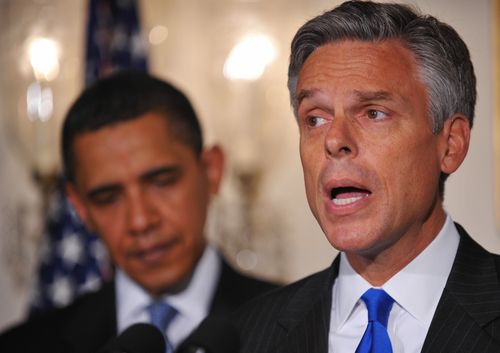
HUNTSMANMandelNgan:Getty

Al Giordano sees more beneath the surface:

That they announced this shortly after Republican National Committee chair Michael Steele gaffed his way into another controversy, this time regarding the evident anti-Mormon bigotry in Evangelical Christian circles, is nothing less than political poetry. Steele said, on Bill Bennett's radio show, "Remember, it was the base that rejected Mitt because of his switch on pro-life, from pro-choice to pro-life. It was the base that rejected Mitt because it had issues with Mormonism…"

The appointment of Huntsman is thus, politically, a slam dunk. When GOP primary voters inevitably reject Romney once again in the 2012 primaries and caucuses outside of the Mountain West, the resentment – already boiling after last year's adventures in presidential politics – among rank-and-file Mormons that the party to whom they've given so much still doesn't really want them in the Master's house rather than the servant's quarters, will sting. Meanwhile, another of their prominent citizens will likely still be Obama's man in Beijing, proof that somebody in American politics isn't dissing the LDS and its members. And in key swing states like Nevada and Colorado, LDS members are legion.

Some said Obama was crazy, back in 2007 and 2008, to reach out to what conventional wisdom thought was an impenetrable GOP base… Crazy, like a fox.

(Photo: Mandel Ngan/Getty.)

The Conservatism Of Doubt

Gary Becker makes a vital point about the spirit of the right:

I believe that the best way to restore the consistency and attractiveness of the conservative movement is for modern conservatism to return to its roots of skepticism toward governmental actions. This involves confidence in the capacity of individuals to make decisions not only in their own interests, but also usually in the interests of society at large. Such a shift in attitudes would require more flexible approaches toward hot button issues like gays in the military, gay marriage, abortions, cell stem research, and toward many other issues of this type. It will not be easy for the Republican Party to emerge from the doldrums if it cannot embrace such a consistently skeptical view of government.

Afuckingmen.

The Morality Of Food, Ctd

Julian Sanchez responds to Max Fisher:

I’m not an evangelist vegetarian; I don’t recall ever trying to press a carnivore of my acquaintance to give the stuff up. This isn’t because I think it’s a matter of pure pesonal aesthetics: In fact, I think they all ought to stop. But part of “making life livable for ourselves” means not turning into the sort of noodge who browbeats friends and acquaintances about their dietary choices—at least until they start ordering the Flipper Tempura Roll at Nobu.  But let’s not coat this in self-deluding horseshit about pluralism or tolerance or “live and let live.” That debases our ethical impulses by making concern for animal (or, indeed human) suffering one more matter of taste—like a preference for anchovies. Respecting other people’s right to make a different choice—at least within certain broad parameters—shouldn’t mean denying we can judge some choices better than others.