A map by Good.
(Hat tip: Flowing Data)
E.D. Kain opines:
He's got a point. Reid and Pelosi really do make me want to change channels whenever they appear on TV. But eight years is a long time; and talent can rise in Washington and state capitals from time to time.
He is right, of course, about long-term fiscal crisis. But he's surely wrong to blame Obama for the debt in 2009 – "I wonder how things could have come to such a pass?" – and the huge unfunded liabilities that loom in the future because of Bush's entitlement spending spree. For good measure, he offers only one option to save money – stop sending stimulus checks to dead people (well, one, actually). Yeah, that will do it. I mean: really.
Then he plays a neat little trick by accusing critics of Carrie Prejean's and Sarah Palin's opposition to civil marriage equality of inconsistency: "When Obama believes it, it’s not bigotry." Again, he's not wrong in decrying some of the nasty stuff thrown at a beauty queen for a political/moral position; and he's not wrong in saying that Obama opposes civil marriage for gay couples. But there is surely a difference between supporting a federal marriage amendment to strip gay couples of all formal rights, as Palin does, and Obama's position in supporting full civil unions with all the state and federal benefits of civil marriage.
Nits duly picked.

Iraqi Prime Minister Nuri al-Maliki speaks during the inauguration of a newly built Tweirij Bridge across the Euphrates River in the city of Karbala, 110 kms from Baghdad on May 15, 2009. Maliki said that serious action will be taken against any corruption found within the Iraqi government. By Mohammed Sawaf/AFP/Getty.
Free Exchange wants to overhaul the entitlement:
Marc reports on the military commission tribunals:
He asks some important questions here. Greenwald is on the case. I'm much more sympathetic to Obama's compromise than Glenn. Once you remove torture, and allow for real legal defenses, and avoid hearsay, the worst of the Bush-Cheney system is eliminated. And it remains my belief that the conflict with al Qaeda is much more like war than criminal enforcement. Finding a way to provide some of the nimbleness and expedition of war-powers without the inhumane dimension of the Cheney era is not easy. But it strikes me that the president is making a thoughtful effort to get the balance right.
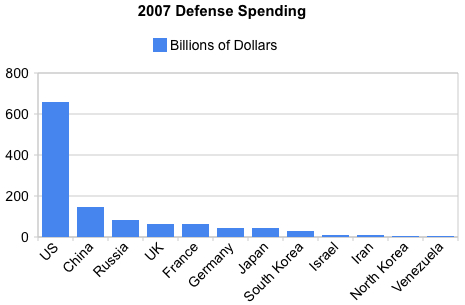
Fred Kaplan covers the Pentagon budget battle:
In the coming weeks, the debate over the defense budget is bound to intensify. Passions will flare. The fight may seem surreal, but that's because it is unusually primordial; it's stripped down to basic institutional interests. The battle, waged behind the scenes in the Pentagon, is fiercer still in Congress, because there, it's conjoined with the struggle for contracts and jobs. (It is no coincidence that pieces of the F-22 are manufactured in 46 states; for more than a half-century, the services have been subcontracting out their most cherished weapons to as many congressional districts as possible in order to maximize political support.)
This is why the budget debate will be worth watching. Gates' proposals aren't particularly radical by most objective measures, but they're deeply threatening to the inside players. He's trying to change the culture in the Pentagon, and that's like shifting the building's foundations. It's going to be a great fight.
A reader writes:
I love your blog. I love the fact that you aren’t letting Obama off the hook. I love (and appreciate and respect) the focus on torture. And, the focus on the recession. And, the economy. And marriage and queers in the military. I love all that.
But, I need more gay. It’s May. It’s been a long year already, at the end of another long year. I need ABBA or something FABULOUS or SICK or even a freakin’ show tune. I need more gay please, especially on a Friday.
Hmm. How about glamour bear Azis, "Bulgaria’s answer to Madonna, Michael Jackson, Boy George, Liberace, and Marilyn Manson all rolled into one colossal glitter-dusted, KY-oozing jelly roll"?
Music video after the jump:
The chance of the IMF defaulting on a loan is usually assumed to be around zero. But a new CBO report on a $100 billion loan from the US to the IMF puts the chance of default at five percent. Simon Johnson explains what this means.
John McWhorter is underwhelmed by the latest archeological finding.
 The Dish