Oklahoma City, Oklahoma, 4.30 pm
Oklahoma City, Oklahoma, 4.30 pm
Ryan Sager isn't a fan of teachers unions:
When you look at any reform (other than, say, doubling teacher pay with no strings attached) the obstacle isn’t Republicans, it isn’t lack of funding, it isn’t Joel Klein. It’s the unions. Sean Safford zooms out and looks at the future of labor unions:
I am not at all convinced that what we should be looking for is a “revival” of the US labor movement. The economy we have today is vastly different from the one in which either the AFL or the CIO was founded. Some unions have adapted. Other unions have gained in significance as the industries with which they are associated have gained prominence in the US economy. But many others are simply out of step. The upshot of what Mike and I were trying to say (with perhaps limited success) is that worker voice today comes in multiple forms and many of these rely less on the blunt instruments of countervailing power than on the relatively softer instruments of building alliances, framing issues, participating on multiple levels (workplace, community, identity groups, local and national governments, the media, international). We lack a vocabulary for describing each of these elements as an coherent “system”. But many of the tools for analyzing—and indeed carrying out—the elements of the system are within the domain of organizational theory.
A mini-round up of those disappointed with Obama. Ackerman doesn't understand why Obama said the photos are not sensational:
Marcy Wheeler notes that this violates Obama's new FOIA guidelines:
Granted, a bunch of Generals and Colonels would undoubtedly be embarrassed by the disclosure of abuse that happened on their watch (above all–as Nell suggests–Stanley McChrystal, newly tapped to take over in Afghanistan). Granted, some of those Generals and Colonels (the aforementioned McChrystal) would probably lose their next promotion if these pictures became public. Granted, pundits speculate, abstractly, that the release of another round of torture pictures will inflame the already volatile Iraq and Afghanistan. But those are all invald excuses, according to President Obama's own FOIA guidelines. If you're going to set a rule, follow it yourself.
I have precisely no desire to put our troops in danger. (Just one more reason not to torture people in the first place.) But we are supposed to be a democracy, and what our government does in our name ought to be available to us unless there is some very good reason to keep it secret. And the fact that people would be appalled by it is not such a reason — if anything, it just makes the case for disclosure stronger. After all, the things it is most important to disclose are the things that people care about, not the things that are a matter of complete indifference.
I briefly had myself convinced that this is a complicated issue, but it really isn’t. There ought to be an overwhelming presumption that the American people have the right to see the facts about what our government is doing in our name, with our money. There has to be some secrecy in the name of national security—it’s good that we don’t publish our nuclear codes or the details of the presidential security detail—but the notion that vague invocations of national interest or policy expediency should be permitted to sweep things under the rug is repugnant.
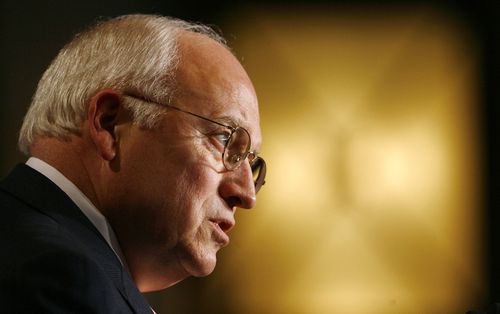
You think the torture program was only to uncover Jihadist threats to American lives? Then you do not know and have not pondered what the power to torture can do to the torturers. They believe they know something; they torture captives to tell them; they then believe they have uncovered the truth. The mindset of the last vice-president, we know, is one of fathomless fear and paranoia:
Everybody's in a giant conspiracy to achieve a different objective than the one we want to achieve."
Cheney saw that conspiracy not just in foreign capitals – but also in the CIA, the Congress, and, above all, the State Department. In his mind, it was obvious that Saddam had WMDs, that he had an operational link with al Qaeda, and the more he failed to find actual evidence for either, the more fanatical Cheney became that he was right. That is an almost clinical description of the motive to torture. And so it is no surprise that Cheney wanted to use the weapon that would prove anything he wanted to prove.
The Daily Beast now reports that no less a figure than weapons inspector Charles Duelfer has written about an incident that adds extra detail to Larry Wilkerson's conviction. According to Duelfer, a figure who is obviously Cheney intervened to urge the torture of a prisoner in Iraq, "Muhammed Khudayr al-Dulaymi, the head of the M-14 section of Mukhabarat, one of Saddam’s secret police organizations. His responsibilities included chemical weapons and contacts with terrorist groups."
Cheney wanted proof that he was right. What better way to "discover" "truth" than to torture it out of someone? And this "truth" from torture – the kind of truth that would never be allowed for an instant in a court of law – formed the basis, we now know, for a large part of the 9/11 Commission report:
More than one-quarter of all footnotes in the 9/11 Report refer to CIA interrogations of al Qaeda operatives subjected to the now-controversial interrogation techniques. In fact, information derived from the interrogations was central to the 9/11 Report’s most critical chapters, those on the planning and execution of the attacks.
How do we know that any of this information procured through torture is reliable? What dark hall of mirrors has Cheney led us into?
The blogosphere is still digesting what the change in Afghanistan means. A round up of what has been dug up so far – and a road-map to some of the questions the press and Congress need to ask. George Packer:
[McChrystal], like everyone, knows that al-Qaida is in Pakistan. Indeed, he was already a strong advocate of expanding U.S. operations into the Pakistani FATA a few years ago. And all the indications are that his appointment signals a "wink wink, hush hush" acknowledgement that the "Afghanistan" War is about to be expanded into its de facto, as opposed to its de jure, battlefield — and that the lion's share will take place below the visible tip of the iceberg.
Learning the correct lessons from the surge is not a thought experiment or some esoteric, academic exercise – it's crucial to understanding what really happened in Iraq in 2007 and 2008; as well as the efficacy of future counter-insurgency efforts in Afghanistan and elsewhere. Only if we are honest about the significant limitations on COIN operations and their limited success in Iraq can we talk about their application in Afghanistan. But if we start to believe that the surge and hence counter-insurgency techniques in Iraq brought significant victories we run the very real risk of beginning to believe our own press clippings.
The danger for the administration in having relieved McKiernan will come if their Afghanistan strategy does not produce the desired results on the expedited timeline the administration has committed itself to. McKiernan is on record as having asked for at least 10,000 more troops than the administration provided, and given his military judgment that the political objectives military force has been enlisted to help achieve would take a decade. If Afghanistan does not turn, the Obama administration will have just created this war's Eric Shinseki.
Not to diminish it’s importance, but why the NYT and WaPo would think the Pat Tillman cover-up might be more of an obstacle to McChrystal’s confirmation than [torture allegations] is beyond me. Really. I feel like I am missing something here. Perhaps it’s simply because the anointed, conventional media filters on the Right and Left like this guy, and have already embraced a narrative of why he was chosen: because he “gets” the “new war” and that the “new” President is “changing course” to overcome the quagmire that “Af-Pak” became under his predecessor. That McChrystal himself might carry the ugly baggage from that predecessor’s policies just doesn’t fit the script.
We appear to be nearing a happy ending in the case of Roxana Saberi, the American journalist detained by Iran and accused of being a spy. But ask yourself this hypothetical and distressing question.
If Saberi had confessed on Iranian television that she was a spy, and if the New York Times discovered that prior to this confession, she had been kept in solitary confinement in freezing temperatures, had been slammed against a wall twenty times in a row, and had then been shackled from the ceiling for days in such a way that the pain was excruciating, and had been blasted in her cell with extremely loud noises to keep her from sleeping for a week …
… do you think the New York Times would report that she had been "tortured"? Or would they adhere to their current practice and say she had been subject to "harsh interrogation"?
If the leaders of Iran publicly stated that they had succeeded in proving that she was indeed a spy and her confession showed it, would Dick Cheney believe them? And would Bill O'Reilly proudly argue that the Saberi case proves that "harsh interrogation" "works"?
The Atlantic's June cover story by Joshua Wolf Shenk tells the tale of an amazing 72-year study. It was touted by Brooks Tuesday and well worth your time. A taste:
How would we know if we have won in Afghanistan?
Peter Feaver on Obama's military race against time:
Some of the same groups that wanted to end rather than win the war in Iraq are now starting to lobby to end rather than win the war in Afghanistan. In so doing, they are increasingly seeing Obama as the problem not the solution, and they are willing to work against him on these issues. That is an indication that Obama, to his great credit, seems to be making war decisions on Afghanistan and Iraq based primarily on his team's assessment of the facts on the ground, rather than on what will serve partisan political interests.
But it does complicate the job of building and preserving public support to continue the war — a job that is inescapably political. Obama has the rhetorical gifts and political strength to build that political support, but it will require expending time and political capital on that effort. And, if my read of the chattering class' mood is correct, it will also require that he swim against the currents in his own party.
A reader writes:
 The Dish