Some baseball players got into a dance-off at a recent USF-UCONN game:
Month: May 2009
Why Marriage Equality Is Winning, Ctd
A reader writes:
It seems to me that, pace your post, people's minds aren't being changed, their gut reactions are being changed. This is not a logical contest—the logic has been there ever since we accepted the Enlightenment idea of marriage for love. This is an instinctual battle with people's disgust, revulsion and deep-down aversion to "the other".
That battle is won when gays are humanized, with every friend that comes out, every celebrity that discusses the matter openly, every older person who passes away having always found homosexuality foreign and vile, and every person coming of age for whom it's just not that big a deal because it's nothing out of the ordinary anymore. A victory will be due not to debate, but to the slowly rising tide of familiarity.
I certainly think this is the crux of the matter, which is why all gay people have a moral duty to be out. But the arguments do count in a democratic society; they persuade those with no gut reaction, and they have also persuaded the gays. We forget how unpopular this was when we started this journey. My own view is that when all gays truly believe they have the right to marry, they'll get it. And getting them to believe required a certain amount of, er, debate.
More Of The Same
In the wake of several big ambassadorships doled out by Obama on Wednesday, David Rothkopf asks why we need ambassadors in the first place:
Of course, if your impulse is to answer the question by saying, "sure we do. If we didn't have ambassadors where would we send all the campaign donors and political hangers-on for whom we couldn't find plum jobs in Washington?" then you not only understand Washington but you understand where I think Obama went wrong yesterday and why my question about the need for ambassadors is genuinely open to question.
Chris Beam takes a closer look at the long tradition of picking rich pals over career diplomats.
Where The Government Grows

This is just one of a stunning series of photos by Taryn Simon of the "hidden and unfamiliar". It's the Research Marijuana Crop Grow Room in the National Center for Natural Products Research, Oxford, Mississippi.
We Are Everywhere, Part XXXVII
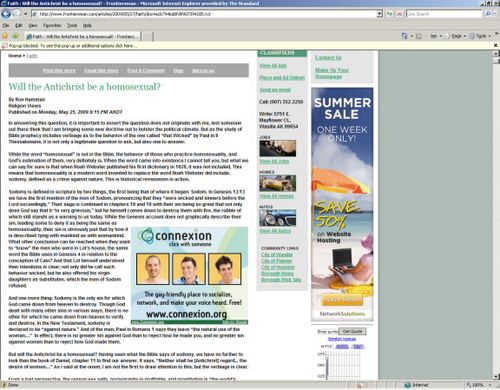
A reader sends along a screenshot of that anti-gay op-ed from the Wasilla Frontiersman that features an inserted ad for a gay networking site in the body of the text. Which just goes to prove, after all, that the Anti-Christ is almost certainly on Manhunt:
Dissent Of The Day
A reader writes:
You wrote: “The speech is imbued with the kind of boomer pomo smugness that reminds me why I'm not on the left.” Could you get any, er, smugger?
On Impartiality And Empathy
Jack Balkin defends Sotomayor from some of her more thoughtful critics:
Gerson and Krauthammer can use Ricci's case to argue for impartiality in judging because they assume that the law clearly favors Frank Ricci. But it does not. An impartial judge reading the law impartially might find against him. But if that is so, what work is the distinction between empathy and impartiality doing in their argument? Impartiality may not be on Ricci's side; empathy may be. Or perhaps– and this is the most likely scenario– the law that applies to the case is not entirely clear.
The most controversial cases that come before the federal courts are usually not clear, even though the lawyers on both sides often persuade themselves that the law is clear and believe that an impartial judge will have no problem finding for their side. That is not surprising. What makes a case controversial is precisely the fact that people disagree strongly about what the law is and how it should apply. The problem is what to do with these cases, where both sides fervently claim that impartiality and objectivity are on their side and claim that the other side is mistaken and wants to twist or deform the law. Arguing for impartiality is simply not going to solve the problem.
Nothing To Lose
Ta-Nehisi on the Newt effect:
[I]t's interesting to note the difference in tone between GOP figures with something at stake (people who have to win elections) and those who have nothing at stake. Newt has a megaphone, but he has no real responsibility. He can yell whatever he wants. He's got books to hustle, dog–not Senators to elect.
Mental Health Break
On the streets of Sofia, Bulgaria's capital city:
Defining La Raza
Pace Tancredo, La Raza's website describes their name as follows:
Many people incorrectly translate our name, “La Raza,” as “the race.” While it is true that one meaning of “raza” in Spanish is indeed “race,” in Spanish, as in English and any other language, words can and do have multiple meanings. As noted in several online dictionaries, “La Raza” means “the people” or “the community.” Translating our name as “the race” is not only inaccurate, it is factually incorrect. “Hispanic” is an ethnicity, not a race. As anyone who has ever met a Dominican American, Mexican American, or Spanish American can attest, Hispanics can be and are members of any and all races.
The term “La Raza” has its origins in early 20th century Latin American literature and translates into English most closely as “the people” or, according to some scholars, as “the Hispanic people of the New World.” The term was coined by Mexican scholar José Vasconcelos to reflect the fact that the people of Latin America are a mixture of many of the world’s races, cultures, and religions. Mistranslating “La Raza” to mean “the race” implies that it is a term meant to exclude others. In fact, the full term coined by Vasconcelos, “La Raza Cósmica,” meaning the “cosmic people,” was developed to reflect not purity but the mixture inherent in the Hispanic people. This is an inclusive concept, meaning that Hispanics share with all other peoples of the world a common heritage and destiny.
 The Dish