The GOP At Low Tide

After diagnosing the causes of the GOP's anti-intellectualism, Richard Posner mulls over the economic implications:

[The financial crash last September and the ensuing depression] have exposed significant analytical weaknesses in core beliefs of conservative economists concerning the business cycle and the macroeconomy generally. Friedmanite monetarism and the efficient-market theory of finance have taken some sharp hits, and there is renewed respect for the macroeconomic thought of John Maynard Kenyes, a conservatives' bête noire.

There are signs and portents of liberal excess in the policies and plans of the new administration. There will thus be plenty of targets for informed conservative critique. At this writing, however, the conservative movement is at its lowest ebb since 1964. But with this cardinal difference: the movement has so far succeeded in shifting the center of American politics and social thought that it can rest, for at least a little while, on its laurels.

I disagree. Its laurels wore very thin under Bush.

The Daily Wrap

Today we learned that another huge torture report is on the horizon, as Obama picked a general for Afghanistan associated with some of the worst human rights abuses in Iraq. The Iranians released one of our reporters, the NYT began to come around on the T-word, Maryland jumped the shark on hate crimes, and banks are bull-dozing the suburbs. Greta lost it again, Satan is talking to Miss California, Newt Gingrich and Bill Donohue each got a Hewitt Award.

The Dish did a reax of Obama's photo op with healthcare execs. We also dwelled further on how waterboarding was just one tool of torture and who actually monitored such techniques. The Dalai Lama had some wise words on science and Scott Adams had some wise words on web advertising. And yet another time-waster emerged on the Tubes.

Stanley McChrystal: A History Of Condoning Torture?

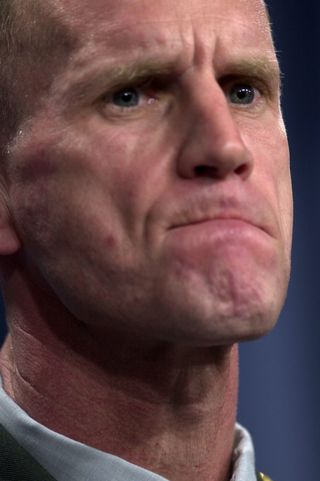
As Fred Kaplan noticed, the man Obama has just selected to be his new commander in Afghanistan has a history. It appears to involve some pretty horrifying toleration of rampant abuse and torture of prisoners:

"Once, somebody brought it up with the colonel. 'Will [the Red Cross] ever be allowed in here?' And he said absolutely not. He had this directly from General McChrystal and the MCCHRYSTALStefanZaklin:Getty Pentagon that there's no way that the Red Cross could get in: "they won't have access and they never will. This facility was completely closed off to anybody investigating, even Army investigators." …
During his first six or seven weeks at the camp, Jeff conducted or participated in about fifteen harsh interrogations, most involving the use of ice water to induce hypothermia …

Cold can be a serious torment to a naked man on a winter night; in Afghanistan, one prisoner died from hypothermia. Sometimes, to maximize the humiliation of the Iraqi men, American women would be brought in to watch them undress. Sleep deprivation was also used to an extreme extent, especially in Jeff's early days at Nama.

They could keep a prisoner on his feet for twenty hours, and although the rules required them to allow each prisoner four hours of sleep every twenty-four hours, nowhere did it say those four hours had to be consecutive–so sometimes they'd wake the prisoners up every half hour. Eventually they'd just collapse. "This was a very demanding method for the interrogators as well, because it required a lot of staff to monitor the prisoner, and we'd have to stay awake, too," Jeff says. "And it's just impossible to interrogate someone when he's in that state, collapsed on the ground. It doesn't make any sense."

Within the unit, the interrogators got the feeling they were reporting to the highest levels. The colonel would tell an interrogator that his report "is on Rumsfeld's desk this morning" or that it was "read by SecDef." "That's a big morale booster after a fourteen-hour day," Jeff says with a tinge of irony. "Hey, we got to the White House."

The full Esquire piece is here. Who was responsible for overseeing one of the worst torture and abuse centers in Iraq?

"Was the colonel ever actually there to observe this?" "Oh, yeah. He worked there. He had his desk there. They were working in a big room where the analysts, the report writers, the sergeant major, the colonel, some technical guys–they're all in that room."

To Garlasco, this is significant. This means that a full-bird colonel and all his support staff knew exactly what was going on at Camp Nama. "Do you know where the colonel was getting his orders from?" he asks. Jeff answers quickly, perhaps a little defiantly. "I believe it was a two-star general. I believe his name was General McChrystal. I saw him there a couple of times." Back when he was an intelligence analyst, Garlasco had briefed Stanley McChrystal once. He remembers him as a tall Irishman with a gentle manner. He was head of the Joint Special Operations Command, the logical person to oversee Task Force 121, and vice-director for operations for the Joint Chiefs.

He's now running Obama's war. We need to know what he authorized and what responsibility he took. I presume that the Pentagon knew of this history. I wonder if the president did.

(Photo: Army Major General Stanley McChrystal, Vice Director of Operations, listens to a reporter's question during a briefing at the Pentagon March 26, 2003 in Arlington, Virginia. By Stefan Zaklin/AFP/Getty.)

The Perfect Is The Enemy Of The Good

Dave Roberts, amazed that the Cap & Trade vs. Carbon Tax debate is still raging, sticks himself in the center of it:

In the short-term, complementary policies will spur the most action. The never-ending, chin-stroking carbon pricing debate perpetually overlooks this basic fact. (See: “Cap and Trade is Not Enough: Improving US Climate Policy” [PDF] from Carnegie Mellon.) What’s going to knock us off the status quo path in the next decade is, above all, new targets and standards for energy efficiency. Also: a renewable energy standard, a low-carbon fuel standard, smart-grid standards and funding, government procurement policies, direct government investment, etc. etc. These are the policies that could get things rolling immediately. And guess what?

The Waxman-Markey bill contains those complementary policies. Also, it exists.

Both these characteristics set it apart from the Alternative Universe Carbon Tax Pony Bill. Carbon taxers seem blinded by a misguided obsession with the specific mechanics of carbon pricing. By bashing Waxman-Markey, they are aligning themselves with people who want to block the best opportunity for climate/energy action in a generation. They’re aligning themselves with people who want to block it not in favor of a pony alternative, but in favor of doing nothing, to protect corporate donors. In many cases, they are adopting the exact same rhetoric as conservative obstructionists.

Whenever your opponents in a policy argument start citing the enemies you're allegedly aiding, you know you're onto something. But it's almost certainly quixotic. One of the results of the implosion of conservatism as a governing philosophy is that these arguments are now conducted largely within the liberal camp, where the primacy of the desired result always wins out.

The Firing Of McKiernan

I don't know quite what to make of it. Fred Kaplan does:

For the past year, McChrystal has been director of the Pentagon's Joint Staff. More pertinently, for five years before that, he was commander of the Joint Special Operations Command, a highly secretive operation that hunted down and killed key jihadist fighters, including, most sensationally, Abu Musab al-Zarqawi, the leader of al-Qaida in Iraq.

Last fall, Bob Woodward reported in the Washington Post that JSOC played a crucial, unsung role in the tactical success of the Iraqi "surge." Using techniques of what McChrystal called "collaborative warfare," JSOC combined intelligence intercepts with quick, precision strikes to "eliminate" large numbers of key insurgent leaders.

Obama is beginning to own the war in Afghanistan. I think he'll regret it but hope he doesn't.

The Rope-A-Dope Again

So Obama plays defense on torture, urging that we move forward, while releasing crucial information and letting others use up the vacuum. Cheney blunders in … and even Lieberman has to take up arms against him. This is how this president operates. After Clinton and McCain, Cheney is the latest victim. And by demanding more and more transparency, the former vice-president slowly exposes … himself.

“Like Something Out Of The Thirteenth Century”

Those were Bob Woodward's words to describe the Bush-Cheney torture techniques. I feel the Beltway finally shifting … realizing the gravity of what took place, and the consequences that stretch long into the future. I wonder if Bush's silence suggests he too is beginning to grasp what he did to America; and how indelible it is.