Don't ever play drinking games with these guys.
Month: May 2009
Buy American Nothing?
Nate Silver suggests that America's car culture is over:
…there is some evidence that more Americans are at least entertaining the idea of leading a more car-free existence. Between October 2004, when gas prices first hit two dollars a gallon, and December 2008, when they fell below this threshold, three cities with among the largest declines in housing prices were Las Vegas (-37 percent), Detroit (-34 percent), and Phoenix (-15 percent), each highly car-dependent cities. Conversely, the two markets with the largest gains in housing prices were Portland, Oregon (+19 percent), and Seattle (+18 percent), communities that are more friendly to alternate modes of transportation.
Why Fear The Racist?
In the wake of a report showing how No Child Left Behind has failed to close the black-white performance gap, John McWhorter and William Saletan went back and forth over Saletan's notion that racial data should not tabulated in the first place. In the latest salvo, McWhorter makes an important point:
Now, I take it Saletan is still worried that just such people, such as [openly racist blogger] Steve Sailer, are still a force to be feared. Respectfully, however, I am still not sure why.
Think about it: our public discourse is at a point where when Saletan even entertains the data that makes us so uncomfortable he is excoriated endlessly. Where is the space in this discourse for people like Sailer to acquire any kind of meaningful influence? … What legislation would have Steve Sailer's imprint? What steps can we imagine [where] we would get to a point where black people were routinely herded apart as mental deficients? Or whatever dystopian horror we are supposed to be worried about.
And if you have more imagination than I do, then specify: how would the steps to the scenario you envision initiate from the back-of-the-class mutterings of people like Steve Sailer, given the now deeply-rooted cultural revulsion towards open bigotry in our society?
Yes, it's still "out there"–but not to an extent that can keep a black man out of the White House, despite what I was repeatedly told all last year all the way up to the second Obama won the election. The issue is not "whether," but "how much" it's out there.
I'd much rather see how far we can get with addressing what kind of schools poor kids go to. My money is on poor black kids looking better decade by decade if we do the right things–but that will mean assessing how the kids are doing by race, and publishing the data for all to see including Big Bad Steve.
Employing Millions
Appleyard thinks I'm wrong about Murdoch and paying for content online.
Mental Health Break
Created using vintage photography of New York City (be sure to wait for the falling piano):
Hauschka – Morgenrot from Jeff Desom on Vimeo.
Tariffs Are Bad, Mkay?
Matt Steinglass breaks with some of his fellow liberals:
There are few areas where I agree with the CATO Institute crowd, but this is definitely one of them: long-term tariffs on manufactured goods are really, really stupid. Germany and Japan are still competitive shipbuilders and the US isn’t, and that’s in large measure because of the 1920 Jones Act, which bars foreign ships from US internal waterways and has created a protected market for US shipbuilders that has gradually destroyed their ability to build anything the rest of the world wants. And Germany and Japan are still competitive automakers, while the question of whether the US remains one is very much up in the air, apparently for some of the same reasons.
Agricultural tariffs are equally damaging. They distort markets – making products like high fructose corn syrup economically feasible – but they also limit agricultural exports from developing countries. And agriculture tends to be a major source of GDP in under industrialized nations. You want more global poverty? Keep your ag tariffs and subsidies.
Lost Letters
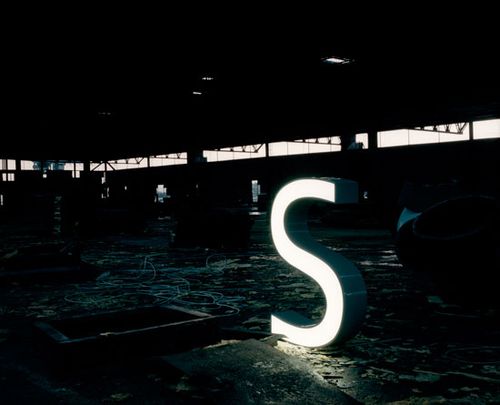
A Finnish company rescues letters from discarded neon business signs and re-purposes them:
When company signs and logos are taken down, they get demolished. We recycle the characters into individual design objects. We dismantle the letters, clean them up, add a new transformer, LED lights and the power cord, and put them back together.
Very hipster chic.
Googling The Flu
Google Flu Trends aggregates search data to track the spread of infection "up to two weeks faster than traditional systems." Time explains:
The reasoning is that if people are searching for information on the flu, they're probably sick themselves or know someone who is — and a geographic cluster of like-minded Googlers could represent a burgeoning outbreak or, worse, the roots of a new pandemic. … [The] benefit is that they rely not on hospital data but real-time information from people who are in the process of getting sick. "What we are seeing are trends of what people are thinking about at home, perhaps before they might go to see a doctor," says Jeremy Ginsberg, lead engineer of Google Flu Trends.
But Alexis Madrigal shows how they missed the swine flu.
What The Dems Knew About Torture
Josh Marshall doesn’t want us to kid ourselves:
I’d be very surprised if the key Democrats at the time weren’t briefed on a lot of this stuff. And to the extent that they didn’t know the details, that it might have been not wanting to know rather than having been kept in the dark.
Drum has a simular response, as does Marc:
Pelosi last week said she had no idea that EITs were even being used and insisted that the subject of waterboarding never came up. That’s hard to swallow, even if you believe the claim about waterboarding. Why would the CIA even brief Pelosi about EITs if it had no intention of using them?
“Hard to swallow” is probably a metaphor worth avoiding when it comes to water torture. I don’t doubt that a few Dems were clued in. And they should be held responsible for their share as well. This was a collective failure on the part of the political leadership of both parties – although obviously the lion’s share belongs in the executive branch. But the Congress is co-equal; they were briefed; we deserve to know exactly what they knew and what, if anything they did to stop it.
All the more reason for a truly independent commission to address all responsible parties. Give it time and money. This failure is different from the failure to stop 9/11, but it is a profound moral failure and legal travesty. There is just as much reason to investigate this. In fact, a thorough investigation by a mature democracy of this failure could begin to repair some of the damage. That’s my hope. I want us to move on. But we cannot move on unless we have held ourselves accountable, and cauterized this period as anomalous.
Or else the threat of a future torture program, justified as this one was, looms over all of us, and the world.
The View From Your Window

Yokosuka, Japan, 6.03 pm
 The Dish