The Lesson Of Pelosi

Scott Horton draws one conclusion from the ABC allegations:

If anything, this helps make the case for an independent commission. Congressional inquiries are in fact subject to manipulation by the leadership. A commission would have the resources and time to get to the bottom of the question. And yes, what the Congressional leaders were told, and exactly what they did when presented with such information, is a critical point of inquiry. The Congressional leaders do need to be held to account for their inaction. Also, the current classified briefing process needs some careful review. Why are staff who have security clearances excluded? How can the restrictions imposed on Congressional leaders about discussing briefings be reconciled with the Constitutional role of Congress? The system failed over the last eight years. We need to ascertain exactly how it failed in order to prevent future incidents.

Jon Rauch makes a sober, reasonable case against legal prosecutions here. I think it's a serious engagement with the problem, even though I think Jon still under-estimates the scale and scope of the lawlessness – though not as much as he once did (for which I am as grateful as I am unsurprised – Jon is as honest an intellectual broker as you'll find in this town). I certainly am persuaded that a rush to prosecute would be imprudent. Which is why, like Horton, I support an independent commission with money and time to cool emotions and gather facts. Among those facts should be a chance for the last president to explain where he was coming from. Then we should make a calm decision on the legal consequences.

Palin’s Fortunes

Nate Silver makes a prediction:

[A]t least one serious contender for the Republican nomination in 2012 will be someone newly elected to his or her state's governorship in 2010. Assuming that the economy has begun to turn around by that point, that person stands to get credit for a recovery that they had little to do with — they will be able to cut taxes or to restore services, and will inevitably be hailed as a genius for having turned a billion-dollar deficit into a surplus. But for gubernatorial incumbents, for whom the opposite dynamics hold, it may be rough sledding ahead.

Carbon Tax v. Cap And Trade, Ctd

Drum goes another round. Avent also replies:

Cap-and-trade can be structured to behave almost exactly like a carbon tax, it has some advantages over a carbon tax, and in basically all the ways that matter it is every bit as good as a carbon tax. It’s the implementation that’s crucial. Those holding out for a carbon tax need to explain why they think Congress would suddenly be less ignorant or craven in debating a tax than they are in debating a cap-and-trade plan, AND they need to explain why the difference in outcome would be large enough to justify the cost of delaying action by a year or several as a new bill was rolled out, sold, defeated a few times, and then eventually passed.

Over to you, Jim Manzi?

“Uneasy”

Jeff Sessions predicts how Americans would respond to a gay Supreme Court Justice. I preferred his first answer. It is and should be completely irrelevant. And yet, for some Republicans, it obviously isn't. Do they know how insulting and anachronistic they sound? Does the GOP really believe it will win back the next generation by fronting Thune and Sessions?

What Green Shoots?

StressUnemployment

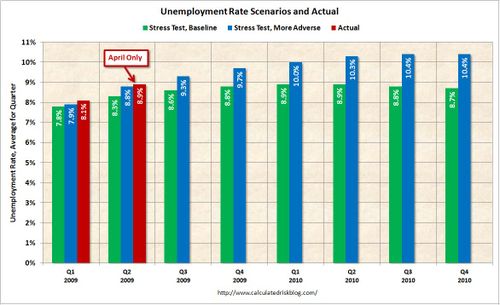
Felix Salmon studies today's unemployment numbers:

Yes, unemployment is a lagging indicator. But with adult-male unemployment rapidly approaching 10%, it’s also going to be a serious drag on the economy for the foreseeable future: households with unemployed men are not exactly engines of economic recovery. Incidentally, the other unemployment measure worth keeping an eye on, U6, a broader measure of underemployment, hit 15.8% last month, up from 13.5% in December. So while the headline payrolls number might have fallen less than economists had expected, I can’t really see any green shoots here.

Calculated Risk notes:

The [above] graph shows the unemployment rate compared to the stress test economic scenarios on a quarterly basis as provided by the regulators to the banks…This is a quarterly forecast: in Q1 the unemployment rate was higher than the "more adverse" scenario. For Q2, April is already higher than the "more adverse" scenario, and will probably rise further in May and June.

Phil Izzo:

Many forecasters expect the official unemployment rate to top 10% by early next year. If the path of the broader unemployment rate continues, it’s likely to top 18%. For people in this group, comparisons to the Great Depression (when 25% of Americans were out of work) may not look so wild even if overall economic activity is holding up better.

But The President Said It Wasn’t Torture

Cheney says:

We resorted, for example, to waterboarding, which is the source of much of the controversy … with only three individuals. In those cases, it was only after we’d gone through all the other steps of the process. The way the whole program was set up was very careful, to use other methods and only to resort to the enhanced techniques in those special circumstances.

How, one wonders, are we to square this statement with the notion that waterboarding was, in fact, a "no-brainer" as the vice-president once boasted? A "no-brainer" does not require this kind of tempered ratcheting up of coercion. A no-brainer techique is obviously legal, so obviously legal that you don't have to think for a second about it. Massie makes a similar point here.

Cheney's public remarks over the past months and years actually prove, it seems to me, that he fully understood he was crossing the Rubicon.

Plainly legal acts of interrogation do not require endless and often absurdly convoluted memos attempting to redefine the bleeding obvious. Adherence to the law and to the Geneva Conventions is very simple and no previous president has ever had to worry about violating them. Because no previous president made the decision to use force and violence to coerce "intelligence" from captives.

That was the key decision. It's a binary one. You either use coercion or not. You either abide by the very clear and very broad interdiction of coercion in Geneva and the UN Convention or you do not. The law is very clear on this: no exigency, no emergency, no crisis over-rules this. In fact, the very clear legal bar is more essential in crises when the temptation to torture, abuse or degrade prisoners may be the greatest. From the Convention Reagan signed:

2. No exceptional circumstances whatsoever, whether a state of war or a threat or war, internal political instability or any other public emergency, may be invoked as a justification of torture.

Whatever else this is, it is not an invitation to governments to find a way around this, to develop excruciating new (or in this case old) euphemisms to explain it away, to construct fatuous retroactive legal memos to justify decisions already taken, and adjusted to provide legal cover as the interrogations became more and more unmistakably graphic. And yet when one looks at the picture of "the program" that we now have in the ICRC Report, the SASC report, and the OLC Memos, you see a pre-meditated systematic attempt to routinize coercion as an integral feature of American government. And that's only from what we have already found out. Somehow I doubt, when the full details of what happened to the 30 prisoners who simply disappeared or around a hundred who died during interrogation, when the deeply secret goings on in black sites by men in masks are uncovered, we will not be more reassured.

Or do we keep on walking even faster?