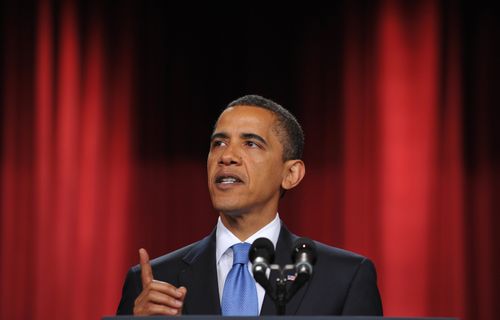
Reading the speech today, I am reminded of why many of us saw this unlikely figure a couple of years ago and concluded that he was uniquely capable of guiding the West – and East – away from a catastrophic conflict that we learned, by bitter experience, could not be won by force of arms alone. Arms remain in Iraq and Afghanistan, but this speech buttressed that hard power with a soft and vital appeal to the masses below – the people who determine whether a global insurgency succeeds or fails. My reader is right: no other figure in global politics could have done this. At its heart, the speech sprang, it seemed to me, a spiritual conviction that human differences, if openly acknowledged, need not remain crippling. It was a deeply Christian – and not Christianist – address; seeking to lead by example and patience rather than seeking to impose from certainty:
“Be conscious of God and speak always the truth.” The man has, for a politician, done this more powerfully than any president I have known since Reagan. And his vision is Reagan’s: a world without nuclear weapons, in which our differences are occasions for healthy and human interaction, not terror, torture and mass destruction. To criticize this speech as not tough-minded enough is to miss the point: it is precisely by opening ourselves up, by showing who we really are, by dropping the pretenses and brittleness of cultural conflict and taking up the challenge of our faiths at their best: peace, and respect – that we can win the war against Islamist terror and tyranny. This does not mean going soft on al Qaeda, which remains as evil as it ever was:
Taking on the 9/11 conspiracy theories and challenging Islamist anti-Semitism was an integral part of this speech, what makes it a form of truth-telling, not pablum-spreading:
By simultaneously expressing empathy for the Palestinians – the “other hand” Hewitt could not tolerate – Obama has single-handedly given the US a chance to return to the even-handedness that is essential if the US is to save Israel from its own understandable fears. Notice too the appeal to the next generation:
He was admant on democracy but careful not to be seen dictating a Western version onto a Muslim world; he was clear about women’s rights, without denigrating those who choose a traditional role; above all, he gave a spiritually ecumenical address – concluding with the truth that we all worship the same God because there is only one God. On this all the Abrahamic faiths agree. We need to listen to this God if we are to obey God’s commandment to love one another and seek healing for the world.
At many other times in history, this sentiment might seem sappy or air-headed or unrealistic. Not now. This spiritual appeal is the heart of coldblooded realism in this frighteningly dangerous world. Either we learn to respect one another or we shall perish.
 The Dish