"I'm a celebrity. Get me out of here."
(Via a reader.)
"I'm a celebrity. Get me out of here."
(Via a reader.)
Ross chronicles the meteoric rise and fall of the biggest farce in American politics in living memory. The column is yet another rehash of the Nixonian class resentments and Rovian cynicism that dominate what passes for the GOP's thinking classes: if only she'd waited and "boned up" on the issues, she could have had a real future. Er: How about nominating someone who actually knew something about some issues before she was picked? Or someone who could at least give a passing imitation of even being interested in them? Did that ever occur to Ross?
He mentions not a single policy issue, nor a single actual accomplishment this hood ornament of a candidate can be credited with. He mentions not one of her increasingly fantastic delusions and lies. But somehow it's her elitist enemies' fault that she came acropper!
How about her elitist friends' fault for believing that a few starbursts and a media strategy worthy of Vladimir Putin could keep the show on the road long enough for them to collect their checks? Really. When will Kristol and Barnes and Douthat apologize for their sponsorship and toleration of this reckless nonsense?
Michael Wolff praises it:
Politico’s writers and editors do several hundred cable appearances a week. They are becoming a one-stop source for Washington news. Politico is like an old newswire, except that it is more specialized, and focused, and fast—and it has faces. And, more important, it’s free—and, unlike the teeth-gnashing old-line news companies, it has no plans or desire to charge (it will benefit from other organizations’ charging, and, accordingly, undermine them). Politico is retailing the news to everyone else in the hopes that this publicity and public profile redound to its own position as the choicest destination for political news.
This has worked—sort of. Politico puts its current traffic at 6.7 million unique visitors per month (down from a high of more than 11 million during the campaign), yet it still can’t support its staff of about 100 on the Internet’s low advertising rates (although, with its agenda-moving audience and its preponderance of advocacy advertisers, it manages to get a higher rate than most sites). But one effect of its Internet traffic and notoriety and the ensuing attention of cable news shows is that the original Allbritton idea for a Capitol Hill paper—one that now largely reprints Internet content—has become, with its special-interest-size circulation of 32,000, a major success. Internet cachet, in other words, has enabled a tabloid-size print version of Politico (also called Politico) to thrive and more than double the company’s revenues—which, just about evenly split between Internet and newspaper, will, it appears, be more than $15 million in 2009—meaning, according to C.E.O. Fred Ryan, that Politico, paying its staffers at nearly the level that The Washington Post pays (starting salaries for reporters at the Post are about $45,000 per year), has hit breakeven.
Gabriel Sherman isn't so sure.
A report of a process of torture:
In 2001, Ali Afshari was arrested for his work as a student leader. He said he was held in solitary confinement for 335 days and resisted confessing for the first two months. But after two mock executions and a five-day stretch where his interrogators would not let him sleep, he said he eventually caved in. “They tortured me, some beatings, sleep deprivation, insults, psychological torture, standing me for several hours in front of a wall, keeping me in solitary confinement for one year,” Mr. Afshari said in an interview from his home in Washington. “They eventually broke my resistance.”
The problem, he said, was that he was not sure what he was supposed to confess to.
Cheney or Khamenei? The only difference is the reason for the arrest. But remember that the reason for arresting all those in US custody during the torture years was mere suspicion of terrorism. There was no due process. You will also note, as Glenn Greenwald notes, that the NYT uses the word "torture" to describe some of this, which did not include waterboarding. The New York Times' policy is that if foreign governments use these techniques, they're torture. If Bush-Cheney used them and worse, they're "enhanced interrogation." The NYT's concern that their reputation and sources should always remain ahead of publishing the truth and using the English language – gets clearer and clearer.
New details are emerging about the killing of a gay, black soldier at Camp Pendleton:
Provost had complained of homophobic and racist harassment. President Obama refuses to change the military policy that sustains the homophobia that the military will neither counter nor acknowledge.
I asked: "Can you remember a story where pundits have varied so widely on the basic facts?" Larison replies.
A few weeks later, Kaplan evaluates Sri Lanka successfully ending a quarter-century insurgency:
So is there any lesson here? Only a chilling one. The ruthlessness and brutality to which the Sri Lankan government was reduced in order to defeat the Tigers points up just how nasty and intractable the problem of insurgency is. The Sri Lankan government made no progress against the insurgents for nearly a quarter century, until they turned to extreme and unsavory methods. Could they have won without terrorizing the media and killing large numbers of civilians? Perhaps, but probably not without help from the Chinese, who, in addition to their military aid, gave the Sri Lankan government diplomatic cover at the UN Security Council.
These are methods the U.S. should never use. But the fact that this is what it took for the Sri Lankan government to subdue the Tamil Tigers makes clear just what a hard grind lies ahead for the U.S. in Afghanistan.
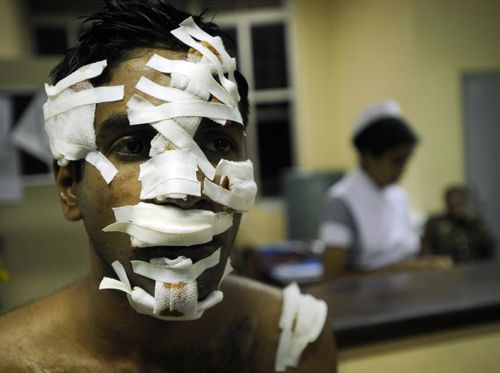
(Photo: An injured man is taken to a ward in the main hospital of Colombo on February 20, 2009 after he was wounded following a rebel Tamil Tiger attack. Tamil Tigers carried out a kamikaze-style attack in Sri Lanka's capital late tonight, smashing a light aircraft into the main tax building, killing two people and wounding 50, officials said. Sri Lanka's air force said anti aircraft guns shot down one of the light aircraft that had flown over the tightly-guarded capital while the remains of the second was found inside the Inland Revenue building, which caught fire. By Ishara S. Kodikara/AFP/Getty.)
Courtesy of Conor Clarke.

 The Dish