In graph form.
Month: July 2009
Home And Wet
Man am I glad to be back where I can breathe and sleep and think. The Dish will return to normal for the foreseeable future. Thanks to Chris and Patrick for helping while I was in transit.
Just To Reiterate
The post below dealing with torture was not written by me. — AS.
Face Of The Day
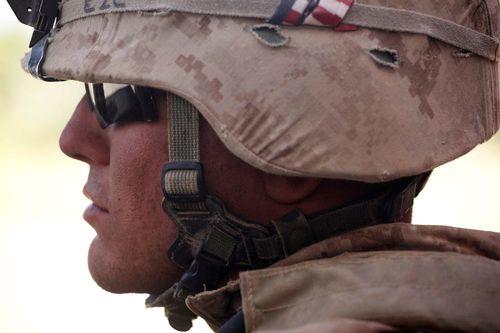
A U.S. Marine from 2nd Marine Expeditionary Brigade, RCT 2nd Battalion 8th Marines Echo Co. keeps an eye out to where enemy fire is coming from during the start of Operation Khanjari on July 2, 2009 in Main Poshteh, Afghanistan . The Marines are part of an operation to take areas in the Southern Helmand Province that Taliban fighters are using as a resupply route and to help the local Afghan population prepare for the upcoming presidential elections. By Joe Raedle/Getty.
An Ethical Case For The Ticking Time-Bomb Scenario
A reader writes:
Say it ain't so, Andrew, please. "But more to the point: he and his fellow students were tortured for their political beliefs, not their perceived ties to terrorism." Their perceived ties to terrorism are Cheney's political beliefs, surely. But that's beside the point too. Torture is torture is torture is torture. The point you've been making for so many months is evident. There is no justification for torture whatsoever.
Andrew did not write that post; I – Chris – did. (Like every post during these rare co-blogging days with Patrick, I put my initials at the end of the post, and in this case even referenced Andrew by name.) I think this is worth reiterating because readers sometimes forget.
Anyway, I also published this email as an opportunity to air an argument: while I am firmly anti-torture, I actually think the ticking time-bomb scenario can be justified. But my take is very different from the likes of Krauthammer; I think the TTB scenario can be ethically justified, not legally justified. Torture should always be illegal, without exception. But in the infinitesimally small chance that someone is put in the situation where he or she is utterly convinced a captured terrorist holds the key to preventing the deaths of countless people, torturing one person would be the lesser of two evils.
Nevertheless, the onus should always be on a person who decides whether or not to cross the bright legal line of torture. He or she should be ready to accept full responsibility for the outcome, whether it be imprisonment or even death. But that risk is not new or unique; military servicemembers for ages have suffered far worse fates on the battlefield. Both scenarios – a TTB, a war – are just different ways to sacrifice for one's country.
So let's say an American did decide to torture a terrorist in defiance of the law, and that torture ended up preventing mass murder. No jury would ever punish that person. And even if an absolutist judge did convict, any US president would readily use an executive pardon, fearing no risk of public backlash. On the other hand, if the TTB threat turned out to be false, the torturer, even if acting in good faith, should still face the full brunt of the law. Again, the onus is always on the individual; he or she has to be utterly convinced the threat is real and be willing to face the punishment if mistaken.
So essentially my difference with Krauthammer is that he uses the ethical case for the TTB scenario to justify its legalization; he makes the rare exception the rule. (And with legalization comes bureaucratization, the evils and dangers of which Andrew has exhaustively chronicled on this blog, persuading me at every turn.) But as centuries of civil disobedience have shown us, what is legal is not always ethical, and what is ethical is not always legal. One can be ethically for torture - in the rarest and gravest of circumstances - but still oppose it legally. In fact, I think an ethical case for the TTB scenario actually strengthens the case against Krauthammer and Cheney, because even though torture is illegal, there will always be an American willing to risk death or imprisonment to prevent a major terrorist strike.
— CB
What Now?
Ackerman reports on a press conference by Trita Parsi of the National Iranian American Council:
[If] a compromise can’t be found, then the opposition enters a new phase, having to face a choice between accepting Ahmadinejad and moving to a more radical position. “There are people loyal to the system, who don’t want to bring the system down but at the same time believe the system is quite imperfect [and wish to] ensure the system changes through peaceful means,” Parsi said. If they fail, “then we face a significantly more radical movement in Iran, with more bloodshed than we’ve seen.”
The important criterion for American policy right now has to be to reject Ahmadinejad’s attempts at portraying his victory as final. That means no negotiations, which is “creating some problems with the Obama administration, which is so very dedicated to the process of diplomacy,” Parsi said. While the administration has placed the onus for any diplomacy on Iran, if Iran calls the U.S.’s bluff and talks renew, it will send the message that the international community views the opposition’s efforts as futile.
–PA
Quote For The Day II
"[Palin] is not a serious candidate for the presidency. She had to go home and study and spend a lot of time on issues in which she was not adept last year, and she hasn't. She has to stop speaking in clichés and platitudes. It won't work. It could work for eight weeks if you're the number two candidate, as she was last year. But even so, she got singed a lot in that campaign. You cannot sustain a campaign of platitudes and clichés over a year and a half if you're running for the presidency,"- Charles Krauthammer.
–PA
Playing The Aid Card
Greg Weeks, who runs a blog on Latin American politics, has been all over the situation in Honduras. Apparently, "U.S. aid is contingent on whether or not a coup is a 'military coup.'" The U.S. is waiting until Monday to decide whether to cut it off entirely:
My first impression is that this could very well ease Zelaya's arrival on Saturday. It is a public warning that aid may well be suspended if things go badly over the weekend. Like if the Honduran police tackle Cristina Fernandez and Rafael Correa in order to grab Mel Zelaya. It is also a signal that the U.S. likes how Zelaya has responded thus far, and expects Micheletti to be nice too.
–PA
“Baring Its Fangs,” Ctd.
Al Giordano defends himself again via e-mail:
The reader who accuses me of "twisting the news"
is playing the game of Twister here, and the contortions of fact are staggering. He says I am part of some big media cabal that "won't show one picture" of the protests in favor of the coup. Funny, but I posted a photo on June 30, describing the pro-coup rally as "a decent sized – but not all that impressive considering all the power at its command – crowd." I also pointed out that in the photo appears General Vasquez, who led the coup, on stage next to "president" Micheletti, and that the mostly Caucasian gang on stage is hardly representative of the Honduran people.
What's most interesting is your reader's citing of the daily La Tribuna in Tegucigalpa as of the "independent news" upon which he relies for his "google translated" version of events (I'm fluent in Spanish, and read the same sources, too). The publisher of that newspaper, Edgardo Dumas, was recorded today telling W Radio in Colombia that there is no coup, there is no repression on the press and that "CNN is on the payroll of Chávez." At that link, we also embed videos that show coup soldiers forcibly taking over Channel 36 TV and Progreso Radio in Honduras. Your readers, I'm sure, would be interested to see one or more of them.
The newspaper publisher – and former Defense Minister in Honduras – Dumas, in that interview. represented himself as vice president of the Inter American Press Association (IAPA), whose executive director Julio Muñoz just thanked me for passing on that interview and said to expect an official statement from IAPA today. I don't expect that IAPA will agree at all with Mr. Dumas' fictional version of events in Honduras, but apparently he has at least one reader – through Google translations – who takes his claims at face value.
"Military coup" is not a buzzword here. It exactly describes what has occurred, and is still happening, in Honduras. As US Ambassador to the UN Susan Rice said yesterday, "a coup is a coup, and there are not good coups and bad coups."
–PA
Unemployment At Ten Percent?
Daniel Indiviglio says the unemployment numbers are even worse than they first appear. Buttonwood is also pessimistic:
[It] is a bit hard to see where the recovery is coming from. American wages are up just 2.7% a year, and it is a lot harder for workers to borrow money to maintain their spending. The boost from lower gasoline prices (seen in the winter) is disappearing and consumers seem to be saving, not spending, their tax breaks. David Rosenberg of Gluskin Sheff points out that same store sales are down 4.4% year-on-year, a bigger decline than that seen in May. If consumers are not spending, why would business invest? We have seen some kind of a rebound, after inventories were slashed in late 2008, but will it last?
–PA
 The Dish