by Patrick Appel
Monogrenade – Ce Soir (HD) from Monogrenade on Vimeo.
by Patrick Appel
Monogrenade – Ce Soir (HD) from Monogrenade on Vimeo.
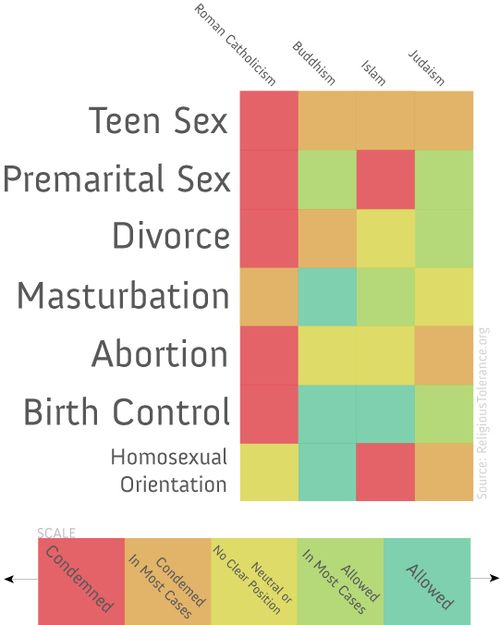
by Chris Bodenner As a helpful reader pointed out, the chart I posted earlier curiously characterized the Catholic view of "homosexual orientation" as "Neutral or No Clear Position." To a religious layman that label seems absurd. But what exactly is the official, boiled-down position of the Church? I don't have the Pope's phone number, so I went to the next best authority, Catholic.com:
[W]e must reject sin, including homosexual behavior—that is, acts intended to arouse or stimulate a sexual response regarding a person of the same sex. The Catholic Church teaches that such acts are always violations of divine and natural law.
Homosexual desires, however, are not in themselves sinful. People are subject to a wide variety of sinful desires over which they have little direct control, but these do not become sinful until a person acts upon them, either by acting out the desire or by encouraging the desire and deliberately engaging in fantasies about acting it out. People tempted by homosexual desires, like people tempted by improper heterosexual desires, are not sinning until they act upon those desires in some manner.
Along those lines, the chart's creator, ReligiousTolerance.org, opted for the label "homosexual orientation" over "gay sex," while it referred to "teen sex" and "premarital sex" elsewhere. So it appears their methodology took into account the Catholic parsing of desire and behavior. I personally think such parsing is bullshit (e.g. how exactly is "deliberately engaging in fantasies" an action?). But in the mind of a strict Catholic, a homosexually-oriented person who's never engaged in gay sex is still neutral to sin.
As far as the other chart's characterization the reader took issue with – masturbation – Catholic.com says:
[T]he Church’s sees homosexual and masturbatory acts as in the same category. Dealing with masturbation, The Catechism calls masturbation "an intrinsically and gravely disordered action" (CCC 2352). […] The Church makes the same moral judgment about masturbation that it makes about homosexual acts.
So why ReligiousTolerance.org categorized masturbation as "Condemned In Most Cases" rather than "Neutral…" is beyond me. But I'll make sure to call them for an answer and clear it with Patrick before posting any of their charts in the future.
by Patrick Appel
Rob Goodman wants to stop abusing the word "hero," especially in sports:
for a job well done.
And they need heroes as much as the rest of us. The best justification for the larger-than-life world of sports I've ever seen wasn't any particular game, but a 30-second commercial in which office workers were shown celebrating a new contract just like professional athletes–dousing each other with Gatorade and jumping onto a dog pile in the nearest cubicle. The joke actually hurts after a while–most of us will never have the chance to celebrate an accomplishment of our own with that kind of hubristic pride. It would be rude, disruptive–entirely too much. The ordinary rules of decorum make our life together livable, even when they make it tedious. That's why, for so many of us, sports are a cathartic outlet, a place of outsize passions and unfamiliar moral rules–a vacation from virtue.
by Patrick Appel
This is true:
"The things we forward, tweet, or post send a message about who we are," says [Jonah Berger, a professor at the University of Pennsylvania's Wharton School who has been studying how trends rise and fall for almost a decade]. "And you don't want the message to be that you're behind the curve." Before you share something, you need to do some digging—you have to analyze what Berger calls "the velocity of adoption." If that hilarious Web video has been percolating below the radar, posting it will make you look good even if it's old. But if it racked up big numbers in just a month, don't risk your reputation. A rule of thumb: If something has fewer than half a million hits—even if it's been around a while—go for it. Otherwise, skip it, no matter how recently it entered the ether.
Internet culture has a very short half life. We usually try to catch videos before they have 50,000 views (with some exceptions). That requires constantly reading the culture blogs, which Chris Bodenner does for the Dish.
by Patrick Appel
Marc condenses the Sunday shows. Point four:
Malcolm Gladwell's evisceration of Chris Anderson's new book got some attention awhile back. Among other free services, Gladwell targeted YouTube as an instance of free online content gone wrong. This YouTube myth-busting offers some counterpoints:
Myth 3: Traffic, growth, and uploads are bad for YouTube's bottom line. There's been a lot of speculation lately about how much it costs to run YouTube. With revenue estimates ranging from $120 million to $500 million, and costs on an equally large spectrum, it seems people can pick any number to fit any theory they have about our business. The truth is that all our infrastructure is built from scratch, which means models that use standard industry pricing are too high when it comes to bandwidth and similar costs. We are at a point where growth is definitely good for our bottom line, not bad.
by Chris Bodenner
David Waters rounds up some "surprisingly positive" reviews for the latest Harry Potter movie:
"As 'Harry Potter and the Half-Blood Prince' opens, we are once again reminded of the characteristics that make him something of a Christ figure," Connie Neal writes for the evangelical Christianity Today.
"It is more likely that at the end of the viewing or reading, rather than the allure of magic … what remains are the scenes that evoke values such as friendship, altruism, loyalty, and the gift of self," wrote L'Osservatore, the Vatican's semi-official newspaper.
Even Focus on the Family's pluggedin finds something redeeming: "Harry, whatever his faults, embraces such unglamorous words as 'duty,' 'responsibility' and 'sacrifice.'"
(This, of course, after many fundamentalists initially forewarned their flock of J.K. Rowling's occult themes, notably in this famous scene from Jesus Camp.) CBN's Gina Burkart examines the film's Christian themes at length.
by Patrick Appel
In response to Chris posting this graph, a reader writes:
I saw that chart awhile ago, noted the errors with regard to Catholicism, and decided the whole thing was suspect.
An interesting article by a humanist parent:
To be sure, I'd always been comfortable with our familial arrangement: our boys have parents with very different views on religion – their mother a Catholic, their father an agnostic humanist. This is only one of the several ways in which our family is "mixed": Nilsa is from Puerto Rico, I from the Midwestern US; she grew up in a working-class family in the countryside, I in a middle-class one in the suburbs; she speaks to the children in Spanish, I in English. Our differences regarding religion must therefore seem, to the kids, par for the course, no?
 The Dish