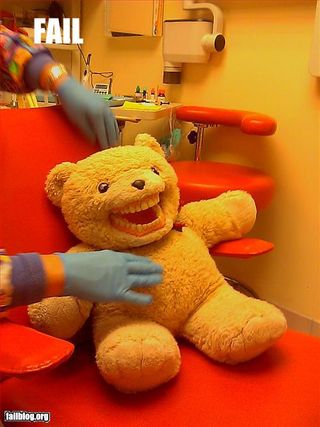
Several readers have noticed a strange discrepancy – not unusual in police reports:
Month: July 2009
Believing In Belief
by Patrick Appel
A reader writes:
My grandmother has cancer. And while all cancer is bad, this is of the horrible variety: liver, kidney, pancreas, bladder, bone, and still spreading. Throughout her 89 years, grandma was a devout Christian filled with nothing but love.
Her first husband was an abusive alcoholic. He died in WWII. Her second husband, a grandfather that I never met, died of a heart attack in his early thirties. After that she never married (or even dated) again.
All of her children and grandchildren went to church with her regularly. Every Sunday and most Wednesday nights were virtually mandatory. Not because she mandated it, but because we knew not showing up would hurt her feelings, and nobody wanted to do that.
A majority of the family remains faithfully Christian, at least in practice. I fell out many years ago because I honestly could not take it anymore. Intellectually it made little sense and seemed rather, for lack of a better word, childish. I preferred (and still do) to be spoken to, not at.
These days, I fall somewhere between agnostic and athiest, but this cuts two ways. I don't blame any god for giving a totally dedicated person this horrible diseases. Nor would I ever, ever take this faith from my grandmother that has provided her with nothing but love and hope throughout her life, especially now.
Personally, my feelings seem aligned to yours. As living beings we can never know whether or not God exists. Any statements of certainty on either side strikes me as hubris. But to each his own.
Another reader writes:
I am surrounded by an extended family of fundamentalists, and despite my conviction fundamentalism is always corrosive, how is the humanist––athiest or agnostic–to approach the religious people he loves when they are in pain? Does one attempt to pull their faith from beneath them when they are struggling with a child's divorce or their own terminal illness?
I know my attempts get them to shed a faith I find destructive would 1) fail 2) alienate me from the family and 3) send them reeling. When you are dealing with 70-year-olds, things are pretty fixed in their mind.
The humane response, I suspect, is to sort through the dross of their belief system and find something which might prop them up. That's too much work for me, so I just attend to their creature comforts through superficial conversation, rides to the hospital, help with finances, etc.
They think I am going to hell, yet when trouble comes, or even spiritual sadness, ;it is the phone of their gay nephew which rings first.
If I were to alienate them all by being angry at their anti-gay stances (which have tempered a lot since I came out) or by pressing my agnosticism, my life would be easier––but immeasurably rich.
It is just plain hard work.
Face Of The Day
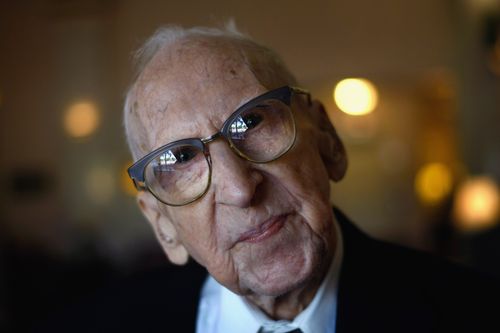
Walter Breuning, at age 112 now considered the oldest man in the world, smiles while at the Rainbow Assisted Living Facility on July 23, 2009 in Great Falls, Montana. Bruening, born Sept. 21, 1896 in Melrose Minnesota, inherited the title when Henry Allingham of England died last weekend. Breuning moved to Great Falls in 1918 with the expansion of the railroad and worked for the railroad for 50 years. He says he stays healthy by eating just two meals per day and excercises by strolling the halls of the retirement home with the aid of a walker. He shuns medicine, except for one low-dose aspirin per day. His earliest memory is of hearing his grandfather talk about fighting as a Union soldier in the Civil War. The Guinness World Records is expected to make the official announcement soon, after verifying his records. By John Moore/Getty.
Deranged Dentist Names, Ctd
by Chris Bodenner
A reader writes:
I’ve got one just as good as Dr. Bonebreak. The oral surgeon who pulled my wisdom teeth is named Dr. Fear. He works with a Dr. Hitchcock. I’m really not kidding.
Another writes:
We had to convince our nine-year-old that Dr. Ken Hurt–wouldn’t. (BTW he is an excellent orthodontist and I highly recommend him.)
Another:
Our family dentist is Dr. Fang
Another:
As a child I had a dentist named Dr. Payne — which was a little ironic, too, given that he was the first in our town to offer the then-new “painless” dentistry.
Another:
A bunch of friends and I were just having this conversation last night. My contribution
was Dr. Scull. Yes, it’s pronounced skull. I laugh (nervously) every time I think of it.
Another:
My dentist, for the past 44 years, has been Dr. Pick.
Another:
The guy who pulled my wisdom teeth (to create more room in my mouth) was named Dr. Widner (pronounced “widener”). And I had a dentist a few years ago named Dr. Roach.
Another:
There is an oral surgeon in Cleveland named Dr. Blood. Despite the name, he is a great doc.
Another:
When I worked at the Nebraska Medical Center, there were two faculty/dentists who had great dentist names. I just checked the directory and they are still there: Dr. Payne and (I’m not kidding) Dr. Toothaker.
Another
As a kid, I had a dentist named Dr. Root. All I can say is that 30 years later, I am still terrified to go to the dentist.
And why not:
I’m a bit late to the party, but I thought I’d share — my grandma’s proctologist’s name is Dr. Ramsbottom. I’m not making this up; I’m simply not that creative.
The Accidental Agnostic
by Patrick Appel
A reader writes:
"Even if I throw in my theoretical lot with agnosticism, I am nevertheless compelled in practice to choose between two alternatives: either to live as if God did not exist or else to live as if God did exist. If I act according to the first alternative, I have in practice adopted an atheistic position and have made a hypothesis (which may
also be false) the basis of my entire life…"
I feel that Benedict is quite wrong here. Part of this is an intensely personal feeling. I somehow manage to be raised in America and yet still only encounter the very question of whether there could be a god or not till very late in life. The result of this has been never truly having internalized the question, and having a somewhat particular form of agnosticism where I've never wondered or seen any reason to wonder at this question, despite repeated attempts by people to try and explain to me why there is something important about it. So it bothers me to have someone pronounce that as I child I made a decision on something I never considered, or that I have as I continue not to now.
I suppose then one would have to argue that I have to act as if god did not exist. But then, having found the existence of religion late, how would I practice it? Observing the religions of the world, I could eat or not eat any of a variety of things. I could refuse all violence or kill in god's name. I could hate or love almost anyone. I could even pray or not pray, observing some modern american Christians.
Denominations aside, one finds in each individual their own particular interpretation of that religion, each listening to or ignoring to their own pastor, if they bother to listen to one at all.
There is no singular life which is living as if God exists, and amusingly, I've more than once found myself closely living some such possible life. I was as committed to non-violence and attended church exactly as many times as the Quaker who lived down the hall from me. I've been as free of vice at times as the most committed born again, foreswearing even swearing. I've turned the other cheek even on literal striking of the cheek. I've done some things even religious people found superstitious just because they felt right at that moment, a sign of respect to nothing in particular.
So I don't see where one can draw the line then between these sides simply in the way they act. There are extremes where it becomes obvious, but in between there is a cross over in the ways we act.
For The Love Of Calories
by Patrick Appel
Jonah Lehrer parses a study that suggest it's not taste that draws us to fatty foods:
Just a Fad?
by Chris Bodenner
Blog scholar Scott Rosenberg muses over the medium
A blog lets you define yourself, whereas on a social network you are more likely to be defined by others. […] A blog lets you raise your voice without asking anyone's permission, and no one is in a position to tell you to shut up. It is, as the journalism scholar Jay Rosen puts it, "a little First Amendment machine," an engine of free speech operating powerfully at a fulcrum-point between individual autonomy and the pressures of the group. Blogging uniquely straddles the acts of writing and reading; it can be private and public, solitary and gregarious, in ratios that each practitioner sets for himself. It is hardly the only way to project yourself onto the Web, and today it is no longer the easiest way. But it remains the most interesting way. Nothing else so richly combines the invitation to speak your mind with the opportunity to mix it up with other minds.
Clever Ad Watch
The View From Their Recession
by Chris Bodenner
One-tenth of the corps dancers at NYC Ballet were recently cut:
The layoffs have produced a complicated set of responses among these dancers, who, since childhood, have endured grueling hours of cloistered study to achieve a remarkable level of artistry, a position at the pinnacle of the ballet world and then, suddenly, unemployment: anger mixed with grief but also a sense of new possibility and youthful optimism.
The emotions are especially acute because, more than many other workers, ballet dancers define themselves and their self-worth by their profession. Losing a job is like losing one’s identity.
Best In Show
The judges in Abu Dhabi view camels with different eyes, scrutinizing them from nose to tail and back again, evaluating each according to strict criteria. Her ears must be firm. Her back high, her hump large and symmetrical. A rump that's not too big, with just enough room for a saddle. The hair, of course, must shine. A good head is massive. Her nose should have a strong arch in the bridge, sloping toward a bottom lip that hangs down like a bauble. A long neck appeals. As do long legs. And the judges examine the two toes of the feet, looking for what their guidelines call "toe-parting length." Because so many beauty pageants, in the end, do come down to cleavage.
was Dr. Scull. Yes, it’s pronounced skull. I laugh (nervously) every time I think of it.