by Chris Bodenner
Apparently this is a real dental aid for children:
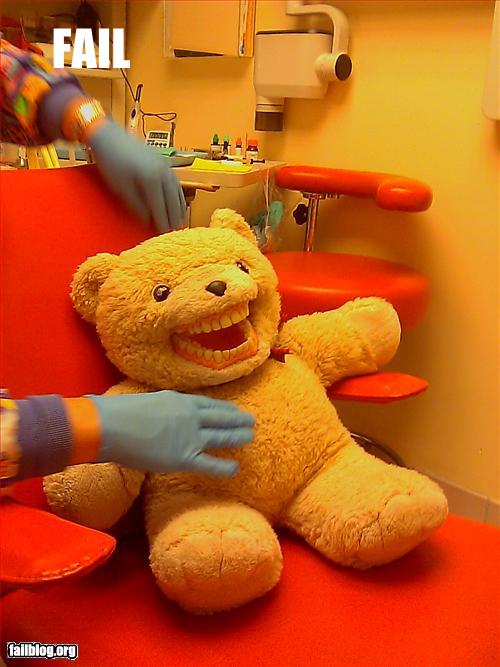
(My orthodontist growing up was named Dr. Bonebreak. Really.)
by Chris Bodenner
Apparently this is a real dental aid for children:
(My orthodontist growing up was named Dr. Bonebreak. Really.)
by Patrick Appel
Marc Lynch's thoughts on the Obama-Maliki presser:
by Chris Bodenner
A reader writes:
The Iranian trio Niyaz blends traditional Persian music with a modern electronica sound. Azam Ali, Carmen Rizzo, and Loga Ramin Torkian are very cool ambassadors of their culture, IMHO. This performance is one of my favorites, filmed a couple of years ago in LA.
The lead singer, Azam Ali, is a great artist in her own right. She has been a featured vocalist in many film scores in recent years, notably "300" and "Matrix Revolutions". (Also see her earlier work as half of the group Vas, with whom she made 4 albums.) I don't know how popular Niyaz or Azam Ali are in Iran, but their music is absolutely superb – not to mention sensual, even erotic – and I'm a fairly picky classical musician working for the Catholic Church.
The above performance starts slow but builds beautifully. Also, here's a taste of the 300 soundtrack:
by Chris Bodenner
Even the Queen is feeling the crunch:
Recent figures reveal that the Queen's estate, the Duchy of Lancaster, has lost £75 million as a result of the recession. Her private portfolio of land and property assets lost a fifth of its value and is now down to a paltry £322 million.
This is further bad news for her Highness, who has had her many, many requests for increases to the royal budget rejected by parliament in the last year. The monarchy's annual expenses currently run at £41.5 million, excluding an estimated £50 million in security costs. Nonetheless, Palace officials continue to engage in talks with the Treasury to elicit more funding for the Crown for, amongst others, planned household refurbishment and the 2012 diamond jubilee celebrations.
The Queen recently dipped into her now-dwindling private funds to pay for a few royal expenses, including Prince Harry's latest trip to New York.
by Patrick Appel
Obama is much better liked by the world than Bush was. Drum marvels:
by Chris Bodenner
A reader writes:
You subscribe, as I did, to the ideal that courting and love is best when honest and transparent. That's quaint, but that's not real. Everyone needs small freedoms, even from their partner, and most have to lie for it. You quoted Savage on hiding porn, but he has been even more on point than that, as in this video. Watch the whole thing for context, but the part worth transcribing is:
"'The One' is a lie, but it's a lie you can tell yourself. A long-term relationship that's successful is really a myth that two people create together. Every successful long-term relationship is a myth, and myths are built of lies… You meet someone for the first time, and they're not presenting their warts-and-all self to you. They're presenting their idealized self; they're leading with their best. And then eventually you're farting in front of each other; eventually you get to see the person who was behind that facade, and they get to see the person behind… your 'lie self…' What's beautiful about a long-term relationship, and what can be transformative about it, is that I pretend every day that my boyfriend is the lie that I met… and he does the same favor to me.. And we, then, are obligated to live up to the lies we told each other about who we are. We are forced to be better people than we actually are."
Of course, to be a thoughtful, considerate and successful lover you have to decide on the acceptable vs. unacceptable lies – in my relationship, sneaking a cigar every 6 months or so is acceptable, whereas staying out all night without calling is not. There's no line-in-the-sand. It's dependent on the people and insecurities involved, and that's what one's brain is for!
As an aside, I credit introducing my girlfriend to Dan Savage with a several-fold improvement in my relationship with her, so you might say I'm a big fan. He's a fantastic ambassador for realism and maturity in sexuality, love, and social politics.
I couldn't agree more; he's by far the most brilliant and brutally honest writers on sex and relationships out there (not to mention a model for gay fatherhood; buy this book to see what I mean).
by Conor Friedersdorf
Brandon Keim writes:
…impending bluefin doom only makes them more valuable. In January, a 440-pound bluefin sold for a record $173,000. Another record will no doubt be set next year. Japanese companies — the de facto controllers of global bluefin fishing — have deep-frozen an estimated 30,000 tons of bluefin; it’s already worth between $10 billion and $20 billion, and the price inflation of extinction could turn that sum into pocket change.
At this point in the discussion, people like me usually shake their heads with despair at the greedy, short-sighted rapacity of the bluefin fishing industry. But the more I think about it, the less they bother me.
Their rationale for exterminating those magnificent creatures at least makes sense: they want to get filthy rich while the money’s flowing. If they don’t catch the bluefin, someone else will. It’s simple supply and demand.
This is as good a moment as any to plug one of my hobbyhorses, the alarming depletion of global fisheries. I understand that climate change is a controversial subject that sparks intense disagreement among people of goodwill, but whatever your stance on it, I submit that preserving humanity's ability to feed itself partly from the bounty of the sea must rank among our most urgent environmental priorities, and as far as I can tell, it isn't anywhere near the top of the political agenda. John Schwenkler argues convincingly that better markets in fish can help. I'd add that a global ban on bottom trawling, one of the most destructive kinds of commercial fishing, is a no brainer.
I've actually strayed from the point of Mr. Keim's post — worth reading in full — which casts aspersions on consumers:
“People believe in their hearts that a piece of raw fish is worth $600. And one of the main reasons that it’s worth $600 is because you can’t afford it and I can’t, but they can. That makes it very special, and it makes people who eat it special.
“Any kind of luxury goods largely come from that sort of statement: I can afford it, and you can’t. I’ll drive a Maserati, even if I can’t drive it faster than 65 miles per hour in most of the United States. I can afford a $280,000 car, and you’re stuck with a Dodge Neon. I can fly private jet, drive a Maserati, do anything I bloody well please, including having a $600 piece of fish. And you can’t.”
And this is the brutal truth: bluefin, which beyond their intrinsic value as living creatures happen to be one of the universe’s more majestic species, a Platonic ideal of oceanic speed and grace, aren’t being extinguished by our greed. They’re being sacrificed to our vanity, pretension, and ostentation — the most pathetic of our vices.
Is he right? If so, "Bluefin — The Diamonds of the Sea!"
by Patrick Appel
Palin hits a new low:
Obama is nearly a mirror opposite. Michelle Cottle plucks out a nugget:
And Ta-Nehisi is right about this:
by Patrick Appel
Mark Blumenthal points to this post by Brenden Nyhan on Obama's unsurprising dip in approval ratings:
by Chris Bodenner
The Smoking Gun has it.
 The Dish