by Chris Bodenner
Nico unearths a very graphic video of what appears to be an injured demonstrator filmed last month:
by Chris Bodenner
Nico unearths a very graphic video of what appears to be an injured demonstrator filmed last month:
by Robert Wright
Is religious belief a “virus” of the mind? My post on that question got some blowback from readers who say that the answer is yes; that the effect of belief on believers—on the “hosts”—and/or their reproductive prospects is sufficiently negative to warrant the term.
What about the millions of people who have died throughout history because of religion? Have the protestants and Catholics in Northern Ireland been "flourishing?"
And, in reference to my point about the Catholic ban on contraception having helped Catholics flourish in Darwinian terms, another reader writes:
Is there nothing at all to be said about the potential Darwinian effects of the vow of celibacy taken by priests and nuns?
Both of these are good points—and neither is inconsistent with my argument. As I said, sometimes the effects of religion are positive and
sometimes they’re negative. My point was that when Dan Dennett and Richard Dawkins
use the term “virus” to describe religious belief generically, they’re implying that all the effects are bad; the
popular connotation of “virus,” after all, is “parasitic.”
However, a couple of other reader emails have convinced me
that my proposed alternative term (“symbiont,” which denotes a co-habitant,
regardless of whether the effects of the cohabitation are good or bad) has problems
of its own, and can be improved on:
I can think of several rational reasons why they might prefer to use virus rather than symbiont. For one thing, "symbiont" is probably not part of the active vocabularies of a large part of their intended popular audience, which would certainly make it a less effective metaphor. For another, as Wikipedia states, "the definition of symbiosis is in flux." When I was in high school in the late 80s, the definition we learned had only positive connotations, much like the one still given by Collins Essential English Dictionary: "a close association of two different animal of plant species living together to their mutual benefit."
It’s true: In the popular mind, “symbiosis” connotes win-win, even though it doesn’t technically mean that, much as “virus” connotes win-lose, even though it doesn’t technically mean that. So my proposed replacement for virus was no better than what it was meant to replace; the cure was as bad as the disease. So what term should Dawkins and Dennett use? Yet another reader provided an inspiration:
I completely agree with your post on rational atheists as it is written. But, I was under the impression that clarity in this area is precisely the reason Dawkins adapted the term "meme" to describe an idea that is transferred "virally", but confers an evolutionary advantage on the host.
Actually, no, Dawkins emphatically did not say that a meme by definition confers an advantage on the host. But he didn’t say it confers a disadvantage. In principle, a meme can do either. That’s why, come to think of it, “meme” is the perfect term for religious belief. In fact, when Dennett introduced the term, in the final chapter of The Selfish Gene, he used belief in God as an example of a meme.
Why didn’t Dawkins just stick with this properly neutral analytical term, rather than load the dice with the term “virus”? A theory suggested by my aforementioned post is that back in 1976, when The Selfish Gene came out, he hadn’t yet developed a sense of enmity toward religious believers/belief, but later encounters with them fostered such a sense. So far I haven’t heard a better theory. But I’m sure Dish readers will be happy to fill this void.
by Patrick Appel
Michael Singh asks the president to think small:

Hollywood, California, 11.32 am
by Patrick Appel
A reader responds to Allahpundit:
I was raised Southern Baptist. One of the few reasons I miss organized religion is the social aspect of "church as an event." In Kansas City some years back, there was a freethinker's group called the Eupraxophy Center. As an atheist, I was attracted to it for its "Sunday School Without Religion," which promised to be a way to converse with like-minded individuals and discuss issues and ideas related to a god-free life.
For a while, it was just that. Eventually, though, it became a sadder, almost desperate attempt at emulating religion – they sang "free-thought hymns" and made pronouncements of purpose and affirmations of worth. It was all done with a sort of blissful arrogance and the air of superiority that only an intellectually insular splinter group can have. It reminded me of the "People's Front of Judea" in Monty Python's Life of Brian. A group of outsiders, all sound and fury, and as disconnected from a practical reality as any religion.
(I am now a practicing Brianist. Behold the shoe.)
by Chris Bodenner
Conor's post on dating deceitfulness reminds me of this classic bit from Chris Rock. Money quote:
You can't get nobody looking like you look, acting like you act, sounding like you sound. When you meet somebody for the first time, you're not meeting them. You're meeting their representative. […] Women the biggest liars. Masters of the lie, the visual lie. Look at you. You got on heels; you ain't that tall. You got on makeup; your face don't look like that. You got a weave; your hair ain't that long.
He then segues into how men in relationships "live a lie" for hiding their porn. It's a topic Dan Savage often addresses in his podcast. He once wrote:
If you must marry her–if you love her and stuff–then you'll have to do what millions of other men in your shoes do: Tell the wife what she wants to hear, hide the porn, and pray you don't get caught.
He basically sees it as a necessary, even considerate, white lie; if one spouse hates pornography, then the other has an obligation to keep him or her from stumbling upon it. And the anti-porn spouse should not go looking for it either, Savage says.
Honesty of course is paramount in any relationship, but I suppose that approach is reasonable in the case of an irreconcilable couple, as long as the offended spouse does not actually consider porn cheating (a question tackled by Ross in a great Atlantic piece last year). Any readers have a particularly thoughtful take on Savage's "see no evil" approach? Is it ever okay to lie to your spouse?
by Patrick Appel
Tyler Cowen's response to the Gates flap:
Presidents (and many others) make big mistakes when they "respond" to people with much lower status than themselves, in this case the policeman and his ilk. The net effect is to lower the status of the Presidency and this will prove especially important when Obama is trying to pass a controversial health care plan. Today he looks less "post-racial" than he did a week ago and although it was only one slip it won't be easy to reverse that.
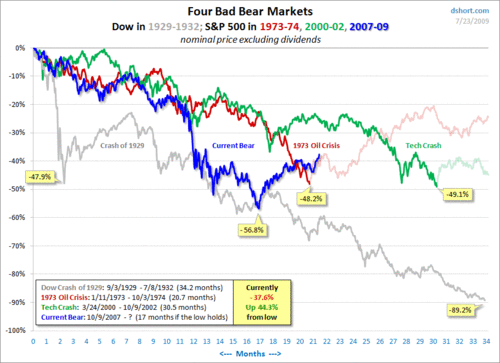
by Patrick Appel
From Doug Short. Justin Fox does some crystal ball reading:
The big bounceback could simply reflect a correction of the extreme, the-world-is-about-to-end pessimism that prevailed in the early part of this year, not a bet that robust growth is in the offing. But I still have this feeling that Rosenberg's prediction [for a sputtering stock market through year-end] will turn out to be right.
Jack Mchugh does some more market analysis.
by Chris Bodenner
Juan Cole turns down the temperature:
The headlines this admission generated in US news sources about 'US troops may stay' are a little puzzling to me, and seem actually sensational. What al-Maliki explicitly said was that Iraq may ask for a handful of trainers to stay. He is not saying that the US military will be rolling tanks in Iraqi cities in 2012. […W]hat al-Maliki said is not a story.
 The Dish