“…Police Misconduct…” cont’d

by Conor Friedersdorf

Anita Bartholomew disagrees with me:

I wanted to point out something regarding your latest post that asks whether Gates's arrest is the one we should obsess about.

Here's why I think it matters more than is immediately apparent:

White Americans don't necessarily relate to the young men who are arrested for driving while black, walking while black, just being in the wrong place at the wrong time while black. You can't convince white Americans that the law is biased against blacks because whites believe (without necessarily admitting it to themselves) that young black men get arrested so disproportionately and go to prison more often because they deserve to.

And by whites, I don't mean just Neanderthals. I mean most of the people you will ever run into. They assume that black men are more disposed to crime and so they don't have to pay attention when you or Radley Balko or someone else points out how many have been railroaded.

But anyone can see that Gates isn't one of "them," the black men so many whites are afraid of. And yet, there he is, shown in his mug shot after being arrested in his own home, humiliated like any youngster dragged into any police station for the crime of being black.

Gates forces white Americans to face the fact that race does play a role in how the police behave, no matter how much Sgt. Crowley protests to the contrary. A distinguished gentlemen with a cane? A Harvard professor? And he's reduced to this? Who can believe that he would have been hauled to jail if his skin were a different color?

We see this and if we're honest, have to face the likelihood that this sort of injustice, if it could happen to him, could and probably does happen to many less distinguished looking, less well-spoken black men.

It's important that we look at this and not make excuses for the cop or claim that we need to learn more of the facts or that we shouldn't care because the charges were minor and were dismissed. We know we would recognize this cop's behavior as injustice if he treated one of us as he did Professor Gates. Gates was loudly complaining about being treated outrageously? No shit. Wouldn't any of us in that situation?

And that's how you get people to pay attention and realize that maybe those black men they are so afraid of aren't any more guilty than Gates.

Understanding The Basics

by Patrick Appel

Andrew Exum is back from Afghanistan. His take on McChrystal:

Forget all that nonsense about a guy with decades of direct-action special operations experience not being mentally limber enough to adapt to protecting the population. About five minutes into a discussion of civilian casualties in my first week in Kabul, I watched McChrystal stand up and spell out for his staff in explicit terms exactly why killing civilians makes one operationally ineffective in an environment like Afghanistan. McChrystal is not inclined to draw attention to his storied history as a special operator. But when he tells you that it's impossible to kill your way out of this war, you believe him — because Lord knows, he's tried.

The Health Care Time Out

by Patrick Appel

Nate Silver tells liberal bloggers to stop panicking:

[One] reason why the delay might be OK for the Democrats is because of the economy. Nobody much seems to have noticed, but the Dow is now over 9,000 and at its highest point of the Obama presidency; the S&P is nearing 1,000 and the NASDAQ has gained almost 55 percent since its bottom and has moved upward on 12 consecutive trading days. There are ample reasons to be skeptical about the rally — it isn't supported by strong volumes, and it's almost entirely the result of surprisingly solid corporate earnings numbers rather than the sorts of figures that Main Street cares about. But, there are two big dates to watch out for. On July 31, an advance estimate of second quarter GDP growth will be released, and on August 7th, we'll get the monthly report on the unemployment situation. If either of those reports reflect the optimism elicited by the corporate earnings numbers — in this context, a job loss number under ~250,000 or a 2Q GDP number somewhere close to zero — there will be a lot of quite optimistic chatter about the end of the recession which might not penetrate to Main Street, but which will at least have some reverberations on Capitol Hill.

Is This the Instance of Police Misconduct to Obsess About?

by Conor Friedersdorf

Interesting as it is to speculate about Henry Louis Gates and the Cambridge Police Department, the attention the case is generating reflects an unfortunate feature of American public discourse: you've got someone like Radley Balko who spends the bulk of his career documenting the most grave instances of police misconduct imaginable — including cases that involve the incarceration of innocent people for years on end — and most of even the egregious cases he writes about never break into mainstream conversation, whereas a minor altercation involving a Harvard professor who isn't even being charged with a crime spawns wall-to-wall media coverage.

Isn't it notable that six months into his presidency, the most prominent advocacy President Obama has done on behalf of minorities mistreated by police is to stand up for his Ivy League buddy? Somehow I imagine that Professor Gates would've fared just fine absent help from Harvard's most prominent alumnus.

Whereas if President Obama spoke up at a press conference on behalf of people wrongly imprisoned due to "testimony" by police dogs, or advocated for those sexually assaulted by an officer, or spoke against prosecutors who block access to DNA testing, or called out the officer who choked a paramedic, or  objected to the practice of police killing family pets, or asked the Innocence Project for a clear cut case of injustice to publicize…

I understand, of course, that Pres. Obama was asked about Henry Louis Gates, which is also part of the problem. Wrongly arrest a black men who happens to be a Harvard professor, release him without filing charges, and the national press corps asks the president to comment. Wrongly imprison for years on end a black man who happens to be working class and without celebrity, and the national press corps continues to utterly ignore a criminal justice system that routinely convicts innocent people. Apportioning blame for this sorry state of affairs isn't as important as recognizing that the news we get on these matters reflects a value system that is seriously flawed, and that news consumers bear blame for too.

Irrational Thinking

by Patrick Appel

A writer at the Economist's politics blog is upset by Dish readers equating certain atheists with fundamentalists. Certainly religious fundamentalism is a greater danger presently – it has greater political clout and contains a far larger portion of the population. That said, Robert Wright made good points yesterday about the unconscious "adversarial instincts" of some atheists. (Several readers took issue with his post and made some worthwhile criticisms. I will try to air them soon.) Atheism as fundamentalism in reverse might not be a very helpful label, but recognition that we are all vulnerable to cognitive biases is worth pointing out. Here's some more of the e-mail Bob Wright excerpted that argued the "New Atheism" is not about God or religion but rationality:

The real-world implications of the "New Atheists" ideas are not insulated from the same dogmatism and intolerance that they decry.

Robert Wright pointed at Hitchens' hawkishness and was in turn pointed to PZ Myers' dismissal of his ideas, and I would also direct him to this post where Myers, one of the more rhetorically intemperate of the 'New Atheists,' takes Hitchens' war-mongering bellicosity to task. Hitchens zeal on, say, the Iraq war, I would argue is clouded by unwarranted certainty.

To get back to my original point about rationalism, the religious aspect is only the one most pertinent to today's issues. Hitler came to power on a wave of nationalism, and the strains of communism have brought about more death than any religious war. But these too were a product of anti-rationalist thinking. Hitler's ideas on Teutonic supremacy had little basis in reality and in fact stretched back to the mass politics and antisemitism of the late 19th century. North Korea has elevated Kim Jung Il and his father into god-figures, and the Soviet Union famously and most disastrously rejected natural selection and genetics on ideological grounds as a "fascist science" and poured its agricultural resources in furthering bogus Lamarckian Lysenkoism.

A believer makes a related point:

At the heart of atheism’s concerns is that irrational thinking creates problems in the world. They claim that religion is the primary source of irrational thinking. The trouble is that even if every person on earth suddenly became an atheist today, we would still have to have to deal with the irrational thinking of politicians, sociologists, historians, economists, philosophers, doctors, scientists, business leaders, ad infinitum.  Pride, vanity, stupidity, laziness, and prejudice taint every human endeavor and it will take more than mere rationality or the scientific method to eradicate these influences. It takes humility, openness, and deep compassion to find the truth behind all our foibles. 

Dish Readers on Romance

by Conor Friedersdorf

Thanks for all the e-mail on "Dating and Deception." Before I put forth new thoughts, let me clarify that while I do think it is deceptive to clean an always messy living room before a first date — that it is "apt to give a false impression of reality" — I don't think there is anything wrong with doing so, especially because by general consensus there is no expectation of transparency in that situation.

Even if you disagree with my assessment, it is nevertheless generally true that we consider some kinds of deception or artifice okay in dating, abhor other kinds, and lack a consensus about where to draw the line. That interests me, and it's useful to probe what the appropriate metric is for making determinations on these matters.

I'd now like to air a bunch of disparate thoughts sent in by readers. I'll begin with a happy story of deception:

My sophomore year of college, my roommate Eric said "Tom, I think Laura likes you." Around the same time he told Laura, "Laura, I think Tom likes you." To this day it's unclear what his motives were. He and Laura were best friends at the time but their friendship was weakening. I knew Laura but I was going out with someone else. That was 1987, Laura and I started dating soon afterwards and have been married for fifteen years now and are still head over heels in love. Go figure.

Several readers wrote to note that relationships which began in low-level deceptions about age, income or occupation ended in happy marriages. Sonja writes:

I wanted to comment on checking out a woman's Facebook page to find out her favorite poem. When I read that I was totally creeped out. How can that be put in the same category as wearing makeup and cleaning the living room? I think it bugs me because it gets close to stalking territory.

It occurs to me that digital sleuthing is an area where people have strong disagreements about what's acceptable. Is a look at a first date's Facebook page or Google history close to stalking? Or due diligence before you go out with a stranger? Luckily the big differences on this question are likely to be generational, but I suspect that especially in relationships with an age gap, these rapidly changing etiquette questions could cause trouble. Incidentally, I agree that pretending to coincidentally like a woman's favorite poem is kind of creepy. On the other hand, seeing via Facebook that her favorite flower is the lily, and choosing them the first time you bring her flowers? Seems like fair game. Matt writes:

What a crazy subject, man. What is or is not okay in dating is the subject of more hypocrisy than anything else in life, even politics. What's morally acceptable? In my experience, whatever it is that preserves or substantiates someone's already held opinion of the person in question. As you alluded to, if John Doe's good friend does it he probably won't think it's inexcusable, but if some other person does it to John's good friend, it's a crime against nature.

I once had a female friend go on a rant to me about a mutual friend of ours that had confessed he had a crush on her, her calling it a betrayal of their friendship and complaining that men can't think about women without wanting to have sex with them and how it disgusted her. Now the fact that she was ranting to another male and obviously excluding me from the guilty party (men) was not the real hypocrisy of the moment. The real hypocrisy was the fact that I was driving her to meet up with another mutual friend who she had a crush on and was hoping to hook up with that night. You never mind someone making a pass at you when you want him or her to.

Time and again I've watched as people that I know are guilty of indiscretions with the opposite sex have held forth with great indignation against someone else who has just done the very same thing. I try to tell people, "judge not lest ye be judged", because no one is innocent in dating.

I don't like what pickup artists do, but in my experience they're only getting away with it because the women involved, on some level, want it to happen. I don't know how much to blame the scumbag guy for that. As far as taking the advice of a pickup artist, I always try to advise people that if what you want is a romantic relationship, you shouldn't listen to someone who uses contempt of the opposite sex as his or her shield for pursuing the narrow goal of instant gratification.

Heather speculates about a sexual orientation divide:

I have a suspicion that the idea of approaching dating as "gaming" likely plays out differently among straight folks than queers. Not because they're any less moral but because anyone who has gone through the experience of coming out has viscerally learned that pretending to be something you are not doesn't ever achieve the thing you are really after: to be genuinely cared for and desired as your self.

I know it's popular for straight dudes to talk about dating as "gaming" and that "being direct" doesn't work with straight women. I heard these complaints from my straight male friends when they were dating. I don't see them applying this "philosophy" though now that they are married. Nothing undermines a relationship more than dishonesty.

Vapor writes:

I was a guy who did pretty well with girls in college, having been an athlete, in a fraternity, and having a pretty wide social circle through my school.  All of that had an expiration date of my leaving school and moving away, and I'd never approached a strange girl in my life.  Had no idea how to do it.  Despite a wide social circle I was an introvert around strangers.

When I started studying dating, I saw a lot of advice that I used to do naturally, but didn't any more now that I was a little nervous and on unfamiliar ground.  And now that I remembered them, I did them again.  And started succeeding again.  And doing better than I did when I was doing things naturally, because I'd actually approach girls I wouldn't have in school.  I wasn't tossing out pretend insults.  I was eliminating needy behavior, making an effort to get to know women, and I wasn't being afraid to express interest that wasn't platonic.

When you talk to guys who are experts who teach this stuff (I don't claim to be one), not random bloggers or guys with an ebook who gives bombastic quotes, there is not a whole lot there to call deceptive.  I know one minister who learned this stuff and got married.  I'm Catholic, and while I certainly have my faults that might make me a bad one, they don't come from how I talk to women I'm interested in or want to get to know.

D. has his own code:

I've thought a lot about this stuff – particularly with regard to relationships in which more or less all I want is sex. I don't believe I'm a saint for doing so, but I have begun doing something I believe is rare for males: stopping soon before sex or its approximates happens – for example, after a kiss in an empty apartment – and making a speech that goes something like this: "I just want to make sure that you know that I don't have deep serious feelings, and I don't think I'm interested in anything serious. I'm just very attracted to you. If you want to quit now, we can quit."

It sometimes seems a bit ludicrous. But…without that disclosure, I feel as if the sex has been stolen. Unless it has come about in a situation in which commitment is absolutely obviously impossible or undesired – say, with a stranger on the last night of a trip to Cancun, or after a "hey babe, wanna have some fun tonight?" pickup line – It has been earned via deception; the woman, in almost all cases – or at least, like, 75 percent of cases – has been led to believe the man has long- or medium-term intentions he does not have. Thus, the "consent" obtained is illegitimate, just like the consent obtained by a phone company that led you to believe it would provide service for a year and then stopped doing so after six months is illegitimate. 

In short: this type of denial of consent is certainly not akin to rape, but it's also bad.

One thing I'm struck by in these discussions is the degree to which different people adopt ethical codes and approaches of their own, many of them highly nontraditional. You never get that impression watching the movies or even reading most novels. But it seems to be the reality of how people approach dating in particular.

Finally, Catherine has a possible revue stream for The Atlantic:

…speaking of dating, I think the Dish should have singles mixers.  Seriously.  In all urban areas.  It'd be a fantastic way to meet people who are from all political points of view but at least I'd know the guys are smart.

I'm not kidding.  I would die to go to that singles mixer.

I'll post once more on this subject to address reader e-mail on "the neg," or the technique of strategically criticizing women you're trying to pick up.
Making Enemies

by Patrick Appel

Goldblog points to a report on "Death to Russia" and "Death to China" replacing "Death to America" in Iranian protests. Larison frets:

If the protesters make anti-Russian and anti-Chinese sentiment a significant part of their movement, they can be sure not only that these powers will do nothing to curb the regime in the event that it cracks down more severely but also that these powers will actively work to sabotage their movement any way they can.

Face Of The Day

89160051
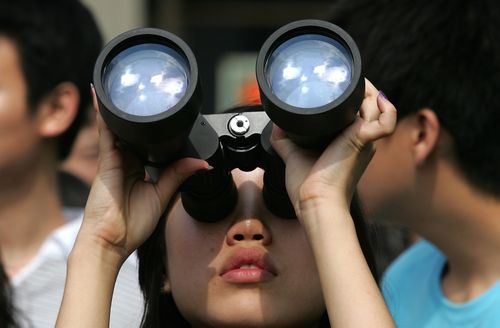
A woman observes the total solar eclipse at the Yonsei University on July 22, 2009 in Seoul, South Korea. The moon covered 78 percent of the sun during the solar eclipse viewed from Seoul. The longest total eclipse of the sun of this century triggered tourist fever in Asia as astronomy enthusiasts from home and abroad flocked to watch the event .The eclipse was visible from within a narrow corridor that begins in India and crosses through Nepal, Bangladesh, Bhutan, Myanmar and China. By Chung Sung-Jun/Getty.