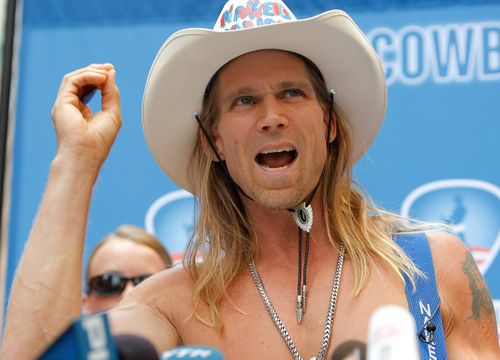
Local New York personality Robert John Burck, also known as 'The Naked Cowboy', speaks with media during a press conference announcing the launch the Naked Cowboy's New York City mayoral campaign at Military Island, Times Square on July 22, 2009 in New York City. By Jemal Countess/Getty.
Month: July 2009
Benefits of Doubts
by Conor Friedersdorf
On Internet discussion boards I've been following, people are debating the altercation between black Harvard professor Henry Louis Gates and the Cambridge, Massachusetts police department. A point of disagreement is whether police officers should be given "the benefit of the doubt" in these situations due to the difficulty of their jobs.
Lest anyone doubt that the job is difficult, let me share a brief story. On a ride along with the NYPD in Manhattan, the squad car I inhabited got a call that sent us speeding from Union Square to a destination maybe 10 blocks away, tires screeching, sires wailing. The dispatcher said merely that someone reported a street scuffle involving a dozen men, that one wielded a baseball bat, and that a street front window had already been shattered. As we pulled onto a small street in question, under cover of darkness, view of the altercation was obscured by a large truck parked illegally on the street. The effect was that after the squad car rounded its cab, we found ourselves on the edge of the melee.
It all happened damned quickly. The two officers in the front of the car jumped out immediately, pushed through the onlookers at the edges of the commotion, grabbed a guy and pinned him against the wall. As I watched from the backseat of the squad car, I couldn't figure out why they grabbed that particular guy, but it quickly became apparent that in a split second they'd somehow identified the only man on the scene with a weapon (a knife), separated him from everyone else, and disarmed him, without ever brandishing their own guns. I was impressed, and conscious of how easy it would've been to make a mistake in that situation: a violent altercation already underway, a crowd of men, one of them armed, and darkness. It gave me a better idea of how police officers are sometimes killed, and how they sometimes injure or kill the wrong person.
Given that kind of situation, where split second decisions are forced upon officers, adrenaline is pumping, and all the rest, I understand the impulse to give them the benefit of some doubts. But why should police officers require the benefit of the doubt when they are confronted with a lone guy — old, nonthreatening in appearance, apparently well-dressed — who is pushing on the front door of a house in a nice neighborhood? Does that sound like a particularly dangerous situation? That isn't to make a judgment about what actually happened, or whether the officer misbehaved. It is merely to say that the matter should be decided on its merits, that it is irrational to give the officer any special "your job is hard" benefit of the doubt, especially in a circumstance significantly less difficult than many police face. Why privilege the story of the officer over a law-abiding citizen who turns out to have been outside his own house? If anyone deserves the benefit of the doubt in cases like this one, it is the citizen.
Walking Away
by Patrick Appel
A reader writes:
I've been following the atheism discussions and I've yet to see anyone mention that there's a third path that's getting conflated here: apatheism. That's what I find, in general, among friends from the Netherlands and Sweden, and in myself and in plenty of friends here in the US. My Swedish relatives are all listed as Lutherans per the national church but many avow a purely secular outlook; unlike some American atheists I've known (and many of the big names, it seems), the combination of listed-religion on one's citizenship and a personal disinclination is not seen as a worrisome contradiction. It just
doesn't matter enough to fuss about.
It's like agnosticism, but lacking the usual agreement with Pascal's Wager: apatheism, instead, realizes that those dice are loaded and chooses to walk away from that bet. Atheism, especially of the stricter political sort, would prefer to end the game, or at least steer potential marks away from it.
Maybe there is a god. Maybe there are many gods. Maybe there's no god at all. Maybe I could drive myself crazy second-guessing myself and every theologian and pastor and religious friend out there. Maybe in the end it doesn't matter, and I've just got to lead the best life I can, as I see it, and if that's not good enough in the end — if there be an end instead of a simple fading away — then as far as I'm concerned, any god that would condemn me for doing my best to be the best person I can isn't a god I'd want to believe in, in the first place. That means not only do I respect other people's beliefs and their right to believe, I even recognize it's possible that they're right — but that doesn't mean my choice is wrong.
The Real Enemy At The Gates, Ctd
by Chris Bodenner
A reader writes:
It not clear to me how much racism had to do with this situation. It seems pretty clear to me what happened: A cop responded to a break-in report and had an unfriendly interaction with Gates, after which he arrested Gates because he didn't like the way he was talking back to him. Arrests of this type are called 'contempt of cop' in the legal field and are VERY common. As in this case the charges are always dropped; they are intended to teach the subject a lesson: don't give cops any lip or you will have to go through discomfort and humiliation. Would it have made a difference if Gates had been a white man? Who knows? Maybe, maybe not.
The only people clear about what happened are Gates and the cops who arrested him. I initially refrained from airing any commentary about the incident because we have no way of knowing exactly what happened. And speculation sheds no light – only people's preconceived notions and political agendas. However, I excerpted McWhorter because he's always been the last person to cry racism over such incidents, and he vouches for Gates regarding the same. I side with that sort of credibility.
Also, from my perspective, even if Gates did get blustery with the cops, they should have cut him some slack for the humiliating spot they put him in, unintended or not.
Health Care Reform’s Last Chance?
by Patrick Appel
Krauthammer's take on the health care bill:
This is [the] signature achievement he has promised. If he doesn't have it, if he doesn't have a bill, any bill, at the end of the year, his presidency is going to be seriously damaged, and all the mystique will disappear. Which is why…I'm absolutely sure that at the end of the year, he will have a bill. It will have the words "health-care reform" on it. It will be extremely watered down: All of the ballast that the Blue Dogs were protesting against, including, I'm sure, the public plan, is going to be thrown overboard.
And it will be a very weak version of what we have now, probably even harmless—which will be a great American achievement. But he's going to have something. He won't have it in August, but he will have to have it at the end of the year.
I'm more optimistic about the bill's chances, but we'll see, won't we? If Democrats can't pass a meaningful bill with all their current political advantages, I'm not sure how it will ever get done. Healthcare is projected to take up an increasing share of GDP. The bigger the industry gets, the more difficult it gets to appease special interests and get a bill passed. If you think that the health care lobby is a barrier to reform now, wait until it takes up 20 or 30 or 40 percent of GDP.
What Steele Wrought
by Chris Bodenner
Please, Mr. Chairman, please put your "urban-suburban hip-hop" genie back in the bottle. We'll give you card check.
Reefer Progress
by Chris Bodenner
We almost missed this AP item today:
Oakland residents overwhelmingly voted Tuesday to approve a first-of-its kind tax on medical marijuana sold at the city's four cannabis dispensaries. Preliminary election results showed the measure passing with 80 percent of the vote, according to the Alameda County Registrar of Voters.
The Dish recently featured the story of a "budtender" from Oakland (also follow the link for Josh Green's Atlantic report on "Oaksterdam").
North Korea, Unruly Teenager
by Patrick Appel
Hillary Clinton, discussing North Korea this week:
“What we’ve seen is this constant demand for attention…And maybe it’s the mother in me or the experience that I’ve had with small children and unruly teenagers and people who are demanding attention — don’t give it to them, they don’t deserve it, they are acting out”
Kerry Howley sighs:
You get the sense here that geopolitics is a very elaborate episode of Jon and Kate Plus 8 in which one lucky nation will get mommy’s undivided attention for a few minutes, briefly quenching some long-held craving for parental affection. That a U.S. Secretary of State can be deaf to how ignorantly hubristic this kind of thing sounds would be surprising if chauvinistic rhetoric weren’t part of the job description.
Mental Health Break
by Chris Bodenner
A screen too small:
Kuroshio Sea – 2nd largest aquarium tank in the world from Jon Rawlinson on Vimeo.
Moore Award Nominee
by Patrick Appel
"Do you count yourself among the thousands of New Yorkers who worry about climate change? Are you bothered by the lack of access to fresh, healthy, affordable food in so many NYC neighborhoods? Would you like to see more gardens take root all over our city, in front yards and back, vacant lots and empty rooftops. If you answered "no" to any of these questions, I'm going to hazard a guess that you're some kind of Limbaugh-loving, Beck-boozled, beyond-the-Palin lemming who will hopefully follow your near-sighted leaders off a cliff before you've had a chance to mate and perpetuate your unfortunate species, which, alas, is not yet on the endangered list and threatens to destroy our habitat," – Kerry Trueman, Huffington Post.
Award glossary here.
 The Dish