By Conor Clarke
There's really no getting around the fact that the country's long-term budget outlook is 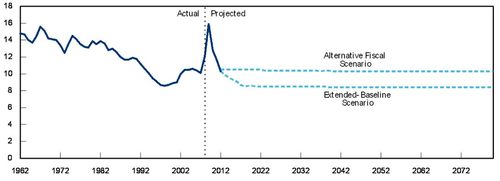
By Conor Clarke
There's really no getting around the fact that the country's long-term budget outlook is
This is past and projected government spending as a percentage of GDP on things besides Medicare, Medicaid, Social Security, and interest. And look, it's not so bad! And sure, maybe that is like saying, "when you consider the ocean without all that water, things don't look so wet." Nonetheless, my sense is that when people worry about the future of big government, they worry about things above and beyond an older population that gets increasingly grabby with the increasingly expensive entitlements. But that's really all we have to worry about.
by Conor Friedersdorf
— This is one of the more delightful examples of public art that I've seen.
— Mental Floss looks at eight very hairy people.
— What do blood diamonds have to do with Goldman Sachs?
— "Catholicism's mysterious appeal to intellectual converts."
— If you've ever been involved in the making of a corporate Power Point presentation, this story is for you
by Patrick Appel
A reader writes:
by Conor Friedersdorf
… is more content like the stuff produced by This American Life.
Though I am a partisan of long form storytelling, here I am lauding another aspect of that great radio program: its ability to consistently broadcast voices that sound different from what we normally hear when we get the news. If your news diet is mainly newspapers, you get quotes so short that they're mostly stripped of any personality. Television news gives the misleading impression that everyone in America speaks in the accent-less manner of the typical anchor.
But if you listen for very long to This American Life, you're reminded how big a country America is, all the regional accents it encompasses, and its delightful regional expressions — and by extension, you gain perspective about the size and diversity of our polity. For me, this underscores the wisdom of deciding many issues at the local level. I am sure others draw different lessons, perhaps as worthwhile. The point is that America is a much bigger, broader place than is generally portrayed in mass media, and we'd all understand the country a bit better if more media outlets did as good a job of rendering that as Ira Glass and team.
By Conor Clarke
When I see a walking, talking anachronism like Pat Buchanan say on MSNBC that Sonia Sotomayor isn't qualified for the Supreme Court because she's an affirmative action baby (via Ta-Nehisi Coates and Ezra Klein), I think back to one of the favorite conservative criticisms of race-based affirmative action: It will forever tar the accomplishments of its beneficiaries. In a way, the fact that Buchanan's worry is so widely shared is obvious proof that this criticism is true. And, in a way, it just proves that the criticism is self-fulfilling. If the same people who doubt the efficacy of affirmative action also doubt its beneficiaries, there's nothing terribly interesting about the latter critique.
Mostly, however, I think it underlines the importance of thinking and talking about affirmative action as a program designed to alleviate a lack of opportunity (e.g., systematic racism, poverty) rather than accomplish some secondary goal (like better classroom discussions).
I made one version of this argument a couple of days ago — and expanded it here here and here — but I want to add a few more points. At the heart of Buchanan's critique is a sense that anyone who was a benficiary of affirmative action in the past cannot be well-qualified today. I don't think this argument can stand scrutiny.
That's because one's qualifications in the present are a function of one's opportunities in the past. There are very talented white children born in the lap of luxury on the upper west side of Manhattan, and there are equally talented Hispanic children born in poverty in the south Bronx. It should surprise exactly no one, except possibly Pat Buchanan and Michael Goldfarb, to learn that they will not get the same SAT scores. An affirmative action system that corrects for this lack of balance is not taking a "less qualified" person and putting her above a "more qualified" person. It is giving equally qualified people the same opportunities. This is liberalism 101, not rocket science.
by Chris Bodenner
One of the more dramatic clips from today:
by Chris Bodenner
Nico makes one of the sharpest points I've seen of today's protests:
The chants against Russia and China — whose governments have both recognized Ahmadinejad's election victory — were widely used today. As noted below by a reader, the strategic benefit here seems to be associating the Iran's government with a foreign power, just as the government is trying to do to tar the reformists.
by Chris Bodenner
A reader writes:
That post is of a video from protests weeks ago; I specifically remember the video, including location (narrow street, many people), the bridge, and the running-up-the-stairs-while-pointing-the-camera-low. I believe the video was actually posted on the Daily Dish too.
I had had a vague feeling that was the case as well. But Raye Man Kojast? is usually a reliable source, and in the immediacy of the moment I leaned towards posting. I just got done scanning several weeks of the Dish and couldn't spot the same video. If anyone happens to know where that same footage is posted on the Dish or elsewhere, I'd be grateful to correct the record.
Update: Regardless of that particular video's veracity, this point remains:
by Patrick Appel
Bruce Bartlett has column a few days ago whacking Republicans for opposing any and all taxes. Money quote:
Drum seconds him. Ezra Klein follows up with an interview today.
by Patrick Appel
From Muhammad Sahimi's analysis of Rafsanjani's speech:
 The Dish