by Chris Bodenner
An orgy of electronic pop and construction paper:
Wax Stag 'And How' OFFICIAL VIDEO from RadarMusicVideos on Vimeo.
by Chris Bodenner
An orgy of electronic pop and construction paper:
Wax Stag 'And How' OFFICIAL VIDEO from RadarMusicVideos on Vimeo.
by Patrick Appel
Roubini says that econopundits have mistakenly labeled him bullish:
by Conor Friedersdorf
A few days ago I wrote a carefully worded post on the abortion debate. Though I find my argument difficult to sum up in a single sentence, it's basically that prevailing social norms in progressive circles send men a mixed signal: should their girlfriend become pregnant, the decision about whether or not to carry the pregnancy to term is hers alone; but should she choose to have the child, he is expected to be as fully invested in its gestation, birth and upbringing as she is.
Personally, I haven't any objection to a society where males are held responsible for their progeny. There is no circumstance in which I'd abandon a women with whom I had sex, or my own offspring. Nevertheless, I think that progressive social norms on this matter work at cross purposes with one another: if men think that whether or not to carry a fetus to term is the sole province of women, they are less likely to be equally invested in raising a child they fathered. "Her body, her choice," these men say to themselves. "The fact that she bore the child must mean that she wanted it — if that's her decision, why should I bear the cost for it?" Again, I am repulsed by any man who takes that attitude toward a child he fathered. It is nevertheless my estimation that a "my body, my choice" approach to abortion marginally increases the prevalence of that attitude.
Damon Linker wrote a thoughtful rebuttal to my post:
Feminists and progressives want abortion to be legal, taken out of the political sphere. Fine. But these goal do not require that abortion be rendered morally unproblematic. And it's a good thing, too, because the decision about whether to terminate a pregnancy is and always will be, among the other things it is, a moral decision, whether or not the decision is legal.
I agree. In my original post, I tried my best to focus on a narrow argument, obscuring my views on abortion generally. Perhaps by doing so I wrote a post that seemed to implicitly agree that abortion is an amoral act. I actually don't think that, and I'm grateful to Mr. Linker for correctly clarifying that "abortion is not, and will never be, a matter of moral indifference. A man can fiercely defend a woman's (public) right to choose an abortion without state interference while also passionately trying to persuade his girlfriend (in private) to carry their (not her) baby to term."
I am less sanguine about the response to my post written by Anna N. at Jezebel. It isn't without substance. She is absolutely right, for example, when she says that "the decision of whether to continue a pregnancy affects the father too, and yes, in an ideal relationship, both partners would discuss the decision (ideally, before it ever becomes a decision — i.e. "what would happen if I got unintentionally pregnant?")." I concur that this approach is ideal.
Soon enough, however, I'm confronted with this:
Friedersdorf's threat that men might withdraw their support in other areas if we deny them a role in abortion reads a little like Lindsey Graham's complaint that Sonia Sotomayor gets to say things he can't say. Men got to make all the decisions, about relationships and everything else, for a very long time. Maybe it shouldn't be a surprise that when they are locked out of just one — a choice that involves a woman's autonomy over her own body, no less — they get mad.
What nonsense. In writing about pregnancy, it shouldn't be necessary to note that any man who impregnates a woman should assume an equal burden in caring for the child. I've taken care to note that anyway. Nevertheless, here is Anna N. stating that my post amounts to a threat to women — and implying that I am mad about the status quo. In fact, I've neither the desire to threaten women nor the emotional investment on this topic to inculcate anger. My judgment is an analytical one. I genuinely believe, without malice or endorsement, that certain specific pro-choice social norms undermine the degree to which the average man is invested in offspring he produces out of wedlock. Indeed, I wish that weren't so, as I very much want every child to be loved and raised by its father. In classic fashion for the subset of feminists whose arguments become doctrinaire, Anna N. imagines that making an observation about an unfortunate trend is tantamount to endorsing — nay, threatening — its propagation.
Elsewhere in her post, Anne N. quotes me as follows: "The narrow assertion I want to make is that the social norms we are inculcating are working to safeguard reproductive choices for women, and to undermine men's investment in pregnancies and child-rearing."
Her response:
Translation: See ladies? If you insist on making your own decisions about abortion, that's fine, but don't expect a man to be around later on when you need help with pregnancy or child-rearing. Because men aren't going to be willing to have a "mutually supportive dialogue" with you unless they get a say in every single decision you make, including the one that has to do with your autonomy over your own body. It's all or nothing, girls! Oh and also, this isn't totally my opinion, it's just something other people might think, and it's up to you to decide, although I did just write an op-ed about it.
In other words, the post as I wrote it wasn't amenable to the kind of outraged, offense-seeking rebuttal that Jezebel traffics in at its worst, so the blogger felt a need to offer a "translation" of my post to rage against — never mind that the "translation" asserts spurious arguments that I utterly reject, and that are nowhere implied by my original post. I defy anyone, for example, to cite anyplace in my writing wherein I argue that men take an "all or nothing" approach to supporting women they impregnate. It is rather easy to argue against a caricature of one's interlocutor, but there isn't much point beyond posing as an aggrieved opponent of misogyny for the majority of readers who never follow the link to my piece.
She concludes as follows:
I don't believe that all anti-abortion advocates are acting in bad faith, or that they all want to control women. I do believe that many of them have genuine religious objections to abortion, and that these objections don't necessarily make them misogynists. But I also believe that on both sides of the debate are men who don't really get what it's like when something is not their decision to make. It's time for them to learn.
I am not particularly religious, I am certainly not a misogynist, and I haven't taken any position on the question of whether or not abortion is a decision that is ultimately the sole province of women. I understand that it is easier to view every debate that touches on abortion as a struggle that pits religious conservatives who undervalue the autonomy of women against enlightened progressives who know better. Doing so in this case, however, entirely misses the point of my argument, the impulses that motivated it, and the opportunity to advance the discussion.
And though I am perfectly equipped to defend my posts, and critique those who misrepresent them, I'd hasten to add that this kind of response to good faith efforts to discuss controversial topics is what discourages many male writers from entering the fray at all. It is oft lamented on feminist blogs that certain subjects pertaining to women are ghettoized in venues like Slate's Double X, rather than being discussed in mainstream publications geared at both sexes. Ann Friedman penned a sharp piece on that topic in The American Prospect. I've personally been told by two male bloggers that they shy away from any subject pertaining to gender because they fear the fallout should their views be mischaracterized and villainized. We'd all be better off if bloggers like Anne N. stopped writing posts that make such fears rational responses to reality.
UPDATE: Michelle Cottle makes some good points in this thoughtful response to my original post.
By Conor Clarke
When I saw this headline in my RSS reader — "One question the senators did not ask: how's her health?" — I assumed it was going to be a story about how those gosh-darn ungentlemanly career politicians failed to ask Sonia Sotomayor about her recently broken ankle. But it isn't. It's a story about how the senators failed to inquire after Sotomayor's diabetes, which she has had since the age of eight. And the article is not concerned with kindness, but miserly moral mathematics: because it is unlikely "that Sotomayor will have the longevity of someone such as Justice John Paul Stevens," Sotomayor’s "seat could more quickly be filled by a Republican than someone without a chronic illness."
Should they have asked about this?
Well, I do think age and health are more obviously reasonable concerns than race or gender, although as a matter of manners it does seem a bit indecorous to bring these things up at a public hearing. (The considerations that get tossed around in Obama's head before making a choice are another matter.) And I'm not quite sure what any Senator would have asked. ("When are you going to die?" Hardly.) Neither party has much reason to bring it up.
That said, I do think there are two important considerations here. The first is the obvious point that we should be concerned not just with quantity (years served) but with quality (effective judging), and adjust expectations appropriately. Second, it seems to me that if we are going to be explicitly concerned with the health of nominees, we should logically extend this concern to many other uncomfortable subjects. We should never nominate a smoker (Rehnquist). Or we should ask about exercise habits. Or we should realize that women tend to lead longer lives.
by Conor Friedersdorf
A long piece at GQ tells the disturbing story of Tony Stancl, an 18 year old high school senior who created a fake female identity on Facebook, flirted with male classmates by Internet chat, and successfully encouraged hundreds of them to send along naked photographs. These he kept on his computer. The unluckiest victims were subsequently blackmailed. The made up female would threaten to release the photographs unless the boys performed oral or anal sex on "my friend Tony." Some boys agreed, and allowed that to be photographed too.
It is difficult to imagine a more striking cautionary tale for teenagers who inhabit the Internet age.
One can only hope that the victims of "sextortion" in this case aren't permanently traumatized — and that the perpetrator is appropriately punished, hopefully discouraging other would be predators from preying on classmates in the same way.
Having laid out the story, the GQ writer reaches the following conclusion:
Am I alone in thinking that the casual attitude taken by many teenagers toward naked pictures generally — as opposed to the horrific deception specific to the case above — isn't surprising at all? In the annals of American history, how many high school boys have exposed themselves to high school girls they met only recently? I am certain that very few stopped beforehand to ponder whether being seen naked would traumatize them, and that very few were ever traumatized by the experience. (I'll avoid speculating one way or another about the experience of women.) I hasten to add that exposing yourself to high school classmates is a bad idea! It would seem to inculcate unhealthy attitudes toward sexuality, and risks prosecution under overly broad child pornography laws. Would my high school senior self nevertheless have complied if a beautiful classmate cornered me at a party, intimated that she had a huge crush on me, and hinted that maybe we could be a thing if only I'd undress? He probably would have!
This issue is so thorny. If I ran for office and confessed that as a 21-year-old I went skinny dipping in mixed company one drunken night in Nice, France, I'd be unembarrassed about the experience, which was innocent enough, pretty damn fun if you want to know the truth, and an exploit with which I imagine most people can identify. What if a classmate from those days, having taken photographs (or even worse, video) without my knowledge, subsequently released them online? I'd be embarrassed. Some folks would regard it as a minor scandal. Can you see the Drudge headline? "Senate candidate exposed in naked romp!"
Like the (apocryphal?) tribes who feared that being photographed would rob them of their souls, we've reached a strange point in society where lots of behavior, whether desirable or undesirable, is considered far worse if it is documented on the Internet. This is at times perfectly rational, or else understandably irrational, but it sure is vexing, and I am quite thankful that my own teenage years were blissfully free of having everything I did documented in the cloud.
by Patrick Appel
The LA Times agrees with the first reader, though it would be great if this was the standard.

Palos Verde, California, 9.30 am
by Patrick Appel
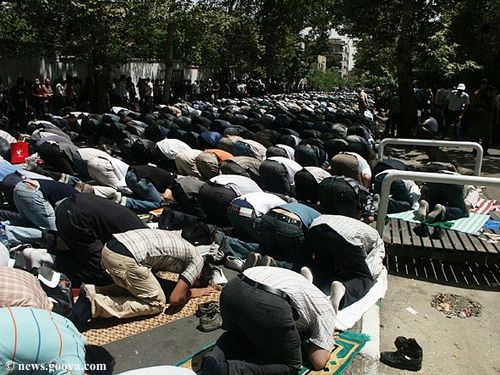
NIAC gets an eyewitness report from "a very close friend" in Iran:
Made my way down the west side of Laleh Park, large crowd was gathered around a radio listening to Rafi give the sermons, moved down to Keshavarz Blvd, where people had already started to taunt the bassijis who look like teenagers with Darth Vader helmets that was one size too big for them.
The main slogans were “Baradar’e basiji chera Baradr Koshi” (”Brother basiji, why do you kill your brother?”, the speaker after Rafi was urging people to shout “death to America” and “death to Israel” people responded in mass by shouting “death to Russia” and “death to the dictator”, things started getting messy in 16 Azar street, I never knew that you can defuse the effect of tear gas if you hold a cigarette close to your face, who cares about second hand smoke when you are fighting a dictatorship… Anyways, they chased and people ran away, they caught few poor fellows who probably are in hospital now, but overall the fear and terror seems to get less and less effective, unless they decided to bring the big guns out one day, even then I do not think they will able to defeat these people.
By Conor Clarke
Washington Post columnist Michael Gerson is disgusted by this response from Ruth Bader Ginsburg, published in an interview with the New York Times Magazine:
Justice Ginsburg: "Yes, the ruling about that surprised me. [Harris v. McRae — in 1980 the court upheld the Hyde Amendment, which forbids the use of Medicaid for abortions.] Frankly I had thought that at the time Roe was decided, there was concern about population growth and particularly growth in populations that we don't want to have too many of. So that Roe was going to be then set up for Medicaid funding for abortion."
After reprinting this quote, Gerson writes: "A statement like this should not be taken out of context." That's actually the very next sentence. Which is odd, because Gerson has … taken Ginsburg out of context. Her full response to the question reads:
Yes, the ruling about that surprised me. [Harris v. McRae — in 1980 the court upheld the Hyde Amendment, which forbids the use of Medicaid for abortions.] Frankly I had thought that at the time Roe was decided, there was concern about population growth and particularly growth in populations that we don’t want to have too many of. So that Roe was going to be then set up for Medicaid funding for abortion. Which some people felt would risk coercing women into having abortions when they didn’t really want them. But when the court decided McRae, the case came out the other way. And then I realized that my perception of it had been altogether wrong.
I suppose Ginsburg's quote is still a little ambiguous. I read her as saying, "At the time Roe was decided, some people held the view that abortion was needed to reduce the population growth of unwanted peoples, but I realized later that this was not a widely held view." (Interpretations can vary, so here is the entire interview.) I think it's pretty clear Ginsburg is not saying is, "I hold the view that abortion is needed to reduce undesirable populations."
Either way, what's not ambiguous is that the last sentence is important context! And I find it incredible that Michael Gerson delivered a pious little sermon on the importance of context immediately after depriving Justice Ginsburg of exactly that.
 The Dish