by Patrick Appel
Tehran Bureau has a round-up.
by Patrick Appel
Tehran Bureau has a round-up.
by Patrick Appel
A new batch from the last few hours (as always, these should be read very provisionally until confirmed):
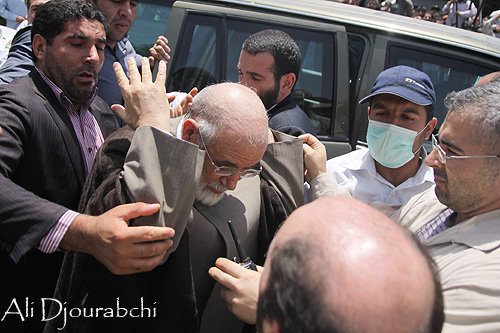
Photo above said to be of Mehdi Karroubi losing his turban in a confrontation. A reader points to a story on the attack:
It seems true. BBC Persian had an article on it. Will translate in a few minutes, but the gist of it is that they have attacked him verbally and took his turban (the symbol of clerics) from his head.
by Chris Bodenner
And just in time for Andrew's return:
Planning inauguration w/LtGov in 10 days, Frbanks. W/same cabinet, same positive pro-AK agenda it’s all good, consistent success bc everyone
elected is replaceable;Ak WILL progress! + side benefit=10 dys til less politically correct twitters fly frm my fingertps outside State sites
(Hat tip: Evan McMorris-Santoro)
By Conor Clarke
I started reading Peter Singer’s big New York Times Magazine piece on health-care rationing expecting to be at least a little annoyed by the time I got to the end. But it didn’t happen! I agree with most of what Singer — the famed utilitarian — has to say, largely because Singer doesn’t say a whole lot about the specifics of the current health care debate, and because his general points seem pretty obvious and anodyne. Mostly, we learn that it is both necessary and difficult to set an implicit dollar value on human life when allocating scarce goods and services that increase safety or improve longevity. Swell.
But I do think the piece has one especially strong argument against the idea that “rationing” is something unethical or un-American or just downright Canadian. And that is Singer’s description of what our government already does:
Why indeed?
by Patrick Appel
Nico does his best to figure it out, with the help of his readers:
by Conor Friedersdorf
Strange as it seems to say it, The Atlantic’s move to Washington DC irrevocably changed the course of my life. Were the magazine in Boston, I’d have gone there to intern after graduate school, and today my biography would include different sets of lovers, jobs and friends. Blessed as I am by the way life turned out—specifically for meeting the kinds of people one wouldn’t trade for anything—I’d thrill in departing the nation’s capital tomorrow if I could toil for this magazine and leisure with select company elsewhere. I’d doubtlessly miss certain people. But I wouldn’t miss this city, or the way things work here.
What do I mean by those words?
It’s a bit complicated to explain. There is this idea among movement conservatives—especially the rank-and-file—that Washington DC journalism is populated by a lot of disingenuous, careerist sell outs. These elites write to enrich themselves, to inflate their sense of self-importance, and to garner social capital, invariably measured by invitations to the dread “Georgetown cocktail party.” Thus they are unconcerned with truth, intellectual honesty, or the actual interests of anyone outside the New York to DC corridor.
This narrative is largely true! Anyone who pays close attention to DC journalism can easily spot intellectually dishonest hacks writing stuff they don’t actually believe, whether to advance their careers or to further a political agenda by the most cynical means imaginable. A blogger could write five posts a day fisking political journalism that is either astonishingly ignorant or disingenuous – and a Washington DC journalist doesn’t have to attend very many happy hours to hear people basically admit that they are hacks who don’t actually believe significant parts of their oeuvres. What vexes me, having observed this game over the last couple years, is that the people accused of being inside-the-beltway sellouts are often the folks who write exactly what they believe; whereas the kinds of publications that rank-and-file conservatives revere for “never selling out” actually do so all the time.
One day I’ll give this subject a lengthier treatment, where I have the kind of space needed to levy serious critiques in a manner fair to all those involved. Here I’ll keep myself to two examples for the sake of brevity. A writer I’ve been privileged to meet, due to my association with The Atlantic, is Ross Douthat, a religious conservative whose opinions on all sorts of matters I disagree with rather vehemently. Were I editor of any serious publication, however, he is among the first writers I’d try to recruit – keenly intelligent, fair-minded and willing to forthrightly engage his critics, Mr. Douthat is precisely the kind of political and philosophical adversary worth having. I cannot recall ever reading a single sentence he’s written that is intellectually dishonest or contrary to his actual judgments on the matter at hand. Some critics nevertheless pillory him for being just the kind of Inside the Beltway character I describe above. It drives me to distraction every time I see it.
On the other hand, there is Human Events, a movement conservative publication that enjoyed its heyday during the Reagan Revolution. Today it is owned by Eagle Publishing, and publishes Ann Coulter. “The powers that be (on both sides of the aisle in Washington, not to mention in caves along the Pakistani-Afghan border!) most certainly do NOT agree with everything we say,” its About Us page brags. “Especially when we reveal the true motives behind their actions.”
Some months ago, I published a post at Red State asking Human events readers to e-mail me explaining their affinity for the newspaper. The consensus among those who responded: whereas so many other politicians and publications sold them out over the years, Human Events never has. It is evident why they think so. The publication gives voice to certain conservative perspectives given short shrift elsewhere in the media. How does Human Events use the trust and loyalty it's engendered by its approach? Judging by the fundraising and advertising e-mails I've received from the publication, one answer is that it cynically exploits the fears and prejudices of its readership, abetting efforts to part the least savvy from their cash. Partly I mean that the publication is guilty of commonplace sins like regularly implying that the Democratic Party has secret plans to reinstate the fairness doctrine in order to spur fundraising efforts ostensibly directed at pushing back against that imaginary endeavor.
More seriously, the newspaper/Web site sends out under its masthead advertisements (clearly labeled as such) that are among the least ethical I've ever seen in a journalistic publication. Their only caveat (emphasis added): "From time to time, we receive opportunities we believe you as a valued customer may want to know about. Please note that the following message does not necessarily reflect the editorial positions of Human Events."
A lesser example is the August 8, 2008 blast noting that "Current real estate market will yield huge profits for investors who buy pre-foreclosures." A publication that counted that as their worst advertisement might be given the benefit of the doubt. But surely it must be withdrawn upon considering that Human Events, with its largely elderly subscriber base, sent out on November 20, 2009, an advertising e-mail that began "What if I were to tell you that a billion-dollar drug company discovered a true CURE for cancer… and told no one? It gets worst…what if they put this miracle cure under lock and key, with no intention of telling anyone ever?" Or that in an earlier advertisement that began by asking folks, "ARE YOUR LUNGS DYING?" these same e-subscribers were told, "With just minutes a day – you can use my technique to give you the lungpower of a 20-year-old. And with all that EXTRA oxygen and cardiovascular power, you'll REAWAKEN the energy and vitality you had years ago – even if you're past retirement."
And my personal favorite?
Dear Reader,
Can I speak to you in confidence…?
Thank you. It's one of the conditions I was asked of by an insider I'd like to introduce you to in just a second
So he's an insider? Yes. But although that in itself means there's money to be made here, it goes a LOT deeper…
Once in a blue moon, you have a revelation. Something which makes you kick yourself and ask: "I can't believe I've been so blind! How could I have missed this?"
So you think this might be about trading shares or commodities? Think again! You're about to walk into a whole new investment world; the LARGEST and most amazingly uncomplicated trading on the planet!
A mountain of solid-gold has passed us by for a long time… but not anymore!
This insider slapped a brown paper envelope on my desk- a highly confidential report. I read… and realized I was about to make a select number of my subscribers the proposition of a lifetime… so here I am.
I must warn you though, what you're about to read is… well, a little stirring. Just remember though, it's ENTIRELY legal (or I wouldn't be mentioning it to you!) and completely factual.
Readers are subsequently sent here. (It's hard to know whether to be angry or to laugh.) Let us grant that magazines aren't responsible for the ethical behavior of all the companies who advertise through them. Surely, however, there are two sides to that hazy ethical line, and these advertisements are easily on the wrong side of it. You might even say that this is precisely the behavior of a publication that doesn't mind selling out its readers. As yet, however, I haven't heard Eagle Publishing called out on the Rush Limbaugh or Mark Levin program as being a bunch of cynical Inside the Beltway elites (do note that Eagle Publishing and Human Events are large enterprises that employ all sorts of ethical people, many of them no doubt uncomfortable with this behavior).
I'll merely add that it is very difficult to write for the publications where Mr. Douthat made his mark — the print Atlantic, the print National Review, The New York Times — and comparatively easy to write copy for Human Events, Newsmax, Townhall, or any number of other places where a talented twentysomething actually interested in maximizing their profit per hour worked would write all their copy, if they really didn't care about anything else.
Though I don't plan to make my life in Washington DC, I wish the right-leaning critics of its journalistic culture would come visit before I leave, make themselves flies on the walls at various social gatherings, and observe who it really is that stays true to themselves in their writing — and who views their work as a political writer in the most cynical, careerist terms imaginable. They'd realize that they've got everything exactly right, and exactly backward, at the same time. It is merely another example of a need for the right to better identify its elites, and demand better ones.
by Chris Bodenner
A reliable twitterer in Iran:
Karoubi attacked by the plain cloths http://www.etemademelli.ir/…
The plain cloths attacked Karoubi in such a way that his turban fell.
Karoubi’s son: The plain cloths who attacked my father were congratulated by their commander on their radio!
by Patrick Appel
Joe Klein tries to make sense of this morning's events in Iran:
So what does this mean? As an Iranian friend of mine predicted yesterday, this means that Rafsanjani intends to lead an Iranian opposition front to the Khamenei-Ahmadinejad government. Given his stature–he is the one opposition leader who is part of the regular Friday Prayer rotation–this seems a clear indication that Iran remains something less than a totalitarian state, controlled by the Revolutionary Guards. The question now is: how broad an opposition front? Will it include people like Mohsen Rezaie and Ali Larijani, conservatives who are at odds with Ahmadinejad, as well as the Green Revolutionaries? Will it include conservative newspapers like Resalat, which have been critical of Ahmadinejad? Will it be able to moderate the ruling junta in any way? There's no way to know…but it is good to know that the struggle in Iran continues, and may now have an organizing force.
By Conor Clarke
Matt Yglesias says that CBO director Doug Elmendorf's testimony yesterday morning (in which he said the House is not proposing "the sort of fundamental changes that would be necessary to reduce the trajectory of federal health spending by a significant amount") is going to change the health-care debate. In particular, Matt says that "Elmendorf’s words will now help [Senator Max] Baucus, the [Senate] Finance Committee, and taxing health benefits all get back in the game."
I hope that's true! The idea of taxing health benefits was floated by Baucus a couple of weeks ago, but torpedoed before you could say "complicated tax loophole." But it really should come back in fashion. Capping the health-care tax exclusion is a fantastic idea — one we should be pursuing even in the absence of the current health care debate. A little background: The employer-sponsored insurance (ESI) exclusion means that when your workplace supplies you with health care, or pays part of the cost of health insurance, it' is not considered income and you pay no tax on it. This has been described (accurately I think) as the single largest subsidy in the tax code: The government forgoes $250 billion a year to keep it around. That's a lot of money. It's also a lot of money going to a bad cause.
Why is it a bad cause? Four reasons:
First, the ESI exclusion is unfair. If your employer doesn’t offer health care, or you don’t have an employer, you have to pay for your health insurance with after-tax dollars. If you are self-employed, you can deduct your insurance premium from the federal income tax, but not the federal payroll (Social Security and Medicare) tax. Unless there is some reason we wish to encourage people to work for big companies with lavish fringe benefits — and there isn’t — this discrimination makes no sense.
Second, the exclusion is unlimited. Even the most lavish and expensive health care plans are fully tax-free. That means the benefit of the exclusion goes disproportionately to better-off employees — the ones who need help the least.
Third, the exclusion traps people in their current jobs, usually when their current employer offers better insurance than a potential one, or especially if an employee or family member has a “pre-existing condition” which will be excluded from coverage in the new job. This also is unfair and inefficient.
Fourth, when one product or service gets special tax treatment that most others don’t, it artificially encourages people to consume more of that product or service than they otherwise would. And it is easier for suppliers of that product to raise prices. Because of the exclusion for employer-paid medical care, employees consume more health care and suppliers charge more for it. This is inefficient and especially unfair to those who don’t have employer-supplied insurance, since they get no subsidy but are stuck with the higher prices anyway. (And of course it is the last thing we need as we try to moderate health care costs.)
In my opinion, getting rid of the ESI exclusion is a no-brainer, at least when we'd be using the additional revenue to fund comprehensive reform. If only the unions, the rest of the Senate and President Obama would agree!
 The Dish