
Brooklyn, New York, 12.03 pm
Brooklyn, New York, 12.03 pm
by Patrick Appel
A reader writes:
I'm a little bothered by how many people are attacking Clinton over his (possibly new) position on gay marriage.
When Colin Powell's position shifted, it was heralded as a sign of the times; proof momentum was here and it was time to finish the fight. President Obama's position is not only against gay marriage (sorry, no Federal benefits for gay couples unless you work for Hillary…how's that for some irony?) yet the lip service he pays to extending and addressing gay rights are then followed up with the coldest of shoulders.
I think it's fair to hold former President Clinton accountable for sleights both perceived and real. I don't think it's fair to take him to task for being able to evolve his opinion more now that he's not in the middle of a political bloodbath where he has to carefully consider his every word and action lest he lose even more votes to Newt's revolution. Isn't it a little ironic that we're holding the former President to a different standard than the sitting one?
I've read so many pieces by Obama apologists saying he really does support gay marriage but can't afford to spend so much political capital on it — and that's why his public position is negative. I've read opinions saying he's working behind the scenes to line up every domino he can. I've also seen a couple of pre-emptive apologies saying he'll push harder for it once he's out of office; his hands are tied by healthcare and the economy and we're just going to have to wait in the back of our bus for the right time.
For all this, President Obama's most effective time in office is drawing closer to its end and his focus is squarely elsewhere; even if it were not, he hasn't indicated he's willing to push for fully equal protection.
We can make excuses all we want to try and demonize former President Clinton, but his political world was vastly different than Obama's. He was embroiled in a scandal, his party's power was waning, and he was effectively being held hostage by Republicans. Even before the massive losses in the House and Senate, Democrats had much less legislative backbone and were busy trying to appear to be Republican Lite to keep seats and not offend the delicate sensibilities of their constituency.
Whether Clinton is throwing his full weight behind the issue or not, it's still more than I'm getting from President Obama. I'm grateful for whatever support he's willing to lend us.
I take all the points about Obama and have never been one to excuse the president's actions (or lack thereof), but former president Clinton is obscuring the substance of his record on gay rights. He needs to admit that section 3 of DOMA was wrong. He needs to recognize that DADT is a failure. It's good to have Clinton say nice things about marriage equality, but let us not pretend he has recanted fully and forgive all past sins.
by Chris Bodenner
Abbas Milani surveys the landscape of the Iranian president’s second term:
There are already signs that the Islamic Republic is losing much of its influence in the Muslim world. The Iranian-backed Hezbollah lost the recent election in Lebanon, and there are hints that Hamas might be inching towards an alliance with the Palestinian Authority. Some radical Sunni groups like the Muslim Brotherhood, who had earlier been flirting with Iran, are now voicing criticism of Iran’s flawed election. Perhaps most significantly, the regime’s Shiite allies in Iraq–from Muqtada al-Sadr to Ayatollah Sayed Mohamad Baqir Al-Hakim [to Ayatollah Ali Sistani]–are also distancing themselves from their Persian patrons.
Ahmadinejad, buoyed by support from Khamenei and the IRGC, will still have a relatively strong hand heading into his second term. But the continued defiance of the Iranian people and an increasing number of the Islamic elite, dire economic realities, and a rising chorus of criticism from democracies all around the world make it highly unlikely that Ahmadinejad will be able to ignore reality for very long.
by Patrick Appel
Amazingly, the GOP rump still loves Sarah Palin.
I've come out in favor of non-comprehensive, piecemeal health care reform, so I ought to suggest at least one discrete policy change. Unlike some conservatives, I haven't any ambition to eliminate the FDA, but I do think that when it comes to the trade-off between approving drugs that hurt people and slowing down drugs that help people, it does the latter more than is optimal.
The solution? The United States should also consider a drug approved so long as it passes muster in certain other countries that we regard as having perfectly acceptable evaluation systems. Say that ended up meaning the European Union and Japan. The effect would be to lower the cost of getting drugs approved, thereby increasing innovation, and offering consumers a choice they wouldn't otherwise have predicated on accepting a risk that they'd be apprised of beforehand.
Though I remember reading something like this before, I cannot find it on the Internet for the life of me. That's too bad. Someone who knows more than me about drug approval could sketch a more sophisticated proposal. But I'd be curious to hear any objections to the core idea.
by Chris Bodenner
I just wrote a fun little piece for the Atlantic.com examining the cultural breakthrough the Wii has had in nursing homes and what it could mean for the gaming industry:
Sales of video games — an $8 billion industry once thought recession-proof — have plummeted in 2009. May alone showed a 23 percent drop from the same month last year. And the horizon looks bleak, since disposable income tends to tighten in an uncertain economy. The industry, therefore, would be smart to look to a new, seemingly unlikely, audience: the 80 million Baby Boomers entering old age..
Seniors today are already using the Wii not just for entertainment but to help fend off physical and mental infirmity. It's becoming so popular that retirement communities are using it to lure new residents, evidenced by the promotional video above.
by Patrick Appel
DiA responds to Conor Clarke:
Many of the events that have broken down (or erected) religious, gender and racial barriers in America have occurred as a result of court opinions. The court has corrected a number of the historic disadvantages faced by certain groups that Mr Clarke says are worth correcting. If these groups had been better represented amongst the justices in the past, the changes may have come quicker. So, for the sake of opportunity, I'd say it's useful to try to make sure historically disadvantaged groups are represented on the court, as long as the quality of the court is not degraded as a result.
Now, that doesn't necessarily default into an argument for racial diversity, over religious or gender diversity. Disadvantaged groups come in all forms and one has to take stock of time and place. But right now, in America, the pick of a Latino woman seems like a pretty good choice.
But doesn't the near abolishment of de jure discrimination for certain groups almost always proceed their selection to this type of high office? I'm not arguing that racism or sexism don't still exist (they certainly do), but Sotomayor's nomination would have been much more significant fifty years ago when large contitutional questions about race and sex remained. Ricci is fairly minor when compared other decisions regarding descrimination.
By Conor Clarke
This 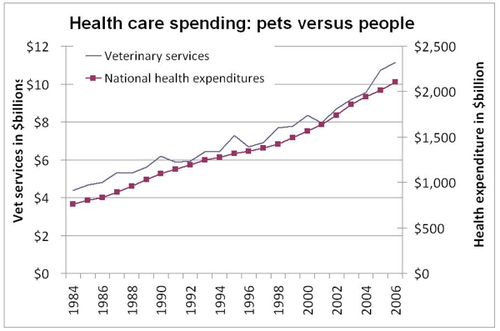
And it's gotten approving [update: and skeptical!] chirps from Megan McArdle, Tyler Cowen, Jim Manzi, Arnold Kling and Greg Mankiw and others, a good deal of whom parrot the old line about how this shows that "The reason that we spend more [on healthcare] than our grandparents did is not waste, fraud and abuse, but advances in medical technology and growth in incomes." If it were waste, fraud and abuse, wouldn't you see the difference in the animal market?
But let's not flap about this too much. The chart is hounded by some fatal problems. John Schwenkler gently badgered me into trying to make a new version of this chart that deals with some of them, and I've been monkeying around with the data for the past couple of days. But, for reasons I'll grouse about after the jump, I can't reproduce a better version of this chart. (Scott Winship and Zubin Jelveh have ferreted out some of the missing data.) What I can do is graph the growth of pet food spending over the same period, and then list some of the reasons why the original chart doesn't prove much at all. (And cut out the dumb animal puns.)
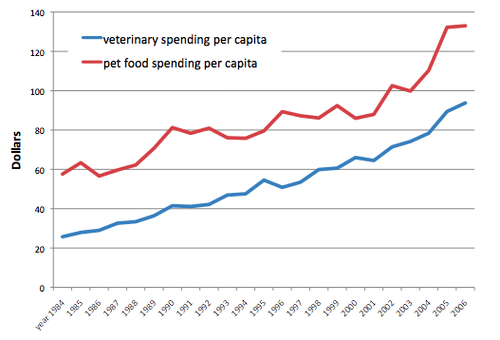
1. This data is drawn from the same source (the Consumer Expenditure Survey) as the original chart. The raw slope of the pet food spending line is actually higher than the raw slope of the veterinary spending line. The normalized slope of the veterinary care line is a bit higher, but both are higher than average economic growth over the same period. Does this mean there is something unique about the two health markets, or something unique about the two animal markets? Or neither? I have no idea.
2. As Schwenkler and Manzi and others have pointed out, the original chart does not have per capita data. But of course we only care about how much is being spent on health care per person or dog. If the population grows quickly, the overall level of spending will grow with it. (Incidentally, this is why I'm having trouble reproducing Biggs' chart exactly: I can't find the number of total pets per person in the country between 1984 and 2006. And, to be extra cautious about it, I'd also need to know something about how the population has changed — more ponies or parakeets or whatnot.)
3. Even if the chart made the same point on a per capita basis, I'm not sure why it would be surprising. You don't really have insurance or adverse selection in the veterinary market. But you do have large information asymmetries (the vets know more), large demand uncertainties (the need for veterinary care springs up uncertainly), large supply constraints, and a whole series of new patent-protected treatments that can lead to market failures.
4. Even if none of the problems in # 3 turn out to exist, I'm not sure why the growth of veterinary spending is a point in favor of conservative theories about the growth of health-care spending. Two of the most commonly cited conservative reasons for the rise in health-care spending are (1) The tax exclusion for employer-sponsored health insurance; and (2) malpractice liability, which is supposed to lead to defensive medicine and higher costs. But neither of those things happen in the veterinary market! If the original chart is correct, then are these things not really problems?
My overwhelming suspicion is that the chart does not tell us much that is useful about the market for medical care. I spoke with Andrew Biggs yesterday, and he very kindly shared his data from the expediture survey (which is not publicly available). He also cautioned against taking any of this too seriously. 700 words and two charts later, I agree.
by Chris Bodenner
Palin apparently sees herself as a bear (don't tell Andrew):
Great day w/bear management wildlife biologists; much to see in wild territory incl amazing creatures w/mama bears' gutteral raw instinct to
protect & provide for her young;She sees danger?She brazenly rises up on strong hind legs, growls Don't Touch My Cubs & the species survives
& mama bear doesn't look 2 anyone else 2 hand her anything; biologists say she works harder than males, is provider/protector for the future
by Chris Bodenner
Peter Suderman, trying to make sense of Palin like the rest of us, settles on three major traits: ambition, incoherence, and paranoia. Regarding the latter, he points to a now-familiar story containing a key detail the Dish had missed:
After hearing someone from a crowd shout a derisive remark about his membership, Palin sent an email to Schmidt grossly exaggerating what had happened, saying that she'd seen protester signs and received questions about her husband's [Alaska Independence Party] membership from multiple reporters. She wanted a statement released addressing the issue. But the statement she wanted released — that secession isn't part of the group's platform and that Todd's membership was an "error" — was untrue.
Schmidt called her bluff and refused to send out any statement about Todd's membership, arguing that doing so would only draw attention to what was really a non-issue.
The incident seems revealing: Palin, faced with a single comment in a rope line, built up substantial threat in her mind where none previously existed and then attempted to readjust the facts of the case to make her and her family seem more victimized.
Now imagine a President Palin perceiving a slight from the likes of Ahmadinejad or Kim Jong Il.
 The Dish