Keep It Simple?

by Patrick Appel

Publius responds to Conor Friedersdorf's plea for shorter, simpler legislation:

I think the government sometimes has to pass big complex legislation.  Assuming you accept that premise, then you should prefer Congress to go ahead and spell all this detail out.  Otherwise, the questions would be shifted to the agencies — where non-transparency and capture are a trillion times worse.

I side with Publius on this. Also, as a friend who works on the hill pointed out to me, there are often politically unpopular but necessary parts of comprehensive bills that would never get passed on their own. Compromises have to be packaged together. An example: funds to hospitals are being cut as part of health care reform. These cuts makes sense in the context of the bill but no representative is going to sign onto a bill that cuts payments to hospitals and nothing else. The attack ads write themselves. I fully endorse Publius's other point:

I'd like to see a waiting period between the final release of legislation and the vote.  The public could then go all "Army of Davids" on the legislation, which would enhance transparency, democratic deliberation, etc.

The Abortion Debate: What’s the Role of Men?, Ctd

by Patrick Appel

A reader writes:

Thanks Conor F. for highlighting what seems to me to be a clear gap in the debate on abortion. I had the same thought myself about a decade ago when a law undergraduate at Cambridge. I wrote a thesis for my finals entitled "Should Fathers Have Any Rights In Abortion Law?". My interest in this topic stemmed from a general desire to understand my own feelings towards abortion at a time when I was moving away from Catholicism and towards atheism, and an overwhelming feeling that there was something manifestly unjust in a father of an unborn child having no say whatsoever in whether that child lived or died.

With some regret, the conclusion I reached was that whilst (of course) in the ideal liberal world you describe any decision like this should be taken by a couple together, enforcing any sort of formal role for a father would be both impractical and unwise. This is because any decision taken affecting the welfare of a fetus also affects the body of the mother. Anything medically done to the mother without her consent is an assault. What if a mother is compelled, as a result of the father's wishes and her own, to carry a child to term and then dies in childbirth? If nothing else, the possibilities for litigation are endless. On a practical note, interfering the genuine choice of the mother in this situation (whether because of the father's wishes or society's) will plainly lead such women back into the dangerous world of backstreet abortions.

The time when this debate becomes interesting, in my view, is when science reaches a point where a fetus can be brought to term outside of a women's body. With present progress in medicine I do not think this is a purely science fiction "what if"? In that situation the women's' right to make decisions on what happens to her body falls away and much more careful consideration would have to be given to the legal status and rights of the fetus and the father than is the case now.

At present, I regret that my view fathers are in a manifestly unfair position, but that trying to do anything about this formally would cause more problems than it solves.

Another reader gets personal:

About 16 years ago, I was dumped from a serious relationship. I was heartbroken and it took me years to recover. About three weeks after the break up, she approached me and told me she had, just after the break up, discovered she was pregnant and went ahead and had the abortion. She wanted to me to pay for half, even though she had insurance, because that would be "fair". Of course, I paid.

I support a woman's right to make that choice, but it still really hurt that she never consulted me beforehand. There were cruelties: around this time she took up with a "friend" of mine, and they were never honest with me about it or the chronology. They eventually married and had one child of which I know. I wish I could say I wish them well, but I am still bitter. Rationally, I know I am better off that I didn't marry such a cruel, selfish, and inconsiderate person. But it still hurts, even 16 years later.

The abortion is just one element in my sad little tale, but I did and do think it was wrong of her to tell me after the fact. At the time, it just made me even more miserable. I'm not saying I had a right to input on the decision, but I think I was due a little consideration.

Ah, well. Ghosts of the past.

Another reader gets practical:

Raising money for an abortion is reasonable and to be expected. Even if you go to Planned Parenthood, they're not cheap, and unless you live in a major metropolitan area, you've got to include food and gas money, and probably a hotel room, since after having an abortion, you probably don't want to hop right back in the car for a two to eight hour drive, depending on how far out in the boonies you are. I always figured that as a gay man, I'd be far from the action on this debate, but in college, my straight best friend got his girlfriend pregnant, and I ended up paying for her abortion. From Roswell, New Mexico, it was a four hour drive in any direction to the nearest clinic (Albuquerque, Santa Fe, El Paso, maybe Las Cruces or Lubbock), so they chose the money saving option and went to El Paso, crossed the border into Juarez, and saved a couple hundred bucks.

Another:

Conor, you write:

"As I understand it, the most common position on the left is that how a woman deals with an unwanted pregnancy is a choice to be made by her alone. At the same time, the progressives I know subscribe to a partnership ideal in relationships, wherein major life decisions between couples are made via a process of mutually supportive dialogue, stripped of archaic gender norms whenever possible."

You seem to argue in good faith, so I'll spare the snark, but those two ideals aren't in opposition. The final -choice- is hers alone, but that doesn't preclude dialogue, or even argument, tantrums, graphs, etc.

Try this: "As I understand it, the most common position on the left is that how a woman deals with an unwanted DOUBLE-CHIN is a choice to be made by her alone. At the same time, the progressives I know subscribe to a partnership ideal in relationships …" The couple might talk about her impending plastic surgery, they might fight and argue and wheedle–but in the end, the woman decides what elective medical procedures she undergoes. It's really that simple.

And it works both ways. "As I understand it, the most common position on the left is that how a man deals with a VASECTOMY is a choice to be made by him alone." My wife and I are currently arguing this one. I listen to her opinion because I respect nobody more–just like she'd listen to me, in the case of an abortion. But it's still my decision.

One more:

The only proper response from a man when his lover tells him she's pregnant is: "Okay, do you want to do it? Because if you do, I'm right here."  Any man who says, "What are we going to do about it?" sounds like a jerk incapable of leadership or support. Any woman who hears a man say that is going to want to spontaneously abort as soon as she hears it.

It's unfair, but heterosexual relations are unfair, and a man's responsibility should always be up front: "If you ever get pregnant, I will stand up and meet my responsibilities, period."  A woman has to know that, because otherwise she will be hesitant to go through with it.  But even though a man has to be willing to follow through just as described, if the woman does want to abort, he has to let her do that, too.  Like I said, unfair.  Of course, straight couples where the woman goes ahead and has an abortion frequently break up, but, that's another issue.
A Turning Point?

by Patrick Appel

Joe Klein previews Friday:

There's lots of speculation about what Rafsanjani might say. One Iranian friend said, "It's the speech of his life, a chance to redeem his career. He must call for the rejection of the election results." Unfortunately, that's never been Rafsanjani's style and is an unlikely alternative now. But he and his family are also too closely identified with the protest movement for him to just acquiese and kowtow to the Revolutionary Guard Corps-dominated government. Another Iranian friend predicts, "He'll announce the formation of a political front that will work within the system but oppose the Ahmadinejad government." That seems more plausible.

We’re Number One! – Of Many

by Chris Bodenner

Peter Scoblic sat in on Clinton's address yesterday:

The key idea of the speech was that, because no nation can meet modern threats like proliferation and climate change on their own and because most nations worry about those threats, the United States should establish an "architecture of global cooperation." […] Clinton made clear that she was looking for something beyond containment, unilateralism, or balance-of-power realism. What's more, the administration is clearly not relaxing its emphasis on engagement with rogue regimes despite criticism over its handling of Iran's elections, because "[a]s long as engagement might advance our interests and our values, it is unwise to take it off the table."

Finally, Clinton emphasized the essentiality of American leadership to global cooperation–"just as no nation can meet these challenges alone, no challenge can be met without America"–which I think is important both because it's true and because it represents a constructive interpretation of American exceptionalism that can be leveraged to our benefit.

Reality Check

by Patrick Appel

Pollster.com just added a new chart. Mark Blumenthal cautions, "Keep in mind that for the moment, only two national surveys have measured Palin's favorability since her resignation announcement":


Update:

Mark Blumenthal e-mails:

A clarification: On Tuesday, when I wrote the post you linked to, we had only two new national surveys that had updated their Palin rating. As of this morning, however, we have three more: USA Today/Gallup, Diageo/Hotline and YouGov/Polimetrix. So we have more confidence now in the "nose" of the trendline.

Why Are People Waiting to Marry and Have Kids?

by Conor Friedersdorf

Ben Domenech laments that Americans are delaying marriage and reproducing less prolifically than they once did:

For the most narcissistic among us, the problem is even reaching a point in life where marriage and reproduction are viewed in positive terms. As Kay Hymowitz has pointed out in a recent series of articles in The Manhattan Institute’s City Journal, “in 1970, 69 percent of 25-year-old and 85 percent of 30-year-old white men were married; in 2000, only 33 percent and 58 percent were, respectively.” This demographic shift has now pushed the median age of marriage for white males to nearly 28 — if they get married at all — further delaying fatherhood and motherhood.

Hymowitz offers several complex reasons why this is the case. But I

say the simplest answer is true: American men today delay the act of reproduction and union because they devalue it. Because technology and culture (today, technology is culture) unite to encourage them to devalue it — to favor distraction over maturity, personal growth over familial growth, and self over society.

Is the simplest explanation really that people today want fundamentally different things out of life? I think not.

Mr. Domenech goes on to argue that "Within the next few years, the American male will hit the highest median age for marriage in the history of the country. Perhaps this is a product of the new economy. Or perhaps it is the result of a media-altered vision of womanhood – young men who have an airbrushed vision of the opposite sex in mind can become reluctant to settle for normalcy and the face to face of the real world."

In my experience, most of the folks who are delaying marriage and family do want those things eventually. So why wait? Let me air some alternative explanations. Birth control is one factor. By decreasing the cost of sex, it changes social mores and lessens the benefit of marrying earlier (as does the related decline in the taboo against premarital sex). The rise of career women — now dubbed "women" — is another major factor. Given choices and opportunities beyond being a married homemaker, it is no surprise that many women rationally decide to exercise preferences unavailable to their ancestors — preferences that require intense career focus during one's early to mid-twenties if ambitions are to be fulfilled. 

I'd also like to push back against Mr. Domenech's culturally driven arguments, which seem to assume that delaying marriage and family imply devaluing those things. Maybe that's happening, but I'd argue that the opposite is going on too. Young people in the middle and upper classes in America delay marriage partly out of a desire to avoid the rampant divorces that plagued their parents' generation. The conventional wisdom that some folks "just married to young" leads to years long relationships wherein the participants are cautiously "making sure" that they are "ready to get married." They may be right to do so!

Reproducing is even more fraught. Young people raised by relatively prosperous Baby Boomers know that if they reproduce in their early twenties, it is possible — even likely — that they'll be unable to afford their children all the same advantages they remember. Even among my Catholic high school friends who married young and desire children, there is a widespread practice of waiting many years to do so, a period that is one of financial and emotional preparation. The middle class notion of what it means to be a good parent is simply much higher today than it was in the past. 

I'm uncertain about whether these trends are demographically problematic, but let's imagine that they are. It is quite possible that later marriage and child bearing is bad for society as a whole, but good for the vast majority of individuals who do it. In any case, I am very suspicion of the "cultural decline and narcissism" narrative advanced by the piece. "In any case, we have now reached a point where parenthood, something that has been an expected and lauded part of the American life, is now viewed as inessential or even unfortunate," Mr. Domenech writes. Does that ring true to you?

Her Father’s Daughter (Mostly)

by Patrick Appel

Meghan McCain is not a fan of a certain plumber:

Shortly before McCain sat for this interview, Samuel Wurzelbacher, aka Joe the Plumber, gave an interview to Christianity Today in which he complained about “queers” and declared, “I wouldn’t have them anywhere near my children.” Unprompted, McCain rails against the man her father’s presidential campaign touted as an American everyman and made a showpiece in the weeks before the election. “Joe the Plumber — you can quote me — is a dumbass. He should stick to plumbing.”

This bit about Cindy McCain was also news to me:

Being free of a presidential campaign’s constraints has liberated [Meghan] McCain to speak her mind, but the true impetus for her current gay rights activism was the passage of Proposition 8 in California. On election night last November, McCain was understandably consumed with the results of the presidential race and, like many, “assumed that Prop 8 wouldn’t pass.” The next morning, however, she woke up in an already sour mood made worse by her BGF (best gay friend) Josh “telling me that on top of everything else, Prop 8 passed.” Like many others, McCain was swept up in a collective sense of grievance, quickly concluding that making the GOP more gay-friendly would be foremost among her priorities. (For the record, Meghan isn’t the only member of the McCain clan to support gay marriage. “My mom was always for gay marriage, but I think me being so vocal about it has made her want to be more vocal about it,” she says. “She texted me: ‘Gay marriage passed in Maine!!’ ”)

Kirchick, elsewhere:

Interestingly, while McCain is more than happy to bash the man whom her father celebrated for weeks on end, the one part of the campaign McCain will not talk about is Sarah Palin.

Another Bad Argument Against Taxes

By Conor Clarke

Here's one from The Cato Institute's Chris Edwards, who describes the House plan as a "Socialist Surtax for Health Care" (what the heck makes something socialist, anyway?) and says that "what’s striking is how far American economic policy is moving to the left of policies in other major nations." By "other major nations" he means, of course, those socialist fools in Europe. Edwards goes on to argue that the new surtax (plus some other Obama tax increases that haven't been enacted yet) would "push the top [American tax] rate to 51 percent, which would be higher than many nations that were traditionally more socialist than America, including France (46%), Germany (48%), and Italy (45%)." Socialism!

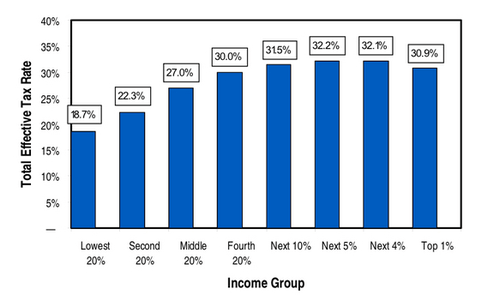
But can you spot the sleight of hand? Edwards is talking about the top marginal income tax rate, not the total effective tax rate. The marginal income tax rate is what applies to your last dollar of of wage income. The total effective rate is what you pay on the average dollar of any income. Marginal rates matter, of course. But they also kick in at different levels and are offset by a variety of other policies. The total effective rate gives you a much, much better sense of how the government nibbles away at your earnings. (For a quick example of how easy it is to be mislead people by talking about marginal rates: the top rate in the 1950's was higher than 90%.)

Why is there such a difference between effective and marginal rates? One reason is that we tax capital gains and dividends at a lower rate than wage income. (This is why, for example, Warren Buffett complains that his secretary taxes at a higher effective rate than he does: so much of his income is from dividends and capital gains.) It's also why, when you look at the distribution of effective rates, the tax system looks a lot less progressive (excuse me, socialist) than it otherwise would:

Total effective rates

(Chart is from the Citizens for Tax Justice; my original write-up is here.)