by Patrick Appel
From Iran state news:
Iran has proposed a new set of media guidelines to ensure that any criticism of state affairs will not stray from objectivity in the future.
by Patrick Appel
From Iran state news:
by Patrick Appel
Robert Wright tackles the subject:
Wright goes on to explore the contradiction between advocating a certain type of foreign policy while also believing that religion is the root of all evil. Yglesias adds his own two cents.
by Patrick Appel
A reader writes:
Another reader adds:
by Patrick Appel
Fear of A Red Planet compares the uprisings in China and Iran:
by Chris Bodenner
Niagara Falls in Motion from Matthew Wartman on Vimeo.
by Conor Friedersdorf
As I ponder an Obama Administration health care reform bill, whatever that turns out to look like, I am struck by how different the debate is on the left, where Ezra Klein and other wonks are deep in the weeds on health care policy, and the right, where objections to a greater federal role are predicated largely on a general principled aversion to interference in markets and a rapidly expanding state. I'd like to pose a few questions meant to stoke conversation between these groups, and to highlight a couple of my own (possibly mistaken) ideas about health care in America. As I've yet to study this issue deeply, I am persuadable on most points, and I expect some who share my opinions are too.
In sketching out these questions and arguments I'm sure I've made some faulty assumptions, fallen prey to some clever talking points that don't hold up to scrutiny, etc., but I think it's worthwhile to raise certain matters in good faith, if only to narrow the gap in the conversation by airing arguments, weighing rebuttals, and reasserting a more refined position.
by Patrick Appel
A reader writes:

Juneau, Alaska, 11 am
by Conor Clarke
That happened last week, but it's only slowly crawling across the Interwebs. At last week's Campus Progress conference, Bill Clinton was asked if he supported same-sex marriage and responded in the affirmative. It seems to me that this is pretty big news and of interest to Dish readers.
As far as I can tell, Clinton is the highest profile Democrat to back same-sex marriage. He's also the man who signed the Defense of Marriage Act and left us with Don't Ask Don't Tell. So I guess he's a bit of a Johnny-come-lately to the equality party, and maybe he's only showing up for opportunistic reasons. (Most democrats now back gay marriage.) Nonetheless, I'm glad to have him on the right side of this issue.
by Chris Bodenner
A reader writes:
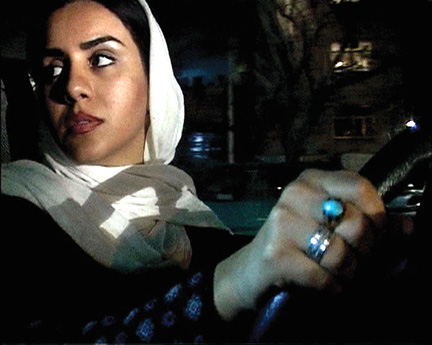
My favorite Iranian film, and one of the all-time greats, is "10" by Abbas Kiarostami. The film, shot in ten scenes from a dashboard camera, features a divorcee driving around Tehran giving rides to people from all walks of life, including an old woman going to mosque and a prostitute. Here's a clip of her with her son, in which they discuss what the father's new wife might be like. The scene centers on how the mother's choices are butting up against what her son thinks a woman's role should be.
The film is quietly funny, quietly moving, with an honest and unmanipulated feel. It envelops you in a trance as it shows the many sides of Tehran circa 2002. The female protagonist reveals herself in layers: headstrong and deferential, self-absorbed and empathetic, and always intelligent and compelling. Lovely stuff and highly recommended.
The Guardian recently ran a profile of the renowned director:
Now 68, Kiarostami has made more than 40 films in Iran in as many years. He is renowned as an artist who stayed in the country after the Islamic revolution of 1979, when others fled abroad. Yet, applying for a visa to direct this month's production of Così fan tutte at the English National Opera, he was asked for a deposit by Britain's
visa office, to guarantee that he would not become a refugee.
Shirin [his latest film] will not be shown in Iran, where none of his films has had a screening licence for a dozen years. Once released abroad, "half-price illegal copies find their way back into the country" as pirated DVDs. "Our government policy is focused on using cinema as a tool of propaganda and religious manipulation, as they've done for 30 years," he says. "Even tolerating independent cinema is unimaginable – they're very suspicious of it."
Kiarostami was born in 1940 in northern Iran. His father was a painter and decorator. "We were many children, with a minimal living, but with peace and quiet. I remember silence at home." After a degree in fine art at Tehran University, he worked as a graphic designer and for a film ad agency before joining the Centre for Intellectual Development of Children and Young Adults (Kanun) in 1969, established by the shah's wife. […] Under the strict censorship of the Pahlavi dictatorship and the shah's Savak secret police, Kiarostami depicted children as stubbornly determined free agents making moral choices, in an education system based on coercion and indoctrination.
His films have also been seen as a cinematic equivalent of Iranian modernist poetry of the 60s. "The calling of art is to extract us from our daily reality, to bring us to a hidden truth that's difficult to access – to a level that's not material but spiritual," he says. "That's what poetry and music do, and that was the first calling of religion. Religion works on some people but not on everyone, because it says, stop thinking and accept what I tell you. That's not valid for people who want to think and reflect. Art is a better way of achieving that, though the aim is the same."
He shared the disillusionment as the 1979 Iranian revolution was overtaken by religious fundamentalism. "I took part in politics only twice: when I was 15 [after the 1953 CIA-sponsored coup against Muhammad Mossadeq restored the shah] and in the revolution," he says. "I'll never take part in any political events again. I'm sure revolution has legitimate motivations, but it's always emotional and irrational. This is what causes legitimacy to be lost. Then evil power comes and takes control, and leads it in another direction."
 The Dish