Reality Check

Blumenthal 

by Patrick Appel

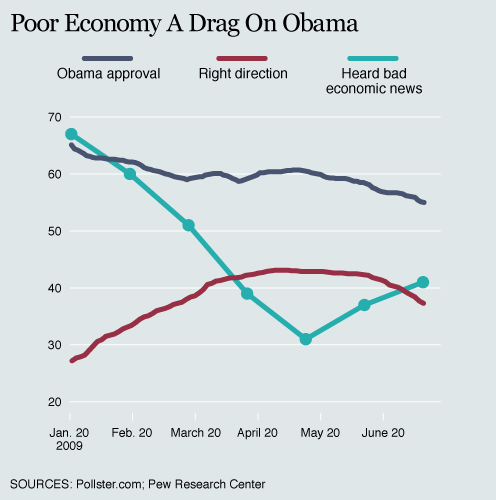
Mark Blumenthal crunches the numbers and finds that Obama sinks or swims with the economy's fortunes:

The apparent relationship between economic news and the president's approval rating is not surprising. "Political science has consistently found that perceptions of the economy are powerful influences on presidential approval," said my Pollster.com colleague, University of Wisconsin professor Charles Franklin. "Surprisingly, people's own job situation is less important than how they view the economy as a whole. Perceptions of the economy are driven by real movement in objective indicators, but it is perceptions that have direct impact on the president's approval rating."

The pattern in Obama's job rating also reflects what pollster Mark Mellman describes as "two tendencies fighting each other." We have a new, personally-popular president facing an economic reality that, barring a quick economic rebound, will drag his numbers down further over the next few months. "Eventually," said Mellman, "gravity will out."

In the long run — meaning 2010 and beyond — where Obama's approval ratings go will depend largely on the direction of the economy.

A Supposedly Tough Sheriff

by Conor Friedersdorf

In The New Yorker, the estimable William Finnegan, whose book on South Africa is a minor masterpiece, goes down to Maricopa County to write a scathing profile of Sheriff Joe Arpaio, who describes himself as the toughest lawman in America. Of course, he is the kind of "tough guy" whose adversaries are handcuffed and guarded by his armed underlings, and who signals his manliness by procuring a military tank to ride on a parade route. But never mind these petty criticism. What really galls are perverse publicity stunts like this one:

In 2005, he forced nearly seven hundred prisoners, wearing nothing but pink underwear and flip-flops, to shuffle four blocks through the Arizona heat, pink-handcuffed together, to a new jail. When they arrived, one prisoner was made to cut a pink ribbon for the cameras. This elaborate degradation, which is remembered fondly by Sheriff Joe's fans, was ostensibly in the name of security–the men were strip-searched both before and after the march. But Arpaio also told reporters, "I put them on the street so everybody could see them."

Elsewhere in the article, we learn how the sheriff manages the jails under his control:

Arpaio ordered small, heavily publicized deprivations. He banned cigarettes from his jails. Skin magazines. Movies. Coffee. Hot lunches. Salt and pepper — Arpaio estimated that he saved taxpayers thirty thousand dollars a year by removing salt and pepper. Meals were cut to two a day, and Arpaio got the cost down, he says, to thirty cents per meal. "It costs more to feed the dogs than it does the inmates," he told me. Jail, Arpaio likes to say, is not a spa–it's punishment.

Of course, lots of criminals inhabit his jails, but they also include people awaiting trails wherein they'll be found innocent. That is reason enough to object to the man's methods. More generally, the citizens who keep re-electing him as sheriff ought to learn that "sadistic publicity hound" isn't a quality you want in a man setting the tone for the treatment of inmates. Elsewhere in the article, we learn about guard brutality, inmate deaths, and federal scrutiny. It's not surprising, given the attitude projected by the man at the top.

I'm grateful for all the attention Andrew has given to prisoner abuse in American run prisons overseas. As shameful is the way many inmates are treated in America, whether in facilities where serial rape goes unpunished, or places like Maricopa County, where voters not only tolerate the most thoughtless kind of faux-toughness, but reward it.

A Hypotheticals Registry

by Patrick Appel

Julian Sanchez has an idea:

[G]iven the transparently partisan way professional ideologues tend to respond to political events, I wish someone would start some sort of Hypotheticals Registry for pundits.  You’d describe, in abstract terms, a potential political controversy or scandal—a program of warrantless wiretaps, an Argentine mistress, an abrupt resignation amid a flurry of ethics charges—and then get the talking head brigade to register in advance how outrageous the behavior in question is. Not that most of them aren’t clever enough to find grounds for distinguishing the actual fact pattern from the hypothetical they responded to when it becomes necessary to do an about-face, but it might at least be more entertaining to watch them squirm a bit.

Waiting In The Wings

by Patrick Appel

DiA makes an important comparison:

In five months, Sarah Palin's political action committee SarahPAC raised $733,000. That's not bad for a governor whose political base in Alaska is not that large, and whose last five months have largely been spent fighting bad headlines and family turmoils. But another relevant number for Mrs Palin might be $1.4m. That's how much Mitt Romney, the erstwhile presidential candidate from Massachusetts, raised in an identical period from January to May.

Romney's plastic focus-group conservatism has always bothered me. Watching him last fall, it seemed like he would flip on any given issue in the pursuit of power. His swipes at fellow Republicans during the primaries didn't land more often than not and made him appear petty. But, compared to Sarah Palin, Romney begins to look more attractive. Perhaps his cringe-inducing pandering to voters would make him more accountable to the public than characters like Cheney ever were. If Palin and Huckabee run they will split the evangelical base and Romney could squeak by. I'd prefer Pawlenty or Crist take a run at the nomination, but I'm not sure either of them want it. Depending on the economic climate, Romney's business acumen could prove a much greater boon the second time around.

Who else is there?

Reading Is Fundamental, Ctd

by Patrick Appel

A reader writes:

The truth is, most legislators don't read most bills, long or short, and no matter how much time they have, something I have learned in 15 years of dealing with state legislators.  That is what they have staff for.  I do object to passing massive bills in short periods of time, especially with placeholders, because it gives so little time to the few voices in the public interest.  Some lobbyists will have read the bill (and made significant contributions) not always a bad thing despite the view that the public has of lobbyists, but the key, and the reason for passing massive bills quickly is to eliminate public comments, complaints, and changes to bills (which are usually a series of compromises).  It's easier for legislators, and they manage to convince themselves that its the best way to do things (rather than say let Andrew Sullivan rile up his readers so that they demand changes).

Another reader argues along the same lines:

It is not for the legislator's sake of reading that this needs to stop. What was put in that 3 AM amendment wasn't a secret to those actively participating in the debate over the bill, in fact often these late amendments are very carefully conceived back room bargains that the major parties have agreed upon. But that's the real issue, all the back door bargaining. Often the interests being represented don't know what they have given up before its too late, but as for the senators and congressman who have been paying attention they know what's in these things. Its foolish to think that they don't read it as they write it. 

Sarah Palin Does Not Understand Cap and Trade

by Conor Clarke

If you're wondering what Sarah Palin will do after leaving the Alaska governor's office, look no further than her op-ed in the this morning's Washington Post. She writes, "at risk of disappointing the chattering class, let me make clear what is foremost on my mind and where my focus will be: I am deeply concerned about President Obama's cap-and-trade energy plan, and I believe it is an enormous threat to our economy."

As a card-carrying member of the chattering class, let me say that I am in indeed disappointed by this development. Not because Palin is showing a greater interest in policy, or because she'll be focusing on an issue that's near and dear to my heart. I'm disappointed because Palin's op-ed displays an ignorance for the subject so profound it's almost gutsy. Almost. Let's start with the big problem:

There is no denying that as the world becomes more industrialized, we need to reform our energy policy and become less dependent on foreign energy sources. But the answer doesn't lie in making energy scarcer and more expensive! Those who understand the issue know we can meet our energy needs and environmental challenges without destroying America's economy.

I don't think cap and trade has many supporters who think it's the best way to become "less dependent on foreign energy sources." (As a sidenote, I'd add that I'm skeptical we should become "less dependent on foreign energy sources" at all, for the same reason I'd be skeptical of becoming less dependent on foreign cars or foreign cucumbers. A "more industrialized" world is an accomplishment of free trade, not a reason to turn against it.) The point of cap and trade is to solve a problem of social cost: As an energy consumer, I am imposing a cost on society (pollution) that I do not take into account when I make the original decision to consume.

This happens all the time. My decision to drive creates traffic that imposes a cost on society. A company's decision to fish in the ocean imposes a cost on the world's common stock of fisheries. A banker's decision to take on a huge amount of risk creates danger for the economy as a whole. The problem is that none of these private actors adequately bears the cost of their decisions. So, the usual solution is to increase the price of these decisions — with congestion charges, or private property rights, or taxes — so that private consumers take into account social costs.

Still, in the case of pollution, there's no denying that a price mechanism will make life more difficult for consumers and energy producers, at least in the medium run. But let's treat this cost honestly! For example, Palin writes:

Job losses are so certain under this new cap-and-tax plan that it includes a provision accommodating newly unemployed workers from the resulting dried-up energy sector, to the tune of $4.2 billion over eight years. So much for creating jobs.

A quick note about the psychology of large numbers: $4.2 billion over eight years is $525 million a year. (That yearly cost is just above the total cost of, I dunno, building a road that Waxman markey and GDP
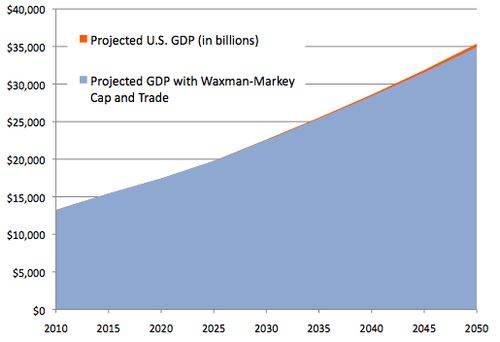
America will remain an incredibly prosperous nation with a cap and trade bill. Indeed, America will be a nation several times more prosperous than it is now! I think this is a small price to pay. Why doesn't Sarah Palin?
Newspapers as a House Fire — Quick, Save the Important Stuff!

by Conor Friedersdorf

In Cato Unbound, Clay Shirky has a sharp take on the future of journalism, but I want to quibble with one of his conclusions (emphasis added):

The journalistic models that will excel in the next few years will rely on new forms of creation, some of which will be done by professionals, some by amateurs, some by crowds, and some by machines.

This will not replace the older forms journalism, but then nothing

else will either; both preservation and simple replacement are off the table. The change we’re living through isn’t an upgrade, it’s a upheaval, and it will be decades before anyone can really sort out the value of what’s been lost versus what’s been gained. In the meantime, the changes in self-assembling publics and new models of subsidy will drive journalistic experimentation in ways that surprise us all.

It may be decades before we're able to assess whether we're better off overall with whatever media model comes next. It is nevertheless prudent to look closely at the model we've got, and ask what about it we ought to deliberately preserve. As an example, I'd posit that my first employer, The Inland Valley Daily Bulletin, does a service to every citizen of the cities it covers by insisting that its municipal beat reporters regularly review the campaign finance paperwork and financial disclosure forms filed by local officials. Were that newspaper to close, or drastically cut back on staff, it would be worthwhile for someone to complete that thankless, boring and important task, whether on a volunteer or paid basis.

Speaking more generally, I am against measures that calcify the current media landscape. Though The New York Times is an invaluable institution, I'd hate to see the federal government guarantee its existence in perpetuity. Still, I am cautious enough to be anxious anytime so many complex, age-old enterprises shrink, and even disappear, so quickly. Rather than ask how we can save newspapers—my own opinion is that we cannot—I propose to investigate which functions, among the many they perform, matter to the health of the polities they serve. Small towns, suburbs and even major metropolitan regions are losing institutions that helped shape public life for generations. Waiting decades to assess what's been lost may sound practical, given the difficulty of making judgments amid this kind of upheaval, but that approach guarantees certain vital roles will go unfilled.

Dissent Of The Day

by Patrick Appel

A reader writes:

I realize that there are two sides to the issue of legalizing kidney donations for pay. But the prospect makes me uncomfortable. I am one of many Californians facing foreclosure on my home. (In my case, we're talking about mid-2010, but of course many other families have a much shorter timeframe.) People are doing everything they can to stay in their homes, and/or to feed their children. I can only imagine what many families would do if it were legal to sell one's body parts for money. And I'm not kidding: as I think about a loved one whom I lost last year, I would have gladly sold one of my own kidneys, if this would have helped pay for better medical treatment for him. If I had the option now, I would do this without much of a second thought.

I've been inclined towards libertarianism and capitalism for many years, but I think we've seen recently that the free market is not perfect. Of the many things we can do to improve the country and the world, legalizing organ donation would not be on my recommended list.