Testing The Cheney Brand

by Patrick Appel

Jason Zengerle is excited about the prospect of Liz Cheney running for office:

Dick Cheney's never going to run for office again, but having his daughter run could be a clarifying moment. Yes, she's a "former State Department lawyer" ("Thanks, Dad!") who's a frequent presence on the cable shows and the WSJ op-ed page, but does she–and her views, which closely track her father's–actually have a big enough constituency to win an election? I have a hunch about the answer to that question, but I'd like to know for sure.

Hilzoy Quits

by Patrick Appel

She is blogging through the rest of the week but will be hanging up her six-shooters at the end of it:

The main reason I started blogging, besides the fact that I thought it would be fun, was that starting sometime in 2002, I thought that my country had gone insane. It wasn't just the insane policies, although that was part of it. It was the sheer level of invective: the way that people who held what seemed to me to be perfectly reasonable views, e.g. that invading Iraq might not be such a smart move, were routinely being described as al Qaeda sympathizers who hated America and all it stood for and wanted us all to die…[It] seems to me that the madness is over. There are lots of people I disagree with, and lots of things I really care about, and even some people who seem to me to have misplaced their sanity, but the country as a whole does not seem to me to be crazy any more. Also, it has been nearly five years since I started. And so it seems to me that it's time for me to turn back into a pumpkin and twelve white mice.

I read a lot of bloggers. Over a thousand according to my RSS account. Hilzoy might be my favorite of the bunch. For purely selfish reasons, I hope that the blogging itch will be to much to bear and that she will relapse somewhere down the road.

The Dish wishes her nothing but the very, very best.

Is A Change Going to Come?

by Conor Friedersdorf

In his classic book The True Believer, author Eric Hoffer writes:

When people are ripe for a mass movement, they are usually ripe for any effective movement, and not solely for one with a particular doctrine or program. In pre-Hitlerian Germany it was often a tossup whether a restless youth would join the Communists or the Nazis. In the overcrowded pale of Czarist Russia the simmering Jewish population was ripe both for revolution and Zionism. In the same family, one member would join the revolutionaries and the other the Zionists… This receptivity to all movements does not always cease even after the potential true believer has become the ardent convert of a specific movement. Where mass movements are in violent competition with each other, there are not infrequent instances of converts–even the most zealous–shifting their allegiances from one to the other. A Saul turning into a Paul is neither a rarity nor a miracle. In our day, each proselytizing mass movement seems to regard the zealous adherents of its antagonists as its own political converts.

It seems to me that America is ripe for a mass movement that upends our political landscape. I don't mean anything as radical or nefarious as what happened in turn of the century Russia or pre-war Germany. I'm imagining something like The New Deal or The Reagan Revolution — a movement that has a new and identifiable constituency, that strongly challenges the elite consensus, and that transforms or even replaces one of our political parties. I say this not because I can identify any present mass movement that I regard as a plausible success, but because there are several factions in American life that each resemble mass movements in their own way, though their leadership meditates against their ever fully realizing their potential.

I'd specifically cite the folks who rallied around Ron Paul during the last presidential election; the subset of Obama supporters who misidentified him as a transformative president rather than an ambitious, politically cautious establishmentarian; devoutly religious evangelicals who have a fraught relationship with the Republican Party (and even the orthodox Catholics encouraged by Ross Douthat to reconsider their political alliances); the Sarah Palin coalition, especially if she broadens it to include Hillary Clinton primary voters; and the folks who fit into the framework Jack Hitt lays out in his wonderful Harper's essay on environmentalism as religion.

Obviously a lot separates these groups, and it is hard to imagine a single movement that encompassed them all. Even so, given the structural changes in American politics over the last decade — I am mostly thinking about the ease of organizing people and soliciting money on the Internet — it seems as though some coalition, perhaps a surprising one, could assemble greater support than Ross Perot managed to garner during his first presidential bid, particularly if America's current economic woes (or unexpectedly quick climate change or radically increased economic competition from abroad) breeds increasing dissatisfaction with the status quo in coming decades. It isn't as though many people have great affection for our two political parties as currently constructed.

Why I Hope Conspicuous Consumption Dies in the Age of the Kindle

by Conor Clarke

Matt Yglesias and James Wolcott are worried about the state of conspicuous consumption in the age of the Kindle. Matt is reading David Foster Wallace's Infinite Jest on his Kindle, which is pretty convenient for a book that weighs in at more than 1,000 pages. But Matt doesn't get the signaling benefits of the dead-tree edition; that is, he doesn't get to show the rest of the world that he's reading such a hefty, ponderous tome. What's going on here? Wolcott writes:

Books not only furnish a room, to paraphrase the title of an Anthony Powell novel, but also accessorize our outfits. They help brand our identities. At the rate technology is progressing, however, we may eventually be traipsing around culturally nude in an urban rain forest, androids seamlessly integrated with our devices.

Well, let's not get carried away! First, I think Derek Thompson, Julian Sanchez and others are making a decisive point when they note that technology has enabled many fantastic new ways of being a snob. We have facebook lists of our favorite books, and Twitter feeds to discuss all the titles filling the the memory of that new Kindle. (There was a day last week when everyone was tweeting fake first sentences of famous novels. It occurred to me that, while I've never come anywhere close to finishing Mrs. Dalloway or Pride and Prejudice, I know their first sentences and can easily feign expertise!)

But I have a bigger concern here: Even if conspicuous consumption were on the way out, I'm not sure why anyone would mourn its death.

The original concept of conspicuous consumption, introduced by Thorstein Veblen, was all about envy and status: You had a generation of rich individuals whose basic consumption demands were easily met, so they turned to forms consumption that made them appear wealthier or smarter or savvier in the eyes of others. But there were, and are, two big problems with this.

First, the supply of status in a given society is fixed. If I go from being the 198,745,647th most popular person in the United States to the 198,745,644th most popular person, I must displace some others on the way up. In the game of status, not everyone can be a winner. Second, conspicuous consumption leads to an arms-race mentality that produces wasteful consumption. Every dollar or minute I spend pruning my outfit or adjusting my bookshelf is a dollar or minute that I will not be spending on something intrinsically enjoyable, like writing a blog post.

Somewhat ironically, this very subject is taken up in Infinite Jest! (There's a wonderful chapter on the rise and fall of the video phone, which creates an incredible social pressure for people to appear attractive onscreen, which sets off a kind of arms race — purchasing masks and bodysuits to wear on the phone, and so forth.) But maybe I'm just mentioning that for status reasons. Who knows.

Do We Need Another Stimulus Bill?

by Conor Clarke

The House and Senate agreeing on another stimulus package is about as likely as two pandas mating in captivity. Which is to say: It's not likely. But that's not a reason to avoid debating it! Today and over the weekend we had Brad DeLong and Paul Krugman and Matt Yglesias and Felix Salmon and Martin Feldstein and Brad DeLong (again!) and Ezra Klein and assorted eminent people in a Washington Post roundtable (gosh, not to mention this Economist round-up) all weighing in on the question: Do we need a second stimulus?

So, do we? Let me to give an impressively wishy-washy answer: Yes and no.

On the one hand, I have a soft spot for Brad's take on the current situation: When Congress and the administration designed the first stimulus, they expected unemployment of 7.9%. Unemployment is now between 9.5% and 9.7%. (That's bad, and the month-over-month change in employment looks even worse.) Moreover, I agree with Brad that this isn't evidence the first stimulus "didn't work." For one, it's hard know where we'd be in the absence of the first stimulus. For another, only a small portion of the first stimulus has been spent.

But it seems to me that Brad's description of the current situation is a necessary but not sufficient (as they say in law school) argument for a second stimulus. Asking, "Is the economy bad and getting worse?" and answering "Of course!" is only half the battle. The other question is, "Would a second stimulus help right now?" And I'm less convinced that the answer to that is such a no-brainer. That's because spending money quickly is hard — really hard! And we'll soon run up against the limits of our capacity to spend, if we haven't already. Here's why:

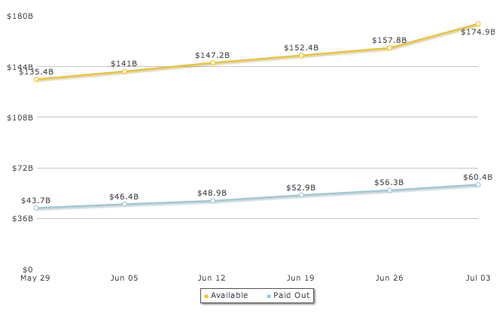
Rate of stimulus spending

This chart is from Recovery.gov, the administration's website for tracking stimulus spending. It's shows the amount of stimulus funding that's been made available to federal agencies ($174.9 billion) over the amount of stimulus funding that's been paid out ($60.4 billion). Note that the rate of increase for available funds exceeds the rate of spending. This suggests that funds are becoming available faster than they are being spent.

It seems to me that the threshold question for Brad is: Why wouldn't this bottlenecking happen to additional stimulus dollars? Would there be something different about the structure of the second stimulus? One big, instantaneous payroll tax cut? Eh?

The Kidney Dialogues: “A Preexisting Condition”

by Patrick Appel

A reader writes:

One of the unspoken pitfalls of being a living donor is that, under current law, health insurers can consider your lack of a second kidney as a preexisting condition.  My dad gave my brother a kidney just two years ago.  He applied for new health insurance, only to be denied.  My mom's health insurance still covers him, but her job as a Catholic school teacher is increasingly unstable from year to year.  My dad still has a few years until Medicare kicks in, so we're all holding our breath that it my mom keeps her current job (and his current insurance) until then. 

My brother will need a second transplant at some point in his life as he just turned 30.  I am the other match that we found among family members.  I only hope that the law has changed before my kidney is needed.  I can't imagine, when the time comes, having my own children without being able to get covered by health insurance.

Until laws change and being a living donor becomes more economically feasible, then I'm afraid many tens of thousands of people will continue to die each year on the waiting list. 

Prison Penny-Pinching

by Patrick Appel

Mark Kleiman outlines how to spend less on California's enormous prison system:

[T]he secret to spending less on prison is having fewer people in prison. And the secret to doing that, without increasing crime, is to learn how to enforce parole conditions. HOPE probation has demonstrated that even meth-using repeat offenders can and will stop doing meth if convincingly threatened with a brief but certain and immediate jail stay every time they get caught using, and that the result is to drastically shrink their new-offense rate and the number of days they spend behind bars.

With GPS position monitoring added to drug testing, parole could be 70% as effective as prison in preventing new crimes at 10% of the cost. My guess is that half of California's prisoners could stay out, and mostly crime-free, under that system, and that many of the people now being sent to prison would do fine on a HOPE-style probation. Less crime, less suffering, lower prison budget.

Oh, yeah, and you'd turn some people's lives around.

His forthcoming book explains this general principal in much greater detail. I highly recommend it.

Face Of The Day

Shepard-Fairey-Aung-San-Suu-Kyi_thumb

by Chris Bodenner

Shepard Fairey honors imprisoned Prime Minister-elect Aung San Suu Kyi of Burma:

“Aung San Suu Kyi is the Nelson Mandela of Asia,” said Jack Healey, the head of the Human Rights Action Center. “Shepard’s tribute to her will remind the world she is the rightful leader of Burma in a powerful way. I always felt it was his image that galvanized the Obama movement, God willing, it will do the same for Aung San Suu Kyi and those fighting for human rights in her name.”

Urban Planning, Health, and Long Walks

by Conor Friedersdorf

Esther Sternberg makes an interesting point about how urban planning can affect not only social interactions, but also health outcomes. Her data point concerns the proximity of neighbors to one another, and the positive effects of increased social interaction. I've always been struck by how much healthier my lifestyle is when I am living in New York, where I walk far more than anywhere else — Clive Thompson once wrote a great piece on why New Yorkers live longer — or my parents' house in suburban California, where perfect weather, easy access to the Santa Ana River Trail and the beachfront bike paths of Orange County encourage me to cycle (especially if my dad permits me to borrow his ultra lightweight road bike).

As a journalist in California's Inland Empire, I did a lot of reporting on planned communities being built by Lewis Homes, one of the more progressive builders in the region. (That isn't saying much.) One community I studied, Terra Vista, included walking and bike paths running through most of its tracts, easily connecting folks to the nearby shopping centers, where they did grocery shopping, patronized a Starbucks, etc. Despite the nod toward a walkable community, however, almost no one used the paths. This is no doubt partly because people who care very much about walking places tend not to move into suburban housing tracts in commuter towns, but I think it's also due to a mistaken notion of what makes walking places pleasant.

Were I given the choice between walking to work on a tranquil suburban trail that winds through a few parks… or else across town on Canal Street, up through the Lower East Side, and into my office… I'd definitely choose the chaotic, noisy, smelly New York City commute. It's not boring, due to the street-scape and the varied people who inhabit it. Jane Jacobs described it a an urban ballet — which is a lot more diverting everyday than watching grass grow.