Guest Blogging Introduction

by Conor Clarke

I'm very glad to be here on the Dish, and thanks to Andrew for the opportunity. I'll be guest blogging for the week, at which point I'm decamping for Argentina. Jokes about hiking the Appalachian Trail are more than welcome.

I write mostly about economics and public policy, mostly from a vaguely lefty perspective. My recent interests have been national tax policy, climate change legislation and interviewing the few remaining economists who do not yet have their own blogs. My full-time blog is here. Since the Dish does not have comments, I should add that am very much amenable to being nagged and criticized by email (conorjclarke [at] gmail [dot] com) and Twitter (conorjclarke). Thanks for reading.

A Brief Introduction

by Conor Friedersdorf

Greetings Dish aficionados — though I first met Andrew a couple years ago, when I interned at The Atlantic, I've been a daily reader since 2001, so it's an honor and a privilege to be guest blogging for a couple weeks, especially given the consistently thoughtful feedback posts here garner. I'll need to be quite prolific for the duration, as I'm also manning an ideas blog elsewhere at The Atlantic Online, contributing at The American Scene, and profiling an allegedly piratical blogger at True/Slant, where I'm covering a different Web log each week.

In Andrew's absence the normal e-mail addresses will be checked by the Dish team, but should anyone want to reach me directly, you can do so by e-mailing conor dot friedersdorf at gmail dot com.

Return Of The Underbloggers

by Patrick Appel

Please continue to send e-mails to andrew@theatlantic.com while Sully is away. Know that I read all of them even though I don't always have time to respond. It's impossible for me to sleuth through the nether regions of the blogosphere to round-up the best bits of bloggy goodness and write the sort of long, thoughtful posts that Andrew is known for. It is only with the help of our incredible readership –and guest bloggers– that the Dish maintains its crispness during Andrew's periodic absences. As always, treat the links and excerpts I post as food for thought and jumping off points for deeper discussion. 

by Chris Bodenner

Specifically, I should add that we are still soliciting material for our running feature on Iranian culture (details here), so if you have any good links, please send them under the subject line "Outing Iran." Also, we are hoping to revive the "Ask The Audience" feature, in which we post emails on compelling topics overlooked by The Dish, particularly from readers with a background or expertise in that area. (Some good examples are here and here.) And as always, we continue to need great contributions to "The View From Your Recession" and "The View From Your Window." Lastly, a quick update on our photo book: its release has been delayed because of our unexpected Iran coverage and some other side projects. Stay tuned.

On Assignment

That's a rather racy way of saying I'm taking two weeks off blogging to work on an essay for the magazine (delayed by the Iran revolution) and get a little breather after an intense year. Patrick and Chris have no such luck; but they'll be joined by two Conors, Clarke and Friedersdorf, both Atlantic alums. Be nice; email them lots; see you when I emerge from the longer-form writing.

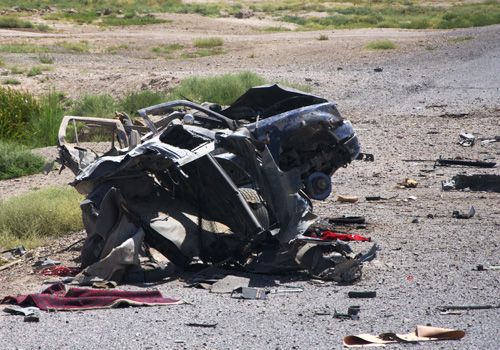
No End To IEDs

Ied_sedan

Graeme Wood reports from Afghanistan:

IEDs are among the least tractable problems precisely because the are among the most simple. Last month, before the Marines pushed into Helmand, US Marine Lt. Col. Scott Fosdal put the problem to me starkly: "We can put more armor on our vehicles, but they can just use bigger bombs." It is difficult to see how the situation does not favor the insurgent, both tactically and strategically.

With predictable speed, the Marine Helmand operation has gone from what military types like to call "kinetic" (i.e., lots of guns being fired and bombs blowing up) to more sedate. This second stage is, paradoxically, almost as dangerous as the first, because the Taliban favor roadside bombs and have progressed beyond the journeyman stage in their craftsmanship. As ISAF and the Afghan National Army plant roots and begin trying to hold Helmand — a province the size of West Virginia, and even better armed — they need convoys to bring supplies, and road patrols to maintain a security presence between villages. Every one of these movements is vulnerable. Just last week, a roadside bomb in Lashkar Gah killed Lieutenant-Colonel Rupert Thorneloe, the highest-ranking British combat death since the Falklands.

For the price of today's one bomb — a large one — the Taliban bought the lives of five men, and the time of dozens more. This scene will be repeated hundreds more times in months and years ahead.

Where Are These Benevolent Peacekeepers Of Which You Speak?

Paul Collier wants to meddle with the poorest states:

Why is outside intervention necessary? The countries of the bottom billion are, paradoxically, too large to be nations, yet too small to be states. They are too large to be nations because, with rare exceptions, too many different peoples, with too many distinct ethnic and religious identities, live in them. This is not because they have large populations: on the contrary, the typical bottom-billion country has only a few million people. But these populations have yet to forge a strong sense of national identity that overrides older sub-national ethnic and religious identities. Considerable research shows that where sub-national identities predominate, it is more difficult for people to cooperate in providing public goods.

Ugh. William Easterly counters:

The UN Security Council decides on military intervention (“peacekeepers”) or a Great Power does it on their own. Two of the Council’s permanent members are authoritarian, most of the Great Powers follow their own geo-strategic interests most of the time, and none of them have any democratic rights for Bottom Billion citizens to make Security Council or Great Power foreign policy decisions. (Small caveat: There never has existed or will exist a benevolent and politically neutral international force that will rapidly deploy to surgically solve Bottom Billion problems.) Yet the Great Powers will decide according to Collier’s proposals whether an “area or people” are allowed to have elections, whether the elections are legitimate when allowed, and when to send in the military (which, despite the nice “peacekeepers” label, are in a purely technical sense made up of soldiers carrying guns that are aimed at people.)

“That Was A Gun, Not A Firecracker”

by Chris Bodenner

Chas Danner finds a gem:

…the first recording of Allah-o Akbar chants to emerge from that night (the day after the election). It has very clear English narration from what sounds like an American visiting family there. It is one of the clearest ” short stories” any of these videos has told. Unique and intense new footage.

Ending Prohibition From The Ground Up

Weeed1

Drum, who has never so much as taken a hit, reads up on marijuana reform:

The real action in cannabis legalization is at the state level. More than a dozen states now have effective medical marijuana laws, most notably California. Medical marijuana dispensaries are dotted all over the state, and it's common knowledge that the "medical" part is in many cases a thin fiction. Like the Dutch coffeehouses, California's dispensaries are now a de facto legal distribution network that severs the link between cannabis and other illicit drugs for a significant number of adults (albeit still only a fraction of total users). And the result? Nothing.

"We've had this experiment for a decade and the sky hasn't fallen," says Paul Armentano, deputy director of the National Organization for the Reform of Marijuana Laws. California Assemblyman Tom Ammiano has even introduced a bill that would legalize, tax, and regulate marijuana; it has gained the endorsement of the head of the state's tax collection agency, which informally estimates it could collect $1.3 billion a year from cannabis sales. Still, the legislation hasn't found a single cosponsor, and isn't scheduled for so much as a hearing.

I’m A Celebrity. Get Me Out Of Here

My Sunday column is on you-know-who:

This helps explain the broader problem with American conservatism right now. It is less a movement than an industry. From Fox News to talk radio to conservative publishing houses, it has created an alternate and lucrative media reality that is worth a fortune to those able to exploit it. Alas, these alternative media thrive on paranoia, hatred of liberal elites and growing extremist rhetoric made worse by a hermetically sealed echo chamber of true believers. Anyone criticised by the left or even by the establishment right is a martyr in this world. In America, martyrdom sells. And Palin is a product worth lots of money.

She wants some of it; and she has no actual interest in governing America (even though she’d love the title of president). She referred to giving up her “title” as governor, not her “office”. In this, she is the ultimate Republican of this degenerate moment: all culture war, no policy; all identity politics, no engagement with practical answers to difficult public problems; and all hysterical opposition to Barack Obama, no actual alternatives offered.

Since even epic scandals heighten celebrity rather than diminish it, Palin’s future is secure. Her party’s? Getting bleaker by the day.