Yglesias uses USSR data to advocate for nationalized healthcare. Those who have never experienced socialism have no idea what they are asking for.
Month: July 2009
That Time Interview
A reader writes:
Your critiques of today's journalists came to mind when I was reading the recent Time interview with Sarah Palin. Go through the article and read only the bold text and you'll see what I mean. The interviewer starts out with the softball, "Did you feel that the institution of government was no longer the best way to bring change about?" and then moves on to such gems as, "Do you see [your resignation] as kind of a selfless move, more for the state than for you?" and "What do you think is particularly wrong with what Obama is doing now?"
Those questions read as if Palin wrote them herself. They aren't even subtle; they are blatantly setting up her talking points. How can anyone who works as a professional journalist ask questions like that and still have a job?
That's the condition for their having jobs in the first place.
The Reason She Matters, Ctd
A tsunami of emails keeps arriving telling me to stay on the Palin story, and agreeing with what I wrote here. All I can say is that I will keep asking until we get answers that can be verified, fact-checked and make sense. And when we do, I intend to hold every single person responsible for this farce accountable for every last ounce of it. If you do not like this, read another blog. We will continue, of course, to cover many other issues – climate change, Iran, healthcare reform, civil rights, the recession, Pet Shop Boys albums, bored cats, and other vital matters. But I won't give in until I figure out what exactly went on last fall and what is exactly going on right now. A classic email on these lines:
I agree with you that the Palin story should not be allowed to disappear into the trashcan where the MSM has filed it. Gut instinct tells me that it is facile to believe that she left in a huff over family photos, or in a sudden fit of wishing to save Alaska taxpayers' money.
A slightly more cynical instinct tells me that Palin's departure was facilitated by sources who offered to fund her future efforts, for motives of their own, while assuring her that her cover story of injured family pride and wounded dignity were not only true, but would be accepted by the public at large.
An even more cynical instinct tells me that the MSM won't pursue the story because they already know exactly who influenced Palin's decision, because it involves members of the media that individual 'journalists' don't wish to offend, and because the story is so injurious to the MSM's false image of independence that absolutely nobody wins (except the public of course!) by pursuing this loser story. Don't let go …
If I survived the insane pressure on me to stop writing about this last September (not from my editor or employer, I might add), I'm not going to flake out now. When will an MSM reporter ask her a relevant question? I keep wondering.
Photoshop: Gets The Blood Out

Al Giordano passes along a doctored photo in a Honduran paper:
CubaDebate has an illuminating find regarding the coverage of the crisis in Honduras by the pro-coup newspaper, La Prensa. The now-iconic photograph of the late 19-year-old Isis Obed Murillo, being carried by his friends to seek medical help moments after his shooting by gunmen during Sunday’s demonstrations in Tegucigalpa, was also published by the Honduran daily… Except that La Prensa chose to airbrush the young man’s blood out of the photo. Media that literally whitewashes the story to this extreme, of course, is not shut down, destroyed or attacked by the coup regime. That treatment is reserved only for real journalists.
No Comment
The Catholic Church is now selling the desk of a priest defrocked for coming out and opposing Proposition 8. The asking price is $999.
Palin, Darling Of The Elites
One recalls that her first ever appearance in the Anchorage Daily News was as a house-wife who wanted to get a glimpse of Ivana Trump when she opened a store in Anchorage. One also recalls a moment in the campaign that the ADN noted:
During her recent visit to New York City she attended a dinner put together by Rupert Murdoch who, according to gossip columnist Cindy Adams, "piloted Sarah around" during the evening. Murdoch is one of the world's most influential media barons. Also present was Cathy Black, president of Hearst Magazines. Other VIPS on hand at Tao on 58th Street, where a Kobe rib eye steak costs $88, included Sarah Ferguson, Martha Stewart, designer Vera Wang and the Queen of Jordan. Not the media elite — just the elite.
Conor Friedersdorf names all the fantastically wealthy, East Coast elitists (Kristol, Ailes, Limbaugh, et al) who did all they could to promote her and prop her up:
Why elide the fact that Sarah Palin is a darling of Fox News, the highest rated cable news network in America? Or that she is regularly defended by Mr. Limbaugh, famous television personality Sean Hannity, and Mark Levin, a nationally syndicated radio host whose latest book just ended a run atop the New York Times bestseller list?
Or again, surely these savvy Sarah Palin defenders know that the editors of National Review and The Weekly Standard, tenured members of the political establishment, lined up behind her candidacy, and that Gov. Palin herself is a millionaire who enjoyed a six-figure family income before she ever took the statehouse—never mind the lucrative book contract and pricey speaking fees now available to her.
Isn’t it actually the case that a good chunk of elite America loves Sarah Palin, or at least is willing to lend rhetorical and financial support to her? Why pretend otherwise? The cynical view is that elite conservatives benefit by hiding this fact from their audiences. Better to convince them that America’s cultural and political tastemakers are as thoroughly liberal today as was the case a generation ago. In that bygone era, The New York Times and the Big 3 networks determined the news cycle, the fairness doctrine constrained the market for conservative radio, and the post-World War II democratic coalition dominated two-thirds of the federal government.
But it isn’t any longer accurate to use “the liberal elite” as shorthand for America’s ruling class.
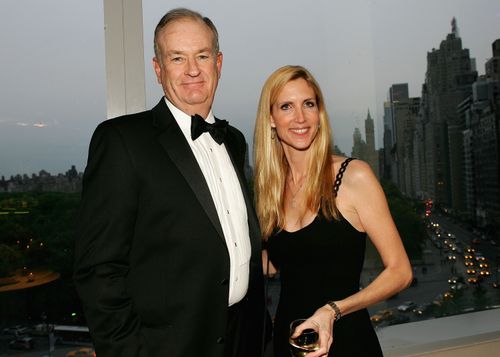
(Photo: Two multimillionaire East Coast elitists by Evan Agostini/Getty.)
Big Protest Tomorrow?
Nico gets an email from NIAC's Patrick Disney:
I wanted to give you and your team a heads-up that we're hearing from a lot of sources that Thursday will likely see a lot of unrest and potential violence in Iran. It marks the 10th anniversary of the "18th of Tir", which is a monumental day in Iran.
On that day in 1999, students protesting the closing of the reformist newspaper "Salaam" were attacked in their dormitories in Tehran and Tabriz. Six days of protests ensued, which began with several hundred students and blossomed into thousands of people from all walks of life supporting the demonstrations. They were the biggest display of [protest] sentiment in the regime's then twenty-year history, and they were put down by the regime with a mandate by the threatened leadership to stop the unrest at any cost.
The parallels to today's events are uncanny, and while the date has been marked with numerous protests since 1999, this anniversary takes on a special significance. We know that authorities are already trying to lock the cities down ahead of time. Demonstrations are planned all over the U.S. in solidarity with the protesters letting them know the world is watching what the regime is doing.
NIAC also relays news that Mousavi, Karroubi, and Khatami met on Monday for the first time since the election. Could they be planning something for tomorrow?
“A Windshield Painted Black”
DeLong ponders a second stimulus:
Any second stimulus package passed this fall would have little impact on the economy until late 2010, that is true. But come late 2010 we might really need more demand to curb unemployment. On balance the inflationary risks of having an extra stimulus hit the economy in late 2010 if it is not needed are outweighed by the deflationary risks of not having an extra stimulus hit the economy in late 2010 if it is needed. It is like driving a car with its windshield painted black by looking in the rear view mirror.
My friend Niall Ferguson sees this as King Kong of Deflation versus Godzilla of Inflation. I do not begrudge policy makers for making mistakes in this kind of climate. What I will begrudge them for is not correcting mistakes if evidence subsequently proves them wrong. We had eight years of that.
The View From Your Window
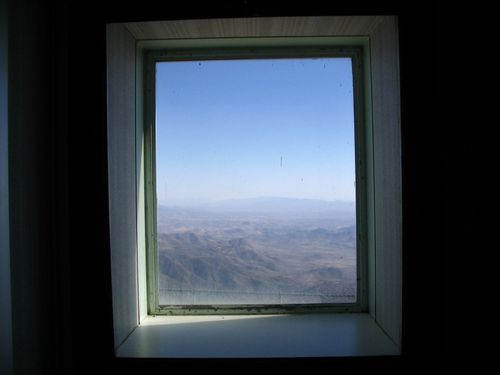
Mt. Hopkins, Arizona, 3.33 pm
Who Wants The Bomb?
Noah Millman walks us through various nuclear arms chess matches:
The main reasons to pursue strategic arms reductions with Russia are: the arms are actually worthless, so eliminating them saves both us and the Russians money, and increases global well-being directly thereby; and the reductions may help us get better support from allies like France and Germany in pursuing stricter controls on nuclear technology transfer (which is one practical way to combat proliferation). The real successes in nuclear-counter-proliferation, however, all fall into three categories: allies who have not needed to go nuclear because they are under the American nuclear umbrella (Germany, Japan, South Korea); neutrals or allies who no longer have significant in-region enemies or rivals against whom they might want to wield a nuclear deterrent (South Africa, Brazil, Argentina); and countries that gave up or have not built nuclear weapons for fear of provoking a much stronger neighbor (Taiwan, Kazakhstan, Ukraine). So the real investment in counter-proliferation is investment in conflict-reduction. Unfortunately, South Asia is the least-likely territory for conflict reduction, just as it is the least likely to be directly responsive to US-Russian moves, while simultaneously it is the most likely venue for war actually escalating to the nuclear level.
 The Dish