A Telling Hypothetical

by Conor Friedersdorf

Andy McCarthy writes on the ongoing debate over Bush era interrogations:

There is a principled human-rights position on all this. You can say: "No one wants to see bad things happen to people, but I honestly believe abusive tactics are so corrosive of our society's principles that it would be better for 10,000 Americans to be killed in a terrorist attack than for us to prevent the attack by subjecting a morally culpable terrorist to non-lethal forms of coercion that cause no lasting physical or mental harm."

That would be the honest argument, but it is not going to persuade many people. Thus the continued pretense, against all evidence and logic, that the tactics don't work. 

Strange that Mr. McCarthy uses a hypothetical wherein everyone who undergoes "enhanced interrogation" is a morally culpable terrorist, where the techniques used are always non-lethal, and where no lasting physical or mental harm is done. In fact, we know that during the Bush Administration innocent people were subjected to "enhanced interrogation," multiple detainees died in custody, and others suffered lasting physical and mental harm.

Limited Public Morals

by Patrick Appel

Ryan Sager makes some smart points in response to Jonah Goldberg:

We’ve come to intuitively believe that virtually every torture situation is a ticking time bomb and that torture always works. Because that’s [what we see in the movies and that's] our most salient experience with the issue. We’ve talked before about the availability bias here on Neuroworld, and that’s what’s at work here. When we think about torture, our brains look for what we know about it. What facts are readily available to us.

Head in the Sand

by Conor Friedersdorf

In an interview at The League of Ordinary Gentlemen, conservative blogger Dan Riehl says the following about our former vice-president (emphasis added):

I’ve observed Dick Cheney for over two decades. And I also think more has been made of some alleged war on terror tactics by the opposition purely for political purposes. Isn’t that like creating a straw man then using it to launch an attack?

I’ve never known Cheney to do anything to harm this country in those decades, why should I expect that of him now for no reason? He seems to be a loyal, patriotic, law abiding American to me. Always has. So, given no evidence to the contrary, the onus should be upon his critics to tell me why I should mistrust him somehow. And not the reverse.

Questioner Scott Payne responds, "is it then your contention that if someone is patriotic that they are thereby incapable of doing something wrong or morally unacceptable, even, perhaps, in the name of said patriotism?" In a lengthy answer that I encourage you to go read, Mr. Riehl writes, "At most, as I understand it, anything Cheney allegedly endorsed discomforted some likely terrorists and I’ll even grant for purposes of discussion some few may have died."

So Mr. Riehl is aware of evidence based allegations that former vice-president Dick Cheney endorsed tactics that resulted in the death of possibly innocent detainees — yet he simultaneously acts perplexed at the notion that there is any reason to think he acted illegally. Elsewhere in his answers, Mr. Riehl takes refuge in the fact that anything Mr. Cheney did wasn't as bad as incinerating millions of innocent people in a nuclear holocaust. It says something when that is your fallback argument. Again, you can read the whole interview here.

Ronald Reagan and Health Care Reform

by Hanna Rosin

Matt Yglesias once pointed out that we already have socialized, single-payer style healthcare. It's called Medicare, and it's one of our most popular social programs. This morning I heard a clip of Ronald Reagan, then candidate for governor, speaking about the prospect of Medicare, and sounding very much like today's town hall critics.

If this program passes, one of these years we will tell our children and our children's children what it was like in American when men were free.

And:

One of the traditional methods of imposing statism, or socialism on a people has been by way of medicine. It's very easy to disguise a medical program as a humanitarian project. Most people are a little reluctant to oppose anything that suggests medical care for people who possibly can't afford it.

Just so you get it, that was almost fifty years ago.

Face Of The Day

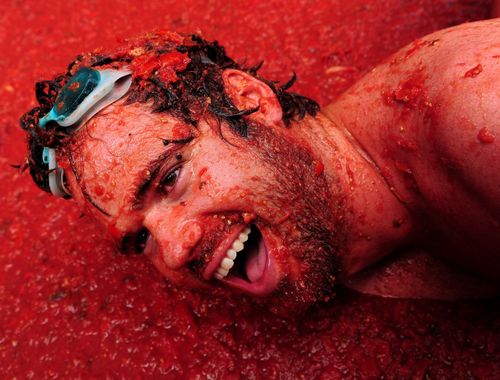
TomatoFightGetty

A reveller lies in tomato pulp during the world's biggest tomato fight at La Tomatina festival on August 26, 2009 in Bunol, Spain. More than 45,000 people from all over the world descended on the small Valencian town to participate in this year's La Tomatina festival, with the local town hall estimating that over 100 tons of rotten and over-ripe tomatoes were thrown. By Jasper Juinen/Getty.

Stats And Subjectivity

by Chris Bodenner

I had never even thought to question the ethics of circumcision before reading Andrew's passionate take on the issue a few years back. His case is very persuasive. But so are the points Hanna raised earlier today, namely this one:

[A]ll that research of specific areas of male sensitivity (Andrew cites some here) has always struck me as dubious. Erotic pleasure is a rich and complicated thing. Specific percentages of sensitivity can't possibly sum up the experience.

I'll go one step further: Is sensitivity that important to begin with? Well duh, of course it is on a basic level. But what if a slight decrease in sensitively actually heightens sex overall? In other words: The guy lasts longer. And that's generally better for everyone involved, no?

When I checked out Wikipedia's many cited studies on "ejaculatory function," most are not statistically significant – and those that are balance out. So my hunch seems unfounded. Furthermore, what if decreased sensitivity from circumcision hinders the game to begin with? But studies on "erectile function" are also inconclusive. So are those comparing "satisfaction."

Studies are a red herring, however, when it comes to the ethical part of the debate. Even if there are no discernible differences between cut and uncut on average, there are still many individuals who are better or worse off from a procedure their parents imposed. As one reader puts it:

It’s my dick. It’s my dick. It’s my dick. It is no one else’s dick but my dick.  And I should have the choice to circumcise it when I am old enough to make that decision.

Then again, if you were circumcised as a newborn, how would you ever know the difference? Wouldn't your range of sensitivity adjust accordingly? (Unless the procedure was botched, of course.)

It's an incredibly nuanced debate, which, by the looks of the many passionate emails to Hanna, won't go away soon.  In fact, many of its themes – namely, of parents making an irreversible medical decision for their child – are similar to the ones found in her Atlantic piece on transgender children; I highly recommend it. Here's a taste:

For years, [transsexuals have] been at the extreme edges of transgressive sexual politics. But now children like Brandon are being used to paint a more conventional picture: before they have much time to be shaped by experience, before they know their sexual orientation, even in defiance of their bodies, children can know their gender, from the firings of neurons deep within their brains. What better rebuke to the Our Bodies, Ourselves era of feminism than the notion that even the body is dispensable, that the hard nugget of difference lies even deeper?

What Did Katie Roiphe Say That’s So Offensive?

by Hanna Rosin

Conor, I edited that Katie Roiphe piece you mentioned, and I could not agree with you more. I am baffled by the enraged responses from otherwise very intelligent feminists. Either the mere sight of Roiphe's name makes them seethe. Or the mommy wars are truly un-killable. Roiphe writes:

One of the minor dishonesties of the feminist movement has been to underestimate the passion of this time, to try for a rational, politically expedient assessment. Historically, feminists have emphasized the difficulty, the drudgery of new motherhood. They have tried to analogize childcare to the work of men; and so for a long time, women have called motherhood a "vocation." The act of caring for a baby is demanding, and arduous, of course, but it is wilder and more narcotic than any kind of work I have ever done.

"Minor dishonesties" is hardly a turning of the rhetorical knife. It's a fairly mild and gentle way to make what is an obvious and undeniable point. The idea of motherhood as a "vocation" has been around for at least a century, and anyone who has ever been to a pre-school parents' meeting lately will recognize its continued prevalence.

Katie did not say that feminists hate their babies, or that baby-less women are useless, or anything else she's being accused of saying. What she did is perfectly capture the seduction of disappearing into the newborn, opium den haze. 

Kennedy Reax

by Patrick Appel

George Packer:

Ted Kennedy was my senator for sixteen years, from 1984-2000, which means that I caught him in the mid-late years of his career. In Massachusetts, he was always there, a florid monument, and yet, unlike other legislators who become landmarks, he never stopped working. Senators who serve more than three or four decades usually cease being productive well before the halfway mark, and by the end are simply holding the chair until they expire and their state can turn to someone else a few generations younger. Not Kennedy: those years when I lived in Massachusetts were his most productive (think of Americans with Disabilities, Family and Medical Leave, Children’s Health Insurance Program). He didn’t pursue the role of statesman; foreign policy seems not to have interested him much, beyond his opposition to the wars in Vietnam and Iraq. But if you measure a senator’s effectiveness by his impact on the daily lives of vast numbers of Americans, it’s impossible to think of anyone else in our lifetimes who comes close to Kennedy.

Matt Welch:

It's always interesting to observe when politicians morph from humans into abstractions, particularly (though not only) in the hands of their political opponents. You see this with Ronald Reagan, who remains to this day the focus of both uncritical worship and fact-averse loathing. Well into this decade you saw this (among liberal activist groups) with Pat Buchanan and Jerry Falwell; it remains to be seen who among the Bush/Cheney/Rumsfeld triumvurate will endure as the totemic hate-figures, though my money's on the Dick. Ted Kennedy was like no other Democrat in this regard. Who's gonna replace him, Barney Frank? Bill Clinton has long since wriggled off the hook.

Jim Burroway:

A man of privilege, he was a staunch supporter of the downtrodden, including the LGBT community when there were precious few allies in Congress. He was an early proponent of funding for HIV/AIDS research and care in the 1980s, battling conservative religious hostility and White House indifference to the emerging epidemic. In the early 1990’s he became an early supporter of gay rights legislation and voted to strip “Don’t Ask, Don’t Tell” from the National Defense Authorization Act in 1993. He stood up as one of only fourteen Senators to vote against the Defense of Marriage Act in 1996.

Alex Massie:

There was plenty to dislike about Edward Kennedy and some of the opprobrium he attracted was deserved. Some of it was also an honour: Kennedy was worth disliking and, yes, fearing too. He mattered. His death marks the end of an era. Though his son sits in the House of Representatives, Ted Kennedy was the last of the clan to stroll across the national stage. It has become customary to refer to him as the great "Liberal Lion" of the Senate and, for once, that's a fair description. No Senator in modern times has done quite so much. There is scarcely an area of American life untouched by legislation written or sponsored by the Senator from Massachussetts.

Mike Allen:

Journalists and lawmakers will talk constantly in coming days about health-care reform as a final tribute to Senator Kennedy, and Democratic leaders will argue that the bill could be a capstone for his legacy. But the legislation that's likely to emerge will be much more minimalist than he would have wanted. And Democrats have to be careful how they play the Kennedy card. To them, "Kennedy" means a career in public service. To many Republicans and centrists, it just means "liberal."

Yglesias:

Ted went on to become the greatest of the Kennedy brothers. But it’s worth being clear about the fact that he had such an impressive career in part precisely because he initially got a job he wasn’t qualified for. The Senate operates largely on the basis of seniority. A guy who can enter his fifth term and only be 54 years old is a guy who’s going to be able to wield some major influence for a long time.

DiA:

Mr Kennedy will never achieve the public sainthood that his brothers achieved. Republicans knew that, especially after he stopped being a presidential threat. That had the effect of allowing conservative activists to underestimate him and allowing conservative senators to work with him. Mr Kennedy found a way to push past his flaws, then use them to his advantage. His brothers furthered the myth that political progress is made by great men at great moments. Mr Kennedy proved that it is often the badly-flawed people, the counted-out people, who really get things done.

Ezra Klein:

Kennedy was beyond reproach. Liberals generally trusted that the deal he got was the best deal possible. That's what made Kennedy a good guy to strike a deal with: His name on the bill brought actual votes and support. And that was only possible because his constituency trusted his compromises. That's not true for the figures left in the health-care debate, at least on the Senate side, and it's a real loss.

Dave Weigel checks in on the war over Kennedy's seat:

All of the potential Democratic nominees have huge war chests and political bases; a GOP candidate would have neither, and would need to gin it up in a couple of months. Still, some ambitious Republican may make a run for it, as the short timeframe of the election reduces the costs and the downsides.

James Pethokoukis:

The cold, hard politics of the situation is this: Kennedy’s death makes passing healthcare reform tougher not easier. His seat will likely remain vacant until late January since there will be no interim appointment in Massachusetts and state law calls only for a special election to be held within 145 to 160 days. That is one extra tough-to-find vote Democrats will need if they try and shut down any GOP filibuster attempts. And if Democrats try to ram through a bill under reconciliation, a special budget procedure, Kennedy could have been helpful in rallying squeamish Dems and lobbying groups for the tough parliamentary battle, points out veteran Capitol Hill watcher Pete Davis, who tracks Washington politics for financial institutions.

Marcy Wheeler:

[R]eflexive punditry–the urge to claim omniscience about politics–arises out of the 24-hour cable world, a need to fill time. Yet to so quickly jump to making pronouncements about whether Ted Kennedy's death is a "win" for progressive Democrats or conservative Democrats, Republicans, and their corporate backers (which is really what this is about) suggests the cable news channels have exhausted all the things they have to say about Kennedy, the man. Now, Teddy Kennedy's record of achievement in the Senate is a half-century testimony of all that progressives have brought to this country. And if the cable news can spend a week paying tribute to Michael Jackson's half-century career in music, then they sure as hell can spend at least one day paying tribute to Ted Kennedy's half-century leading this nation. To so quickly turn his death into one event in a horse race dishonors the man and slights his great achievements.

Joe Klein:

We were never friends; our relationship was professional, but keen and, ultimately, affectionate. I don't remember the last time I spoke with him. It might have been in Iowa, during the 2008 campaign — he had the connoisseur's appreciation of Barack Obama. But the last time I saw him that I really remember was a day I stopped by his office to talk about … what? Health care, maybe the war in Iraq? His dog was roaming about, rubbing up against me, then settling at the Senator's feet. We were surrounded by his oil paintings of Cape Cod scenes. We talked about his painting; we talked about the Cape, a place we both love, little things — this harbor, that herring run. After all the craziness, after 40 years had slipped between us, he was completely at ease. I wanted to ask him about those awkward, awful times back when. But why mess with the mood? He had exorcised the demons. He was whole.

TPM has a round up of reactions from politicians.
Should Porn Stars Be Forced To Use Condoms?

by Chris Bodenner

Tracy Clark-Flory pens a long, interesting post on the question, including an explanation of why condoms on the porn set can lead to increased STIs (Hint: it rhymes with "micro-abrasions"):

The best middle ground solution I've come across is one suggested by Adult Industry Medical Health Care Foundation founder Sharon Mitchell shortly after the 2004 outbreak: Why not promote a "seal of approval" that advertises a porno's ethical production values? The gold standard might be requiring rigorous two-week testing and actively defending workers' right to perform with or without a condom. It would be a disclaimer of sorts — essentially, "no porn stars were harmed in the making of this movie."