by Hanna Rosin
This is, hands down, the worst TV reinactment ever. If you can't actually find the bear, or hire a local circus bear, use a cardboard cut-out instead:
by Hanna Rosin
This is, hands down, the worst TV reinactment ever. If you can't actually find the bear, or hire a local circus bear, use a cardboard cut-out instead:
by Andrew
"Are all of Obama's foreign policy initiatives pegged to the Islamic calendar?" – Michael Goldfarb, panicking at the thought of any tiny progress toward a settlement in the Middle East.
by Patrick Appel
DiA wants to know if legal immigrants will be covered by the health care bill:
As it happens, legal immigrants are by and large younger and healthier than the overall population, so including them in the universal health-insurance system would make it cheaper, not more expensive. But even if that were not the case, legal immigrants in America should be covered by the same health-insurance system as everyone else because that is the decent way to run a society. Legal immigrants are not lawbreakers. They are not parasites. We would not expect an American citizen who has put down roots in France or Japan to be kicked out of the country if she develops a serious illness, and we should not be doing the equivalent to legal immigrants in America.
Agreed on all counts. Ryan Avent has argued that illegal immigrants should be included as well, but that isn't on the table.

Limuru, Kenya, 2.32 pm
by Hanna Rosin
This is life changing for me. From Bruni's final column as restaurant critic today.
Scratch off the appetizers and entrees that are most like dishes you’ve seen in many other restaurants, because they represent this one at its most dutiful, conservative and profit-minded. The chef’s heart isn’t in them.
Scratch off the dishes that look the most aggressively fanciful. The chef’s vanity — possibly too much of it — spawned these.
Then scratch off anything that mentions truffle oil.
Choose among the remaining dishes.
by Conor Friedersdorf
As I read Katie Roiphe's elegant essay "My Newborn Is Like a Narcotic," I thought back to my days in her classes at New York University, where I found her to be among the best professors on an exceptionally talented faculty. One course she taught focused on social commentary. The reading material included op-ed columnists, essayists and polemicists — it may be the only graduate seminar in America whose course packet included Ann Coulter and Maureen Dowd (the bulk of my time in Prof. Roiphe's classes were spent reading authors like Rebecca West, Joan Didion and Mary McCarthy).
One of the minor dishonesties of the feminist movement has been to underestimate the passion of this time, to try for a rational, politically expedient assessment. Historically, feminists have emphasized the difficulty, the drudgery of new motherhood. They have tried to analogize childcare to the work of men; and so for a long time, women have called motherhood a "vocation." The act of caring for a baby is demanding, and arduous, of course, but it is wilder and more narcotic than any kind of work I have ever done.
Alison Gopnik points out the factual truths in this paragraph. Being a piece that ran in the Slate family of publications — a family that is IMHO among the best on the Web — the piece carries a maximally provocative subhead, "Why won't feminists admit the pleasure of infants?"
I remember visiting one of my closest friends on her maternity leave last summer. We sat on a wooden bench in her garden and drank iced coffees, and gazed at her second baby. She is a writer, and we talked about how the women writers we most admired had no children, or have had one child, at the absolute most, but never two. (Edith Wharton, Virginia Woolf and Jane Austen had no children; Mary McCarthy, Rebecca West, Joan Didion, and Janet Malcolm all had one.) My friend looked down at her newborn and her tiny eyelashes. She could entertain this conversation in an academic way, but as she adjusted the baby’s hat I could see how far removed it was from anything that mattered to her. Here, sitting in the garden, looking at the eyelashes, would you trade the baby for the possibility of writing The House of Mirth? You would not.
Who are all these feminists who hate infants and want to take away Roiphe’s ability to experience “The high of a love that obliterates everything. A need so consuming that it is threatening to everything you are and care about”?
But nowhere does Prof. Roiphe argue that feminists hate infants — she says that the feminist movement has produced literature that underestimates and misrepresents the passionate bond between newborn mothers and their children. The same post goes on to say, as if to paraphrase Professor Roiphe, "look, it’s not only Betty Friedan and her lying friends who hate babies: it’s also every great woman writer of the past 250 years." I again refer the reader to the excerpt above about Mary McCarthy, Joan Didion, Janet Malcolm and others. Should the fair-minded personal really conclude from it that Katie Roiphe thinks all those women "hate babies"? On the contrary.
by Chris Bodenner
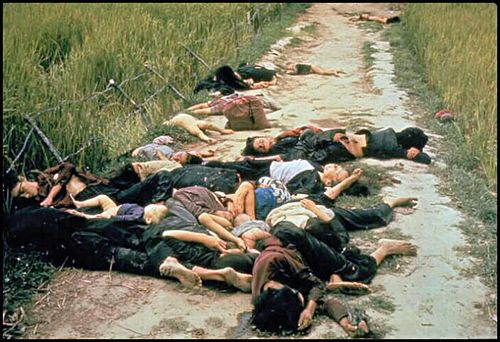
William Calley – the only soldier to be held responsible for the massacre of up to 500 villagers in My Lai, Vietnam – apologizes for the first time. A blogger got the scoop:
[Calley] did not try to deny what had happened on that March 16th, 1968, but did repeatedly make the point, which he has made before, that he was following orders. […] I asked him for his reaction to the notion that a soldier does not have to obey an unlawful order. In fact, to obey an unlawful order is to be unlawful yourself. He said, “I believe that is true. If you are asking why I did not stand up to them when I was given the orders, I will have to say that I was a 2nd Lieutenant getting orders from my commander and I followed them - foolishly, I guess.” He said that was no excuse, just what happened.
Calley had been sentenced to life imprisonment, but Nixon quickly pardoned him. Calley's commanding officer, Ernest Medina, was not even found guilty, despite damning accounts such as this:
While the killing continued, an armed observation helicopter piloted by Warrant Officer Hugh Thompson patrolled overhead. Several times that morning, Thompson and his two-man crew had attempted to aid civilians by marking their location [for medics] and radioing for help. Speaking about the incident years later, Thompson recalled one occasion in which a young woman lay injured in a rice paddy. "We got on the radio and called for some help and marked her with smoke," he said. "A few minutes later up walks a captain, [Medina] steps up to her, nudges her with his foot, steps back and blows her away."
Confused by what was taking place on the ground, Thompson continued to observe the scene from above. He then spotted some soldiers heading towards a group of villagers who had just fled into a bunker. Against orders, Thompson landed his helicopter between the two groups and stepped out to confront the men. "Hey, there's some civilians over here in this bunker," Thompson recalled. "Can you get them out?" One soldier replied, "Well, we're gonna get them out with a hand grenade." Thompson told them to stay put while he evacuated the villagers. He then instructed his door gunner to shoot any American solder who fired upon the civilians.
Thompson called in one of his gunships, which then evacuated nine injured civilians. Transporting a wounded child pulled from the irrigation ditch, Thompson flew back to the 11th Brigade headquarters at Duc Pho. He immediately reported the incident to his commanding officer, Major Fred Watke, who then relayed the message back to the battlefield. Soon afterward, Medina ordered an immediate cease fire in the village, and the killing stopped.
Thompson's heroism and moral clarity was unparalleled – and you don't need a Hollywood script to find it.
by Patrick Appel
Michael Lynch wrote yesterday that peak oil is a myth. Free Exchange is skeptical of some of the assumptions Lynch makes:
Currently, there are about 6.7 billion people in the world, who use about 4.8 barrels of oil per year each, for about 32 billion barrels per year. By 2020 there will be nearly 8 billion people. If oil prices remain low, it's reasonable to expect per capita consumption globally to rise to perhaps 5.5 barrels of oil per year each by then. That would give us an increase in annual global petroleum consumption of nearly 40% in a decade's time. Does it seem reasonable that global production can expand at even half that pace using only supply that can profitably be withdrawn at $30 per barrel?
The Oil Drum is not impressed:
Peak Oil has never been about the amount of hydrocarbon molecules that exist, but flow rates, timing and costs. This post from 2007 gives a general overview of the differences between those concerned about a near term oil peak, and the unconcerned.
by Andrew
A reader writes:
I read the document you are referring to last night before going to bed (not the best idea). One aspect of it that I have not seen emphasized is the fact that the CIA General Counsel's Office was transmitting it to OLC with a request to render a favorable legal opinion about a torture regime that was already being used. This document is from December 2004. 2004! Consider these lines from the cover letter:"Please find enclosed a paper describing a generic interrogation process that sets forth how the Agency would expect to use approved interrogation measures both in combination and in sequence with other techniques. Our hope is that this letter will permit your office to render advice that an interrogation following the enclosed description would not violate the provision of 18 U.S.C. Section 2340A [the federal law that defines and criminalizes torture]." [My emphasis].Then this at the end, after the torture regimen applied to high-value detainees is laid out in excruciating detail:"However, the exemplar above is a fair representation of how these techniques are actually employed."This is fairly conclusive evidence that the Bush team which authorized this torture knew it was illegal when they ordered it, but they didn't care. Only when the CIA interrogators got scared about the prospect of getting charged with war crimes either in the U.S. or at the World Court did they reach out to OLC to get ex post facto legal cover.I am not sure which is more distressing – the moral corrosion of the American polity this episode so clearly illustrates, or the abandonment of the rule of law so casually carried out by our elected leaders. I suspect that ultimately, the two are inseparable.
And this is what makes Holder's decision to withhold the OPR report on the legal professionalism of the torture memos so bizarre. They are the final link of evidence that proves what we already know – that the deicsion to torture was made long before any "legal" defense of it was drafted. The legal memos were not good faith memos, but retroactive cover for criminal acts already being committed. This was a conspiracy against the rule of law, directed from the very top of Washington, empowering the president to torture anyone at will.
What we now know is that immediately after 9/11, Dick Cheney decided that torture was going to be his principal weapon in waging the intelligence war on al Qaeda.
He knew this was illegal but believed he was saving the country and also believed that the constitution empowers the president to assume total, dictatorial powers in war-time. So he sabotaged the usual institutional checks, told the president everything was legal and "not torture", took the US out of the Geneva Conventions, hired freelance goons to devise torture techniques, and began torturing the prisoners as they came in. He realized all along that this was illegal by the lights of every sane legal professional, and so then directed pliable fanatics, like John Yoo, to create legal memos to grant retroactive immunity – a golden shield – for all those involved in the torture. He then used the crudest politicking to brow-beat all defenses of American honor, decency and real interrogation as abetters of the enemy.
We need to see the blacked out portions of the 2004 report, including how four prisoners were tortured to death. There is no conceivable reason not to see this for national security reasons. These were homicides. It would be extremely illuminating to know precisely what brought these individuals past torture into murder. And we need to see the OPR report on the torture memos to close the phony bad faith legal circle and see this as the putsch against the constitution that it truly was. Only then can we look at the question of accountability. And I suspect the revelation of the worst abuses is yet to come.
by Chris Bodenner
Joe Klein writes:
The most important thing about the CIA Inspector General's report is its very existence. It was ordered up after internal complaints from CIA staffers that the interrogation program had gone off the rails. It states, unequivocally, that the Cheney-approved torture was a departure from past CIA practice (and international law) and there was an expectation that there would likely be "long-term legal challenges."
Klein also adds to the Annals Of Chutzpah:
Dick Cheney has now accused the Obama Administration of politicizing the Justice Department…after his Administration criminalized the Justice Department.
 The Dish