Should There Be A Lioness Program?, Ctd

by Chris Bodenner

A reader writes:

As someone who's also served in Iraq, I'm disappointed by your reader who "completely objects" to the Lioness program. Having female search teams is not just a matter of avoiding "offending a local sheik." It is critical to preventing the offending and alienation of the vast majority of the Iraqi population. And that, in turn, is crucial to counter-insurgency efforts, and other long-term U.S. goals in Iraq. You know, the goals which Marine combat operations are designed to support, and for which Marines frequently risk and sometimes lay down their lives.

The risk that one of these Lioness Marines may not be able to carry them to safety would surely be one of the minutest portions of the enormous risks that Marines willingly take for their country. I've signed the death certificates of more than a few Marines killed in Iraq, and I'm strongly in favor of doing all we can to protect them while performing their duties. But to myopically focus on such a small risk, to the clear detriment of the larger military mission in Iraq, is no way to honor or protect the Marines.

Regarding your discussion of Army physical training tests, I'd just like to add that there are not just different standards in place for the two sexes–there are different standards for each of ten different age categories (the Marine Corps also allows slower running times with increasing age, but has only four age categories). Furthermore, those age differences apply to combat and non-combat units alike. It seems to me that the arguments against different standards for females also apply to different standards for older males, but I don't hear anyone arguing that all males who can't meet the minimum standard for 17-21 year-olds should be banned from combat.

(The Army PT charts I consulted in my previous post are here.)
How Do We Pay For College?

BorrowersAndNonborrowers

by Patrick Appel

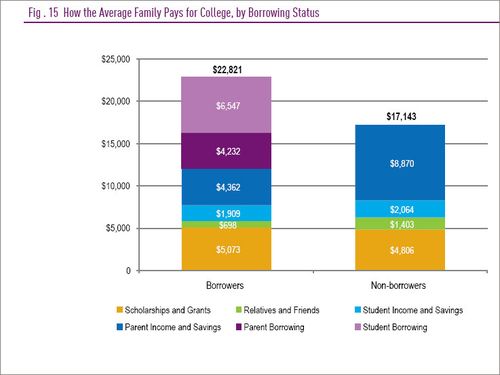
NPR passes along this graph on per year college costs and pulls out a few details from the Sallie Mae/Gallup study (pdf) from which it is drawn:

Students are starting to show signs of putting off school for now. Fewer students said they would rather borrow than not attend college this year, with 53 percent compared to 67 percent last year. It may also be that budget-conscious students have become more wary of debt and are economizing by choosing cheaper schools. Students who borrowed money spent 30 percent more on tuition than those who did not.

The report answers my earlier question: about one percent of college financing this last year came from home equity loans. Though the housing bust will impact those seeking higher education in a myriad of ways my earlier fears appear overblown.

Andrew’s Take On The Latest Torture

by Chris Bodenner

In case you missed it today, he broke from his bloggatical to deliver a barnburner against Cheney, the NYT, and Congressman Peter King over fallout from the inspector general's report. A taste:

The descent of the United States – and of Americans in general – to lower standards of morality and justice than those demanded by Iranians of their regime is a sign of the polity's moral degeneracy.

Read the rest.

Spoon-Fed Morality

by Patrick Appel

Jonah Goldberg claims that because TV series and movies show good guys torturing bad guys to get information these cultural products are "tapping into and reflecting the popular moral sentiments." Anonymous Liberal rightly whacks him:

When you are shown unequivocally that the person being tortured is an evil mass murderer and that the person doing the torturing is a pure-hearted hero — and you are then shown that the torture in fact leads to the disclosure of information that saves a bunch of childrens' lives — it is no wonder that viewers are prepared to morally absolve the torturer. That moral conclusion is being spoon-fed to them in the form of a highly-stacked utilitarian calculus. The thumb is pressing down quite hard on the scale. If, on the other hand, you were to tell a different story, say one involving a detainee of questionable guilt being brutally beaten to death with a flashlight (as described in the IG report), you would likely elicit a very different emotional response.

Messaging Is Not A Science

by Patrick Appel

The WSJ runs a story on the words polled and approved by both sides of the heath care debate. Drum sighs:

I mean, public instead of government is a no-brainer.  Hell, Sean Hannity only figured out a few days ago that he ought to stop using the president's language and instead call it a "government option."  So no problem there. But sliding scale?  I don't care how well that polls, it's ridiculous. Nobody over sold anything by saying it was priced on a sliding scale.  It sounds like classic doublespeak.

Holder’s Baggage

by Chris Bodenner

Jason Zengerle offers another reason why Holder, according to Marc, "really had no choice" but to appoint a special prosecutor:

Remember, the biggest question about Holder prior to his becoming attorney general was whether he would be sufficiently independent of the president—an independence, his critics maintained, that he failed to demonstrate in his handling of the Marc Rich pardon […]. Given those question–and Obama's oft-stated desire to look forward rather than backward on the torture issue–Holder couldn't afford to look as if he was doing the president’s bidding by not investigating the CIA. […] The irony, of course, is that some of the very same conservatives currently attacking Holder for investigating the CIA were earlier attacking him for having insufficient political independence.

Lose the Foreskin!

by Hanna Rosin

The responses to the Center for Disease Control's proposal this week to require all American boys to be circumcized are predictably hysterical. Hundreds of commenters wrote into the New York Times today to complain about "child abuse" and "genital mutilation" and one "religious sect's agenda of control" (i.e. Jews). Subsequent news stories refer to the "controversial procedure" and quote CDC epidemiologists carefully measuring their words.

But the procedure is only "controversial" because people have emotional, psychological and religious reactions to it. Scientifically speaking, it's not remotely controversial. The anti-circumcision sites always refer to the American Academy of Pediatrics' 1999 policy statement on circumcision, which declined to recommend the procedure. But that statement was issued before the most compelling studies emerged about the role circumcision plays in reducing the risk for transmission of HIV and other STD's. This is a good overview from medical writer Arthur Allen

Three trials in which Kenyan and Ugandan men were randomly selected to receive circumcision were halted when it became clear that circumcision helped prevent transmission of HIV. Men who got it were about half as likely to get infected. “A 50% reduction is about the same as some vaccines,” says [Edgar Schoen, MD, who was chief of pediatrics at Kaiser-Permanente Healthcare.]

Yes, conditions in Africa are different. The trials showed results mostly in heterosexual transmission. But the evidence is still pretty strong, and even stronger for STD's. The problem with all this "controversy" is that Medicaid now doesn't pay for the procedure, which costs all of $300 in most hospitals. Rates of circumcision for the poor, particularly African Americans and Latinos, have plummeted in the last ten years.

Over on DoubleX, KJ Dell'Antonia makes the good feminist point. With the HPV vaccines, conservatives raise a fuss that removing the risk of STD's will make girls more sexually promiscuous. In the circumcision debate, silence on the promiscuity front.