by Patrick Appel
EqualityMaine has put out its first TV spot opposing a 2009 ballot initiative that would reverse Maine's recent marriage equality law. Well done:
(Hat tip: Gay Patriot)
by Patrick Appel
EqualityMaine has put out its first TV spot opposing a 2009 ballot initiative that would reverse Maine's recent marriage equality law. Well done:
(Hat tip: Gay Patriot)
by Patrick Appel
Greenwald rounds up the IG report's greatest hits:
Perhaps worst of all, the Report notes that many of the detainees who were subjected to this treatment were so treated due to "assessments that were unsupported by credible intelligence" — meaning there was no real reason to think they had done anything wrong whatsoever. As has been known for quite some time, many of the people who were tortured by the United States were completely innocent — guilty of absolutely nothing.
Publius lists the incidents we learned of yesterday:
The highlights include: (1) mock executions; (2) threatened rape of family members; (3) threatened murder of children; (4) kicking and beating a detainee with a metal flashlight to death; (5) threatening naked hooded detainees with power drills; (6) blowing cigar smoke in detainees' faces until they got sick; (7) waterboarding with massive volumes of water far beyond what OLC authorized (to make it "poignant"); (8) stress positions that nearly caused shoulder dislocations; (9) scraping detainees with stiff brushes; (10) choking a detainee with one's bare hands until they nearly pass out; (11) subjecting detainees to extremely cold temperatures and water dousing; (12) "hard takedowns" (sometimes in diapers); and (13) beating detainees with butts of rifles (followed by kicking them).
by Chris Bodenner
A reader writes:
You wrote, "But of course only individuals physically capable of combat will be sent to the battlefield, and women, on average, are not as capable as men." I'm sure you've received complaints about this line. Indeed, the anticipation of complaints is why you italicized "on average." It is simply impolite to say it: vanishingly few women are capable of the physical performance that the mission requires for infantry combat.
The military actually takes this into account: promotion scores in the Marines depend on physical fitness test scores, and they are curved for women. Heavily. If not for the curve there would be hardly any females in the Marines at all. Men are held to a higher physical standard to get promoted. Is this fair?
How much more so is this important in the infantry? Is it fair to ask infantry Marines to go into combat with a fighter on their left who isn't carrying the ammunition for the machine gun she needs to, because, well, it's too heavy for a woman? Or to go into combat with a compatriot who isn't able to carry him to safety if he is wounded, because she's not strong enough? Does egalitarianism entail no responsibility to be qualified for the position sought, when lives are at stake?
I have served in Iraq; I know Lioness Marines; I completely object to the program. It is one thing to say that we will overlook the reduced combat capacity of a woman in order to be able to search a female Afghan without offending a local sheik. It is another thing to say we will categorically lower the physical standards of a physically-intense, life-threatening field because almost no women would qualify otherwise. I will not let Marines die so that ERA supporters back home can hug themselves and say that patriarchy is dead. And I say that as an ERA-supporting, single-payer advocating, atheist socialist democrat.
Actually, I haven't received any complaints about that line, presumably because most readers agree that while the average woman is not as strong as the average man, there are certainly scores of extraordinary women who are stronger than many men – including many in the military.
But to the reader's larger point: I agree there should be one physical threshold for both men and women in combat units. And yes, currently they are different standards in place. For example, biannual physical training (PT) tests in the Army require men aged 17-21 to complete a 2-mile run in at least 15:54, while the female equivalent is 18:54. However, these are requirements for all Army personnel, not combat units (remember than women are still formally blocked from combat units). So while that different standard isn't technically "fair," I don't see a problem with it, since the typical Army job is unrelated to combat and thus not based on physical prowess. When the military does finally allow women into combat units on a formal basis, only then are equal requirements essential.
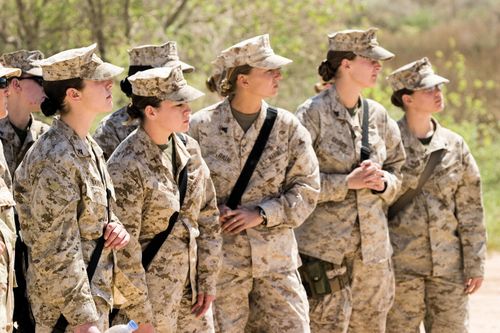
However, the Lioness Program – which allows female Marines to temporarily serve in combat units for the purpose of searching Muslim women – seems to muddy that distinction. So I can understand why the reader would object to the program. But would his objection – that a woman, in a rare instance, would have to carry a man to safety – really outweigh the overall need for female-searching females? Also, I'm guessing there are other temporary positions in combat units filled by people who don't have the same strength as combat Marines. Some translators? What about embedded reporters?
Despite all the reader's objections, he still doesn't seem to reject the idea of women in combat units. He wrote: "[V]anishingly few women are capable of the physical performance that the mission requires for infantry combat." Few, but still some.
(U.S. Marines and Navy sailors receive training in Al Asad, Iraq, during the Lioness Program on March 27, 2007, on various improvised explosive devices being used to attack coalition and Iraqi forces. This program is being taught to ensure the proper care is taken while searching female Iraqis. Photo by Sgt. James R. Richardson, U.S. Marine Corps.)
by Patrick Appel
After hearing that a CIA interrogator threatened to kill the children of a detainee, Julian Sanchez feels shame:
I guess what especially turns my stomach here is that the idea wasn’t just to inflict mental anguish on a presumably odious man in order to extract information. It was to inflict that pain by exploiting, as a weakness, whatever flicker of nobility or love remained in an otherwise wretched soul. It was a method of torture that would have been effective only because and to the extent there was something human left in him. Maybe I’m being overly sentimental, but every cell in my body is telling me this is sick and wrong.

by Patrick Appel
Niraj Chokshi looks at the data on education costs:
For 27 of the past 30 years, the price of education has grown at a faster rate than that of medical care. Education also grew faster than inflation for 29 of the past 30 years, while medical care beat inflation 27 of those years. Could education be our next health care crisis? The answer is probably no, at least not for a long time. Average spending on medical care was between three and four times more than that of education in any given year from 1984 to 2007, the only range that the Labor Department's spending data was available. In 2007, the average consumer unit, similar to a household, spent $2,853 on medical care and $945 on education.
Ezra Klein asks:
I'd like to know what experts think is driving the numbers. Is this hiding a relatively benign story, in which a lot more people are going to college, or graduate school, or even just choosing a private school? Is it just the cost of human labor rising quickly? Or is it more problematic? Or both?
On top of Ezra's questions, I'd like to know about how the decline in housing values might impact this upward trend in education. When housing was going up, poorer homeowners could borrow against the cost of their home to help pay for their kids to go to college. The poorest among us probably won't be much affected because they likely didn't own a house in the first place, but the lower middle-class and middle-class of America could take a hit.
by Chris Bodenner
From Cheney's statement:
The activities of the CIA in carrying out the policies of the Bush Administration were directly responsible for defeating all efforts by al Qaeda to launch further mass casualty attacks against the United States. The people involved deserve our gratitude. They do not deserve to be the targets of political investigations or prosecutions.
Now compare that compassion with his words for Lynndie England just six months ago:
At Abu Ghraib, a few sadistic prison guards abused inmates in violation of American law, military regulations, and simple decency. For the harm they did, to Iraqi prisoners and to America's cause, they deserved and received Army justice. And it takes a deeply unfair cast of mind to equate the disgraces of Abu Ghraib with the lawful, skillful, and entirely honorable work of CIA personnel trained to deal with a few malevolent men.
As Andrew wrote:
Look at the photos again. Forced nudity: approved by Cheney. Hooding: approved by Cheney. Stress positions: approved by Cheney. Use of dogs: approved by Cheney.
Power drills and mock executions: not approved by Cheney. Right?
by Patrick Appel
Scott Horton wants to know why Attorney General Eric Holder didn't release the Office of Professional Responsibility (OPR) report yesterday along with the rest of the torture docs. One possibility:
[T[he Holder Justice Department may want attention focused on the CIA interrogators and away from the reprehensible role played by Justice Department. Release of the OPR report would fuel discussion of the role played by John Yoo, Jay Bybee, and Steven Bradbury and of the link between the CIA and Vice President Cheney’s office—since the OLC memos were written as a collaborative effort between the OLC attorneys and still-unidentified persons who worked for Cheney.

by Patrick Appel
Michael Scherer lists "five important revelations" from the IG report. Number four:
The CIA IG concluded that while high-value detainees did produce valuable intelligence, the measurement of the effectiveness of harsh interrogation techniques “is a more subjective process and not without some concern.” The CIA lists four reasons for this muddled view. First, “the Agency cannot determine with any certainty the totality of the intelligence the detainee actually possesses.” Second, “each detainee has different fears of and tolerence for” harsh techniques. Third, “the application of the same” harsh technique “by different interrogators may have different results.” The fourth reason that the CIA IG found the effectiveness of harsh techniques could not be known objectively remains classified, and was redacted on the released document.
Ackerman expands on this point:
In the absence of information, “the assumption at Headquarters” became that if a detainee wasn’t giving interrogators what they wanted, it was because the detainee hadn’t been sufficiently tortured. “Consequently, Headquarters recommended resumption of EITs [enhanced interrogation techniques].” There became no way for a detainee to prove that he didn’t know something. In that way, once torture was introduced, a prudential interrogator calculation — he probably knows more — became a license to continue the torture.
The documents released yesterday prove nothing about torture's effectiveness, but Cheney is claiming victory. I guess after "death panels" reality is whatever you make it. This reminds me of a line from Mark Danner's speech from 2007 on the reality that the Bush administration encased itself in.
The ceremony served not to proclaim truth but rather to assert and embody a proposition that has been central to the current administration: Truth is subservient to power. Power, rightly applied, makes truth.
Cheney embodies that definition of "truth" better than anyone else.
(Photo: Chip Somodevilla/Getty.)
by Chris Bodenner
The former vice president releases a statement through the Weekly Standard and, predictably, claims vindication:
The documents released Monday clearly demonstrate that the individuals subjected to Enhanced Interrogation Techniques provided the bulk of intelligence we gained about al Qaeda. This intelligence saved lives and prevented terrorist attacks.
Even before that statement was released, Ackerman forsaw such language:
Cheney’s public account of these documents have conflated the difference between information acquired from detainees, which the documents present, and information acquired from detainees through the enhanced interrogation program, which they don’t. […P]erhaps the blacked-out lines of the memos specifically claim and document that torture and only torture yielded this information. But what’s released within them does not remotely make that case.
In other words, Cheney did not write, "The documents released Monday demonstrate that Enhanced Interrogation Techniques provided the bulk of intelligence."
by Patrick Appel
Via Marcy Wheeler, I see that the ACLU has more documents from yesterday's dump. Several of these are as recent as 2007. I've not had a chance to completely read them, but the report titled "2007 OLC opinion on Interrogation Techniques" (pdf) from July 20, 2007 by Steven Bradbury is a full-fledged defense of six CIA interrogation techniques. Interrogators seem to have had an affinity for sleep deprivation:
 The way Bradbury weasels around Geneva's Common Article 3 requires some generous redefining of terms like "punishment" and "outrage." Also check out this footnote that says, if my reading is correct, that Bush could use the Military Commissions Act to ignore the Hamdan ruling if he so desired (click for a larger image):

That's an incredible understanding of executive power, even for Bush. E-mail me at andrew@theatlantic.com if you find anything else of interest in this memo or any of the other documents.
 The Dish