Quote For The Day II

Agblood

by Andrew

"[T]here was so much information in the public domain — and so much information that would eventually be released — that the attorney general could no longer argue that no specific instances of lawbreaking had been brought to his attention. When an OLC memo says "Don't ever do X," and a Red Cross report, backed up by independent witnesses and government cables, is explicit that "X" happened, Holder really had no choice. Some on the left have argued that President Obama risked the legitimacy of American judicial institutions by forgoing a broader investigation and by urging his attorney general not to look more deeply at past practices.  If the Attorney General didn't at least review past cases in the light of all available information, the administration could fairly be accused of refusing to accept the obvious. Lieberman should be satisfied that Holder has decided to limit the investigation to twelve documented instances of abuse, and that the White House's first reaction here was to worry about morale at the CIA," – Marc Ambinder.

Dissent Of The Day

by Chris Bodenner

A reader writes:

As a rule I'm pretty amused by your sarcasm, but your bit on "The Hurricane Whisperer" is kind of disgusting. I was even more disgusted after having read the article to which your referred. You conveniently left out the final paragraph, in which Crist says he takes no credit for the lack of hurricanes, but leaves it up to God – not to mention the entire tone of the article, which is light and whimsical. I'm not sure what prompted you to take such a cheap and dishonest shot, and to tie into it the death of a child, but it's bad form and you should know better.

Yeah, it was pretty mean-spirited of me, particularly since Crist is not a politician to readily exploit religion. He deserved the benefit of the doubt. Nevertheless, his caveat was lame, and his invocation of God was tasteless, especially since the hurricane was still raging. But I was probably just as tasteless.

In my defense, this weekend I was stuck on a plane next to a Baptist minister who persistently pushed his faith on me. He had been rushing from a late connecting flight and attributed his nick-of-time arrival to his prayers (the real reason he made the flight was the hurricane, which delayed our take-off to DC). Also, by strange coincidence, a man right in front of me spent an hour trying to convince a hapless woman that his mixture of herbs cures AIDS. The charlatan was quite charming and said he was chosen by God, so who knows how many naive and desperate people he has grafted (he's already been arrested). Thus, when I wrote that post, I had religious exploitation on my mind.

Also by chance, last week I re-read "The Monkey's Paw," a classic short story whose theme is the tragic, unintended consequences of wishing/praying. I recommend it.

Health Care Non Sequiturs

Cbo health choices cost esitamte

by Patrick Appel

Conor Clarke whacks Lieberman for saying that we shouldn't do health care until after the recession:

As you can see, the real costs do not phase in until 2013. So there are three possible ways to make sense of Lieberman's argument. (1) Lieberman thinks the recession will extend into 2013. (2) Lieberman is referring to a cost estimate that no one else has seen. (3) Lieberman's argument is self-refuting: It makes no sense even if you accept his premise that we shouldn't pay for health-care reform in the middle of a recession. I vote for (3).

Suderman, meanwhile, takes on Michael Steele's spirited defense of Medicare.

Face Of The Day

OfficerGetty2

An officer with the US Customs and Border Protection waits for arrivals in Newark International Airport August 24, 2009 in Newark, New Jersey. Officials with U.S. Customs and Border Protection are introducing are introducing the Global Entry program, which allows pre-screening and approval of travelers and faster trips through customs and passport lines upon arriving into the United States. By Chris Hondros/Getty.

Cheney’s Sleight Of Hand

by Patrick Appel

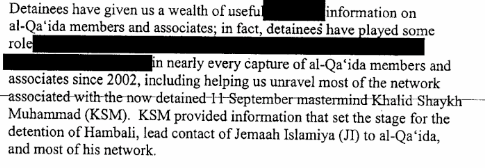
Ackerman has copies of the documents that Cheney said prove that torture works. Ackerman also notices a footnote on the CIA using the terms interrogator and debriefer interchangeably before 9/11. He posits:

Because of the joint relationship of “interrogators” and “debriefers,” it’s extraordinarily difficult to distinguish between what approaches worked and what didn’t for the purposes of the report. (Even factoring out moral and legal considerations.) That lack of disaggregation may be what contributed to the documents that Cheney wanted the CIA to declassify showing the alleged utility of torture.

The documents are heavily redacted, but nothing we can read refers to torture techniques providing solid information. Here's the type of paragraph that makes Cheney smile:

DetaineeInformation 

KSM was brutallty tortured, so it is entirely possible that information obtained from him was the result of torture, but nothing in these documents compares interrogation technique effectiveness. It's worth repeating that no one denies torture produces information. It produces loads of information, most of it bad. The same or better information can be collected through other techniques and, again, nothing in these documents compares and contrasts these methods. Here's Marcy Wheeler's analysis:

The most important thing to understand about these documents….is the timing. The first one came just after (July 17, 2004) the release of the IG Report and was, significantly, an attempt to rationalize the torture program. And the other came at a time (June 3, 2005) when Congress was increasingly pressuring the Administration to bring the torture program under CAT guidelines prohibiting cruel and inhuman treatment. So they're big PR pieces, boasting of how important KSM is to their fight against terror, boasting of how much information they've gotten from detainees.

The Oil Catch 22

by Patrick Appel

Roubini fears a double-dip recession. Free Exchange echos:

Growth above a certain rate will be sufficient to boost oil demand and prices up, dampening consumer spending and slowing expansion—potentially keeping the American economy from growing at a rate sufficient to decrease unemployment. That will be the dynamic until dependence on oil is sufficiently wrung out of the economy, which could take some time. This is yet another point arguing in favour of a prolonged and shallow recovery for the American economy.

Soldier Of Future

by Chris Bodenner

A reader writes:

As a veteran who has served with some outstanding women, I support the integration of the services, but take issue with your suggestion that physical prowess is becoming obsolete. No matter how fancy your toys are, you still need physically superior men and women to march through the bad areas where vehicles can’t travel, to continue on when technology breaks down, and to carry your buddy miles to safety when he or she gets shot. This is not to say that women cannot fulfill that role, but that it’s naïve to suggest that the need for physical strength and endurance has passed.

Of course physical prowess will never be obsolete; I wrote "becoming more and more obsolete" only to emphasize our rapid reliance on combat technology, such as back-mounted computer systems, combat-readiness drugs, exoskeletons (see above), and, eventually, semi-autonomous robots.

Our Delicious Future

by Conor Friedersdorf

In San Francisco there is a street cart company so popular that it has taken to occasionally renting out a local Chinese restaurant and serving sit down meals cooked by guest chefs like Fred Sasson, whose delicious offerings I enjoyed last week. Mission Street Food donates proceeds from these special evenings to local charities that feed the poor. My favorite dish an aged prime ribeye with seared cherry tomato, wasabi creme fraiche, basil oil, yucca crouton and katsuobushi ($11). Also delicious: Mediterranean Octopus Confit with shaved garlic, picked thyme, leccino and extra virgin olive oil ($10). Though the menu changes every evening these events happen, friends assure me that all are worth attending. (The street cart folks also had the good sense to shut off the awful fluorescent lights inexplicably ubiquitous in Chinese restaurants in favor of some hastily strung Christmas lights and table top candles.)

Gourmet street cart food is something of a trend lately — acquaintances in Portland rave about a Korean taco truck that roves the city, announcing its location via Twitter. Washington DC foodies are hopeful that eased municipal restrictions on street carts will lead to better options in the nation's capitol. The New York City market is successful enough that some vendors are paying five figure rents on their mobile stands.

My own food horizons are also lately improved by the excellent Yelp iPhone application, which I've tested out over the last week as I've traveled around California. Yesterday morning, I found myself in Hollywood near Sunset and the 101 Freeway, needful of a good spot for lunch, and afterward desiring a coffee shop with outdoor seating, free WiFi, sparse crowds and electrical outlets. A month ago I would’ve driven around semi-aimlessly and wound up someplace less than optimal. Now I allow Yelp to determine my location, scroll through its restaurant and coffee shop options, and wind up enjoying scenarios like the following: three exceptional fish tacos for $4.50, and what may be the perfect coffee shop for writing work, The Lyric Hyperion Theater and Cafe.

What I am hoping — I’m stealing this insight from a conversation, but I don’t remember who I had it with — is that Yelp plus smart phones, and other similar applications, will tip the competitive balance away from chain restaurants and toward exceptional independent eateries, bars and coffee shops. The uncertainty that is a cost of trying these establishments is growing ever lower with crowd-sourced ratings and reviews that are readily accessible even in neighborhoods far from where one lives. There is some lost fun finding hidden gems oneself, but I nevertheless welcome my new Yelp overlords. 

When I aired these thoughts at The American Scene, a commenter wrote, "I find something touchingly, heart-warmingly naive in the belief that the existence of broad, for-profit services with remarkable customization and targeting abilities will in the end favor small independent establishments over large faceless corporations with their own electronic communications/social media staff." I disagree. The social media staffs of most corporations aren't nearly savvy enough to fool or surpass the combined knowledge of Yelp users.