The Rotten Core

by Andrew

Greenwald notices the craven nepotism everywhere in Washington:

They should convene a panel for the next Meet the Press with Jenna Bush Hager, Luke Russert, Liz Cheney, Megan McCain and Jonah Goldberg, and they should have Chris Wallace moderate it.  They can all bash affirmative action and talk about how vitally important it is that the U.S. remain a Great Meritocracy because it's really unfair for anything other than merit to determine position and employment.  They can interview Lisa Murkowski, Evan Bayh, Jeb Bush, Bob Casey, Mark Pryor, Jay Rockefeller, Dan Lipinksi, and Harold Ford, Jr. about personal responsibility and the virtues of self-sufficiency.  Bill Kristol, Tucker Carlson and John Podhoretz can provide moving commentary on how America is so special because all that matters is merit, not who you know or where you come from. 

Late empires are known for several things: a self-obsessed, self-serving governing class, small over-reaching wars that bankrupt the Treasury, debt that balloons until retreat from global power becomes not a choice but a necessity, and a polity unable to address reasonably any of these questions – or how the increasing corruption of the media enables them all.

Obama is, in some ways, a test-case.

He was elected on a clear platform of reform and change; and yet the only real achievement Washington has allowed him so far is a massive stimulus package to prevent a Second Great Depression (and even on that emergency measure, no Republicans would support him). On that he succeeded. But that wasn't reform; it was a crash landing after one of the worst administrations in America's history.

Real reform – tackling health care costs and access, finding a way to head off massive changes in the world's climate, ending torture as the lynchpin of the war on terror, getting out of Iraq, preventing an Israeli-led Third World War in the Middle East, and reforming entitlements and defense spending to prevent 21st century America from becoming 17th Century Spain: these are being resisted by those who have power and do not want to relinquish it – except to their own families and cronies. 

Nepotism is part of the problem; media corruption is also part; the total uselessness of the Democratic party and the nihilism of the Republicans doesn't help. But something is rotten in America at this moment in time; and those of us who supported Obama to try and change this decay and decline should use this fall to get off our butts and fight for change.
Did Texas Execute An Innocent Man?

by Jonah Lehrer

In the New Yorker, David Grann investigates the case of Cameron Todd Willingham, who was executed in 2004 for murdering his three daughters by setting the house on fire. It's a horrifying story of incompetence:

In December, 2004, questions about the scientific evidence in the Willingham case began to surface. Maurice Possley and Steve Mills, of the Chicago Tribune, had published an investigative series on flaws in forensic science; upon learning of Hurst’s report, Possley and Mills asked three fire experts, including John Lentini, to examine the original investigation. The experts concurred with Hurst’s report. Nearly two years later, the Innocence Project commissioned Lentini and three other top fire investigators to conduct an independent review of the arson evidence in the Willingham case. The panel concluded that “each and every one” of the indicators of arson had been “scientifically proven to be invalid.” 

 In 2005, Texas established a government commission to investigate allegations of error and misconduct by forensic scientists. The first cases that are being reviewed by the commission are those of Willingham and Willis. In mid-August, the noted fire scientist Craig Beyler, who was hired by the commission, completed his investigation. In a scathing report, he concluded that investigators in the Willingham case had no scientific basis for claiming that the fire was arson, ignored evidence that contradicted their theory, had no comprehension of flashover and fire dynamics, relied on discredited folklore, and failed to eliminate potential accidental or alternative causes of the fire. He said that Vasquez’s approach seemed to deny “rational reasoning” and was more “characteristic of mystics or psychics.” What’s more, Beyler determined that the investigation violated, as he put it to me, “not only the standards of today but even of the time period.” The commission is reviewing his findings, and plans to release its own report next year. Some legal scholars believe that the commission may narrowly assess the reliability of the scientific evidence. There is a chance, however, that Texas could become the first state to acknowledge officially that, since the advent of the modern judicial system, it had carried out the “execution of a legally and factually innocent person.”

Just before Willingham received the lethal injection, he was asked if he had any last words. He said, “The only statement I want to make is that I am an innocent man convicted of a crime I did not commit. I have been persecuted for twelve years for something I did not do. From God’s dust I came and to dust I will return, so the Earth shall become my throne.”

Filtering The Front Lines, Ctd

by Chris Bodenner

Rendon gets nixed:

The U.S. military is canceling its contract with a controversial private firm that was producing background profiles of journalists seeking to cover the war that graded their past work as “positive,” “negative” or “neutral,” Stars and Stripes has learned. […] The announcement follows a week of revelations by Stars and Stripes in which military public affairs officers who served in Afghanistan said that as recently as 2008 they had used reporter profiles compiled by The Rendon Group, a private public relations firm in Washington, D.C., to decide whether to grant permission to embed with troops on the battlefield.

In a week when WaPo gives cover to torture apologists and Chris Wallace massages Cheney's messaging, it's especially gratifying to see that some people are still doing good journalism (and, in this case, enabling even more good journalism). Well done, Kevin Baron, Charlie Reed, Leo Shane III, and everyone else at Stars and Stripes.

Dissents Of The Day

by Andrew

Two emails typical of others:

Go ahead. Vindicate Cheney. Me, I would have cut KSM up with a bolt cutter. Burnt him. Cut off fingers. I am furious that we did not cut him up into pieces. Absolutely furious. As are most reasonable Americans. We love KSM being tortured. Me, it is the worst thing that he was only waterboarded. Bolt cutters and blow torches. That's most of us.  

Another:

If this man were to have his flesh peeled inch by inch over the course of a month, I could not possibly have less sympathy, and I suspect I'd have an overwhelming majority of Americans to agree. (Just maybe not on paper or in a poll)

You cannot expect people to share, listen or even give any credence to what you say if you trot out a worthless mass murderer as a play on our morality. In normal people, right or wrong, the rights we hold dear, and the treatment we'd expect to give certain individuals are never going to be afforded those we all agree are just not worthy.

Khaled Sheikh Mohammed is one of those people. I am not aghast, ashamed or outraged at his treatment.

This is the America Cheney loves. It exists, though thankfully, I believe, in a minority. It believes in no laws or treaties restricting the power of government to pursue, torture, mutilate and murder those deemed "the other," or simply "those we all agree are just not worthy." One wonders what classes of people qualify as those "we all agree are just not worthy." One remembers the antecedents to this mindset in slavery and lynching and internment (the latter defended by the woman who know stands atop the New York Times bestseller list). 

It is a form of fascism, designating some human beings as sub-human and empowering the state to torture them in any way that can satisfy the need for revenge. And it is the end of the rule of law, and the inverse of any serious form of Christianity. This impulse, the impulse for vengeful, sadistic violence against the other, is what now motivates large swathes of what's left of the GOP.

They are the torture party now. And so, so proud of it. Just ask Chris Wallace.

Marijuana Goes Mainstream

by Jonah Lehrer

First of all, I'd like to thank Andrew for letting me borrow his soapbox for the week. As as a longtime reader, it's a great honor to be here.

The LA Times profiles the normalization of pot:

After decades of bubbling up around the edges of so-called civilized society, marijuana seems to be marching mainstream at a fairly rapid pace. At least in urban areas such as Los Angeles, cannabis culture is coming out of the closet.

At fashion-insider parties, joints are passed nearly as freely as hors d'oeuvres. Traces of the acrid smoke waft from restaurant patios, car windows and passing pedestrians on the city streets — in broad daylight. Even the art of name-dropping in casual conversation — once limited to celebrity sightings and designer shoe purchases — now includes the occasional boast of recently discovered weed strains such as "Strawberry Cough" and "Purple Kush."

Public sentiment is more than anecdotal; earlier this year, a California Field Poll found that 56% of California voters supported legalizing and taxing marijuana. Last month, voters in Oakland overwhelmingly approved a tax increase on medical marijuana sales, the first of its kind in the country, and Los Angeles Councilwoman Janice Hahn has proposed something similar for the City of Angels. "In this current economic crisis, we need to get creative about how we raise funds," Hahn said in a statement.

I recently moved to Los Angeles and I'm still adjusting to all the medical marijuana stores – there are two within a mile of my apartment. And it's not just the dispensaries, with their parking lots full of fancy cars – it's the Amsterdamesque attitude. Light up a joint and people ask for a hit; light up a cigarette and they give you a dirty look.  

My hunch is that the normalization of marijuana is here to stay. In recent years, there's been increasing interest among scientists in cannabinoid receptors, which are the cell receptors activated when you inhale some THC, the active ingredient in marijuana. (There's a grand scientific tradition of naming cell receptors after the drugs that activate them, which is why you also have opiate receptors and nicotinic receptors. For some still mysterious reason, a chemical in the tropical shrub cannabis sativa  is able to perfectly mimic our natural neurotransmitters. As Roger Nicoll, a neuroscientist at UCSF, puts it: “The brain makes its own marijuana.” Smoking a joint just helps you make more of it.) While these cannabinoid receptors have been targeted for the treatment of a wide variety of ailments and disorders, from obesity to chronic pain, I think they might hold the most promise for the treatment of anxiety. There's now good evidence that mice lacking a normal cannabinoid receptor have difficulty forgetting or unlearning fearful memories. This suggests that endocannabinoids – the natural molecules in your brain that work like THC – help the brain get over the negative emotions  triggered by past trauma. Of course, this shouldn't be too surprising: Despite the fact marijuana was first cultivated almost 10,000 years ago, modern medicine has yet to find another substance that can melt away our fears with such slick efficiency.  

Neuroscientists now believe that a faulty endocannabinoid system might play a part in all sorts of anxiety syndromes, from post-traumatic stress disorder to irrational phobias. The Holy Grail of Big Pharm would be a THC compound targeted to the specific parts of our brain—like the amygdala—that modulate our sense of fear. Such a pill would give us the anti-anxiety effects of pot, but without the giddiness, hunger or irrational urge to watch The Big Lebowski. While scientists still don’t know if such a site-specific pill is possible—can we just get our amygdala high?—experiments done in the next few years should help resolve the issue. If such a pill ever hits the market, of course, I think it would dramatically alter the way in which most Americans (and not just those in my liberal zip code) think about marijuana. Weed would no longer be synonymous with Cheech and Chong, or Jeff Spicoli, or Harold and Kumar. Instead, it just might be the new Prozac.

Why Don’t People Buy Insurance?, Ctd

by Patrick Appel

A few readers have taken issue with this post where I linked to Jonah Lehrer's discussion of the cognitive biases at work in the health insurance market. I didn't mean to imply that these were the only reasons that people don't buy insurance, cost and pre-existing condition rejection are big factors, but the issues Jonah raises are relevant when discussing one silver of the uninsured. A typical response:

I think Jonah Lehrer may be correct that some people don't buy health insurance for the reasons he states.  But there are many other reasons that people do not buy health insurance. I do have health insurance that I buy as an individual.  No group policy. If I had diabetes, that pre-existing condition would not be covered nor anything the insurance company decided was related to diabetes, which could be almost anything. My insurance premium would also be sky high even though that condition was not covered. In my state, it is highly unlikely I could find an insurer to sell me a policy. My husband was denied coverage even though perfectly healthy and NO pre-existing conditions. So getting a policy is not as easy as he may think.

Another reader:

I'm wonder if Jonah would shell out $90K for a cochlear implant. It's my heart's desire but my deafness is a pre-existing condition that *no* insurance company will cover short of a several thousand dollar monthly premium. I'm otherwise completely healthy and an implant would put me back in the work force for the first time in eighteen years. How do you buy insurance when you don't have a job? I'm not old enough for Medicare and I've been denied SSI **twice** on the premise that I'm able to work.  How do you get a job that doesn't require the ability to hear? After handing out 170 resumes over the past decade, all I know is that once an employer knows you may have two college degrees but you can't answer the goddamn phone.

Cancer As The Cure

by Chris Bodenner

Michael Wilkerson reminds us that the conviction of al-Megrahi, the Lockerbie bomber, was questionable from the start, and that his pending appeal – nixed upon his release – actually had a chance of succeeding. He also points to an "astute, if impolitic" assessment by Glen Newey:

It served nobody’s interests to have the Lockerbie bombing conviction debated in open court. Hence the great good fortune of al-Megrahi’s terminal prostate cancer, which sped his release from Greenock. With a ‘compassionate’ wave of the biro, the [Scottish National Party] administration has rid itself of a high-profile prisoner with an unsafe conviction and enhanced, or created, its international profile. The UK government can keep in with the Libyans and protect its commercial contracts, on the plea of respecting devolved powers. […] It’s almost enough to make one believe in divine providence.

Wilkerson adds another whiff of intrigue:

To be clear, it is unlikely officials could fake the cancer diagnosis and Al-Megrahi does not look very well in the photos of his departure from Scotland. But well, who knows? Maybe he'll make a miraculous recovery at home in Libya.

Tortured To Blog

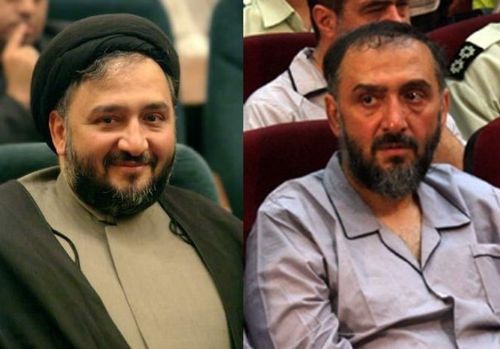
Abtahi

by Chris Bodenner

Hamid Tehrani of Global Voices reports:

Mohammad Ali Abtahi, a leading reformist blogger and former vice president, started to update his blog in prison. He says that the interrogation continues but he has very friendly relation with interrogator and protesters in prison know that there was no significant fraud in Iran's presidential election.

Does Abtahi look like he's been friendly with his interrogator?