Medal Of Goner

by Chris Bodenner

David Silbey reads a heroic account of Marine Pfc. Richard Weinmaster in Afghanistan and writes:

Now that reads to me like a Medal of Honor citation. Weinmaster didn’t quite jump directly onto a grenade, but he did put himself between the grenade and his fellow marines, shielding them from the explosion and absorbing the blast. More, after Navy-cross surviving that, he got back up, grievously wounded (including having a bit of shrapnel lodged in his brain, where it remains to this day), and continued to fire on the ambushers until literally collapsing from his wounds. Rating acts of valor is a bit of a mug’s game, but having read a fair number of Medal of Honor citations, that account would not, it seems to me, be out of place. The citation, however, is not for a Medal of Honor: Weinmaster was awarded the Navy Cross, the second highest award for sailors and marines. The most substantial difference that I can see from his situation and other recent Medals of Honor is that Weinmaster survived the action.

In fact, during the last eight years in Iraq and Afghanistan, only six Medals of Honor have been awarded – all posthumously. In Vietnam, only 92 of the 246 recipients lived to see their award (one of them – Robert Patterson – happened to be in my dad's platoon). Congressman Duncan Hunter is pushing a bill to have the selection process reviewed.

Finally, to add a bit more perspective on the Gitmo transfer debate: Leavenworth is home to more Medal of Honor recipients than any other place besides Arlington.

The Biology Of Joyfulness

by Patrick Appel

Huda Akil is exploring it:

I recently challenged my laboratory staff to think of animal models that could teach us about the biology of joyfulness, if not long-lasting happiness. My student, Javier Perez–possibly because he was in a joyous stage of life, having just completed a Ph.D. and fathered a beautiful little girl–rose to the challenge. He initiated studies on the impact of music alone or music coupled with an enriched environment (a space filled with toys) on the emotional responses of rats and associated changes in their brains. Although these studies are currently being run in adult animals, I have a feeling that we will shortly move to very young animals to determine whether such experiences have a long-lived effect on the brain and how. I am betting that the repercussions will last far beyond the momentary enjoyment, that such fun and positive activities will not only enhance positive responses in adulthood but also protect against stress and modify coping strategies. Science will tell.

(Hat tip: 3QD)

Would A Health-Care Mandate Be Unconstitutional?

by Conor Clarke

Interesting op-ed in the Washington Post about whether it would be constitutional for the federal government to pass an individual health-care mandate — i.e., a requirement that everyone purchase a health-care plan. Of course, no mandate supporters take the position that the law should read, "purchase health care or face death by hanging." That would probably be a bad law. It would also, says the Post authors, be an unconstitutional law.

But mandate supporters do imagine using tax incentives to nudge everyone towards buying a plan, and the Post piece takes the position that it would also be unconstitutional to have tax penalties for individuals who don't. And that's where my intuition gets confused. So here are some legal questions: Tax benefits that encourage people to do certain things — get married, buy a house, have kids — can be described as disadvantageous to individuals who choose not to take part (or who are legally prevented from doing so). But the United States is filled to the gills with these tax carrots. So does the law operate only in one direction here? Is it unconstitutional to face a tax penalty if you don't do something ("purchase health care") but just fine to enjoy a tax benefit if you do ("purchase a house")?

I understand that the law is filled with one-way ratchets. And I understand why. But if that's how the law works in this case, why can't someone sneak a mandate in through the constitutional back door? You could have a "health-care head tax" of $500 per person (or whatever), and you could rebate that amount to the individuals who purchase plans. This would have the effect of punishing everyone who doesn't purchase a health-care plan, but it would be indistinguishable from lots of junk that already litters the tax code.

Face Of The Day

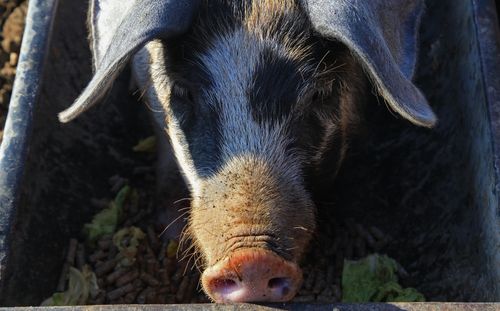
PigGetty

Pigs belonging to Jan Fletcher that she owns with her partner and two other couples feed on land close to her home on August 17, 2009 in Peasedown, England. This week major DIY retailer B&Q, announced that it is planning to stock modern pigsties to cater for the growing number of consumers interested in keeping animals in their back garden. Helped in part by the recession, recent evidence suggests lots of people in the UK are keener than ever to grow their own food, be it vegetables or more adventurous husbandury such as bee-keeping and pig rearing. By Matt Cardy/Getty.

Making Your Opponent’s Argument For Him

by Patrick Appel

Julian Sanchez wonders if there is a better way to argue about politics:

Consider the way our views normally evolve. We sort of hunker down in our ideological bunkers trying to fend off various attacks and challenges. Sometimes an especially forceful argument will require a modification in the fortifications—and on rare occasions, we’ll even be forced to abandon a position. Which is to say, we learn from other perspectives largely in a defensive mode, through a kind of Darwinian selection of arguments.  But what if instead we tried to use the insights available from our own perspectives, not to defeat or convert the other guy, but to give his argument its best form?

This might sound like giving aid and comfort to the enemy, but even in terms of the Darwinian struggle, there’s value to being able to show how your view trumps even the optimal form of the competition. Think of chess: You can’t see your own best move unless you have some sense of what your opponent’s best response would be. But the more intriguing possibility is that a smart progressive’s good-faith reformulation of libertarianism might be something that the libertarian, too, could recognize as an improvement—and vice versa.

Will Obama Kill The Netroots?

by Patrick Appel

Henry Farrell posits:

The real worry for the netroots is that Obama is undermining their particular blend of online politics. He has taken the parts of netroots politics that he likes (online organizing and fundraising), while dumping the parts that he doesn’t (a strongly confrontational politics and emphasis on bottom-up decision making). There isn’t much room for the netroots and vigorous online partisanship in Obama’s plans for the future of the Democratic Party.

(Hat tip: Sides)

Inglourious Basterds As Comedy

by Conor Clarke

There is much debate about what genre Quentin Tarantino's Inglourious Basterds deserves. Is it comedy? Philosophy? Revenge fantasy? Silly exploitation? David Denby, for instance, takes that position that it's "lodged in an uneasy nowheresville" between these things. I'd take the position that it's too easy to over-intellectualize a Tarantino film, which is probably just an empty (but extremely well crafted) vessel studded with encyclopedic and occasionally annoying references to films the director likes. Good luck speculating about Tarantino's intentions. But I can report that the audience with which I saw it last night treated it as comedy, which is probably the right mindset with which to enter the theater, at least if you want to have an enjoyable experience.

The Root Of Honesty

by Patrick Appel

Veronique Greenwood reports on the science of truth-telling:

[Harvard’s Joshua Greene and Joseph Paxton's] study suggests that honesty in particular is automatic only for some, which [John Bargh, a Yale social psychologist who studies automaticity,] interprets to mean that some portion of the population might be naturally honest, while others struggle with telling the truth. “It could potentially be some of the most intriguing evidence for group selection,” Bargh speculates, adding that the results are reminiscent of the evolutionary idea that “cheaters” and “suckers” coexist in a specific ratio in the animal kingdom. The classic example is parasitic cuckoos and the hapless birds that raise the cuckoos’ young. Bargh wonders if the ratio of “cheaters” to “suckers” exists in our species as well.