by Chris Bodenner
If Ali G worked for the Swedish Tourism Authority:
(Hat tip: BF)
by Patrick Appel
Radley Balko passes along a video.
by Patrick Appel
The Economist reports on the connection between climate change and farming:
Imagine a small group of farmers tending a rice paddy some 5,000 years ago in eastern Asia or sowing seeds in a freshly cleared forest in Europe a couple of thousand years before that. It is here, a small group of scientists would have you believe, that humanity launched climate change. Long before the Industrial Revolution—indeed, long before a worldwide revolution in intensive farming, the results of which kept humanity alive—people caused unnatural exhalations of greenhouse gases that had an impact on the world’s climate.
by Patrick Appel
Sarah Palin joins the tort reform debate. I have a hard time believing that she actually wrote this for reasons Gawker has outlined in the past.
by Chris Bodenner
In the Friday prayer sermon in Tehran, Ayatollah Ahmad Jannati – the head of the Guardian Council and a strong Ahmadinejad supporter – implied that the top leaders of the reform movement should be arrested. Meanwhile, in the conservative holy city of Qom, the popular Ayatollah Ali Amini condemned the government’s use of violence and called for the release of prisoners. NIAC notes the significance:
The striking differences between the sermons in Iran’s political capital (Tehran) and its religious capital (Qom) provide further evidence of a deep rift between religious and political sectors in Iran that has developed since the June 12 election.
by Conor Clarke
That question is answered here. I should say that I do find it quite surprising that 16% of the birthers actually approve of the job Obama is doing as president. This suggests to me that they might not understand the upshot of the question. Meanwhile, a solid 63% of Palin supporters think that Barck Obama was not born in this country.
by Conor Clarke
If you're sick of hearing about Nazis and death panels and health care, here's something else entirely: A piece in the New York Times about a championship runner whose accomplishments are being challenged because she might not qualify as a woman. Really. You might wonder, as I did, why there's uncertainty here. When the clothes come off, it's either there or it isn't, eh? Nope. I encourage you to read the whole piece.
But there is one general point to make about this kind of story, and I think it's an important one. If it turns out that the young woman has a muddily advantageous genetic composition, we would all consider it "unfair" to the other young women against whom she competes. After all, the outcome of a competition like running is supposed to be determined by training and grit, not the utterly arbitrarily presence of an extra gene.
And yet that intuition is impossible to extend. We are all born with talents that are equally arbitrary — strength and intelligence and social grace — and yet we all compete for prizes under the impression that the outcomes are fair. Perhaps something called free will enters the picture at some point. And perhaps not: The ability to work hard might be doled out just as arbitrarily at a Y Chromosome or a great voice. I don't know how you'd prove it either way.
Anyway, the cynical conclusion here is that there's nothing inherently just or fair about these outcomes. The idea of life as a meritocracy seems awfully nice, but it's undermined before the race even starts.
by Peter Suderman
I normally cringe my way through Michael Gerson columns, but I think this is just about right:
Talk of "death panels" is the parody of the debate — hyperbolic and self-defeating. But a discussion about the prospect of rationing in a public health system is not only permissible but unavoidable. Every nation that has promised comprehensive, low-cost health coverage for all citizens has faced a similar dilemma. Eventually it is not enough to increase public spending or to reduce waste. More direct forms of cost control become an overwhelming priority. And because health expenditures are weighted toward the end of life, the rationing of health care often concerns older people most directly.
Keith Hennessey, former director of the National Economic Council, puts the dilemma simply: "Resources are constrained, and so someone has to make the cost-benefit decision, either by creating a rule or making decisions on a case-by-case basis. Many of those decisions are now made by insurers and employers. The House and Senate bills would move some of those decisions into the government. Changing the locus of the decision does not relax the resource constraint. It just changes who has power and control."
As I've written before, I think warnings about rationing are a red herring. The word is typically off-limits in reasonable health-care conversations — politicians don't like admitting that not everyone will get everything they want — and thus when it is used, it tends to be to scare people. But the fact is, health-care resources are limited; we already ration them through the current mesh of employers, insurers, and government agencies and regulations; and the question is not whether to ration, but who gets to make decisions about care and how.
Leave decisions to central authorities, and individuals and providers tend to have fewer choices, and innovation tends to proceed somewhat more slowly. Leave decisions in the hands of private entities, and care tends to be spread less evenly. Beyond the hyperbole on both sides, the fact remains that no matter how one structures the rationing process — whether it emphasizes government or the private sector — there are always trade-offs.
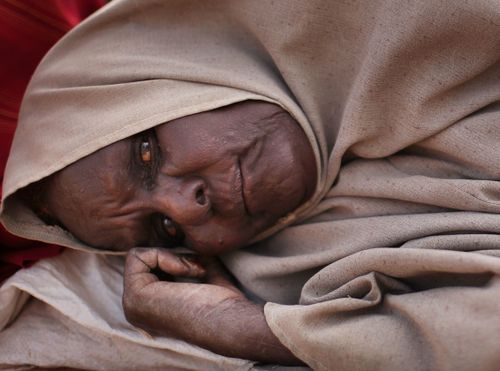
A woman rests while in line at a processing center for new arrivals in Dadaab, the world's biggest refugee camp August 20, 2009 in Dadaab, Kenya. The Dadaab refugee complex in northeastern Kenya consists of three separate camps and has been in operation for 18 years and is currently home to some 289,500 inhabitants. Most of the residents of the camps are Somalis who are fleeing escalating violence in that country. Dadaab currently holds three times as many people as it was designed for with 43,000 refugees arriving from Somalia this year alone. Concerned over the deteriorating situation in Dadaab, the Kenyan government has recently begun moving some refugees to another camp which is a three day bus ride away. By Spencer Platt/Getty.
 The Dish