A Vatican Double Standard?

by Chris Bodenner

A reader writes:

In watching the funeral mass for Ted Kennedy, I was struck by a question that seems relevant to gay civil marriage: What is the status of Ted and Vicki's marriage according to Church law?

To my knowledge, the relevant facts are (a) they each have a prior living spouse, whom they each married in Catholic wedding ceremonies, (b) each of Ted and Vicki had obtained a civil divorce (but not a church sanctioned annulment) prior to marrying each other in a civil ceremony in Virginia, (c) much later, Ted later obtained a Catholic annulment of his marriage to Joan Bennet, (d) Vicki never received an annulment from her first husband (please confirm) and (e) Ted and Vicki's civil Virginia marriage was never solemnized by the Catholic Church (please confirm).

So does the Church view them as "married"? The officiating clergy during the religious services certainly referred to Vicki as Ted's wife and spouse. If, as I suspect, they are not "married" as defined by the RC Church, then why was Vicki recognized, addressed, praised and prayed for in Church yesterday as Ted's spouse? If we imagine that Ted had a legal and valid Massachusetts civil marriage to a man, instead of a legal and valid Virginia civil marriage to a divorced woman, would his male spouse have been recognized, addressed, praised and prayed for in Church today as Vicki was? Am I seeing some blatant Catholic church double standards, or is their marriage valid under Catholic marriage laws?

Regarding (e), the Boston Globe reported: "[H]is second marriage, to Victoria Reggie, although conducted as a civil ceremony, was "blessed by the church,'' according to Kennedy's office." I couldn't find anything regarding (d) – her annulment. Perhaps a reader with more time and knowledge can help
A Big-Hearted Sort Of Politics

by Patrick Appel

From Andrew's column marking Ted Kennedy's funeral:

He was a senator able to be fiercely ideological and also fiercely pragmatic, able to develop friendships beyond politics – friendships that are the grease that makes the Senate work. He was a master of parliamentary procedures and the helm of a ship of highly skilled staffers.

He was also, of course, a politician. Despite being a proponent of green energy, he single-handedly prevented the construction of a wind farm off Cape Cod because it might obstruct his sea view. In 2004 he fought hard to remove Romney’s right to appoint a temporary senator if John Kerry were to win the presidency. And yet in the week before his death he urged a return to the appointment of a temporary senator – in order to keep a Democratic vote for healthcare reform intact. He could be partisan and hypocritical, as well as bipartisan and principled.

He was also, I can personally attest, the de facto father of the orphaned children of Jack and Bobby.

Face Of The Day

VictoriaKennedyGetty

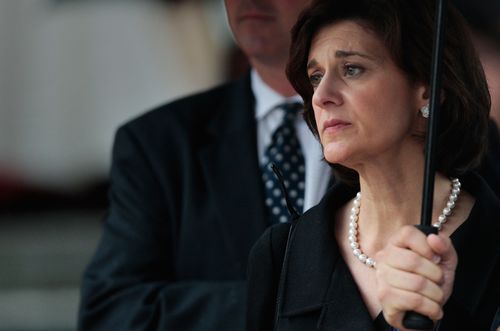
Widow Victoria Kennedy watches the coffin of her husband Senator Edward Kennedy be loaded outside of the Basilica of Our Lady of Perpetual Help after the funeral of the senator August 29, 2009 in Boston, Massachusetts. Kennedy, youngest sibling to brothers President John F. Kennedy and Robert F. Kennedy, died of brain cancer August 25. By Chris Hondros/Getty.

One More Week

by Patrick Appel

Many, many thanks to Hanna Rosin and Conor Friedersdorf for their admirable work. Please visit Hanna at doublex.com and Conor at his various haunts. Andrew will not be back to full-time blogging until after Labor Day, but we are very lucky to have three extraordinarily talented writers joining us this week: Jim Manzi, Julian Sanchez, and Jonah Lehrer. Jim Manzi blogs at The American Scene, National Review's The Corner, and The Atlantic Business Channel. His interview this weekend with The Economist provides good background information. Julian Sanchez, who blogs at JulianSanchez.com, has just begun a new job with Cato. He has worked for Reason, The Economist's Democracy In America, and most recently as the Washington Editor for Ars Technica. Last, but by no means least, we have neuroscience maven Jonah Lehrer who blogs at The Frontal Cortex, edits Mind Matters, and has written for Wired, Seed, The New Yorker, the Boston Globe, and the Washington Post. His new book, How We Decide, is well worth the purchase price.

As always, I will be manning the Dish's inbox (andrew@theatlantic.com). If you have any comments for me, Chris Bodenner or any of the other guest bloggers please send them there.

Shedding Blood For Pakistan?

by Chris Bodenner

Joshua Foust offers another reason to stay the course in Afghanistan:

[L]est anyone think it is appropriate to write off the India-Pakistan conflict as somebody else’s problem, it is never somebody else’s problem when nuclear weapons are involved. As Jari Lindholm reminded, India and Pakistan have come a hair’s breadth from nuclear conflict twice over Kashmir. And like it or not, it is a compelling and vital American interest to prevent nuclear conflict in South Asia—which makes “fixing” Afghanistan in some way also a vital American interest.

Michael Cohen counters:

Now I certainly share the view that preventing nuclear conflict in South Asia is a vital American interest, less clear to me is why we need to fix Afghanistan to achieve that goal. Is the fear that if we leave, Afghanistan will become a proxy war for India and Pakistan that could turn into a full-fledged nuclear conflict? […] I do wonder how much of the "Indian influence" is being hyped by the Pakistani government. […] Why would the United States willingly hold itself and its soldiers hostage to an unresolved regional conflict? And are there really no other options – for example, diplomatic – for preventing such a war than "fixing" Afghanistan?

Chris Wallace, Torture Defender

by Andrew

They really are coming out of the woodwork now. Here is Chris Wallace signing off on a segment today, effectively dismissing moral and ethical and practical objections to torturing human beings. I always thought that the role of a moderator on these things was to remain in some sense neutral. But Wallace is clearly a Cheneyite, a believer in torture, and the dispensability of the rule of law when Republican presidents have a chance to torture terror suspects at will. As Media Matters notes, he also stated last week that on waterboarding, that "I'm with Jack Bauer on this." Jack Bauer is a fictional character.

For my analysis of Wallace's joke of an interview, see here and here. His advocacy of torture as an allegedly neutral journalist is a disgrace.

The F Word

by Patrick Appel

Andrea Walker briefly reviews Jesse Sheidlower's new book:

Though the earliest examples are to be found in the fifteenth century, the more than one hundred new definitions included in this edition extend to "artfuck," "MILF," and "Fuckfriend." Other entries which fascinated me: early names for hawks were "windfucker" or "fuckwind," from 1599 and 1611, respectively. A "Dutch fuck" is the act of using one cigarette to light another. And then there are the expressions: "hotter than a fresh-fucked fox in a forest fire" (translation: "extremely hot"); "fucked by the fickle finger of fate" (translation: "thwarted or victimized by bad fortune"); and, a military expression, said in reference to a stupid man, "could fuck up a wet dream" (no translation required).