The Twist At The End Of The Health Care Fight?

As soon as something passes, the narrative will switch to how amazing it was that Obama actually pulled off healthcare reform, something that has bedeviled politicians for ages and even stymied the Clinton administration. At that point, the fact that there was opposition on the left and the right will make the success seem that much more impressive, as will the fact that administration has been active on so many fronts at once. No bill, though, and it looks like a failure. So I think that’s why you will probably see increasing flexibility on the part of the administration to make sure they pass something.

Lyndon LaRouche, Hitler and the Health-Care Debate

by Conor Clarke

That clip of Barney Frank mocking a townhall protester who compared proposed health-care reforms to Nazism has been making the rounds on the Internet. Now, via Dave Weigel, it looks like the woman is a Lyndon LaRouche cult member, or at least a sympathizer. The relevance of this fact eludes me. But John McCormack of the Weekly Standard, tagteaming with Michelle Malkin, says this is evidence that some of the vilest town hall protesters are Democrats, not conservatives: "No one disputes that LaRouchites are on the fringe — but it's indisputable that they are fringe Democrats."

Well, no. It's actually quite disputable. LaRouche (whom I interviewed and profiled for the New Republic a few years ago, and who really doesn't like me) has never been recognized by the Democratic Party, which won't let him seat delegates at its conventions and has cited his "explicitly racist and anti-Semitic” views as a reason for the ban.

I confess I don't know the political registration of the young woman in question, and I have neither the means nor the inclination to find out. But I think it's disingenuous for McCormack to refer to "Lyndon LaRouche Democrats" when the Democratic Party has done everything in its legal power to keep LaRouche and his wacky cult at pole's length.

But really, who cares either way? My sense is that when most people call attention to town hall protestors behaving like Nazis ("Heil Hitler") or calling Obama a Nazi ("Why do you continue to support a Nazi policy?"), they aren't trying to make the point that all Republicans are Nazis, or think Obama is a Nazi. I'm sure 99% of the townhall attendees are good and decent and honest people. But the remaining 1%, wherever they come from, are doing something extraordinarily ugly and harmful to the public discourse on health care.

Face Of The Day

MillerGetty2

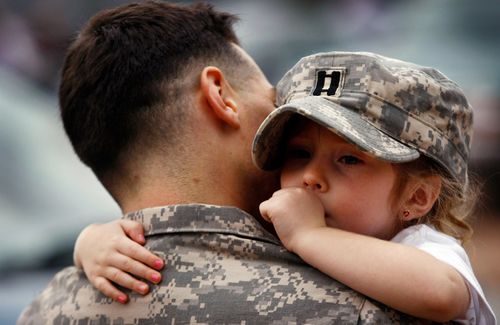
Serenity Miller, 4, clings to her father Cpt. David Miller after he and fellow U.S. Army soldiers arrived home from Iraq on August 18, 2009 to Fort Carson, Colorado. Approximately 575 soldiers from the 2nd Brigade Combat team from the 4th Infantry Division returned Tuesday following a 12 month deployment to Iraq. By John Moore/Getty.

The View From Your Sickbed

by Patrick Appel

A reader writes:

My mom, who was a respiratory therapist, watched many people kept alive, probably against their will, because they had no real instructions. Many came in and out of consciousness, but because they were intubated, they couldn't speak. They'd plead with their eyes to just be let go.

Mom, when the first signs of Alzheimer's appeared, went to her doctor, filled out a living will, got it witnessed and gave it to my brother.

At the time she went into a coma at home, they were talking about amputating both her legs due to diabetes and then dumping her in a bed somewhere until she died. She went into a coma at about midnight and my brother called her doctor, who arrived with an ambulance in case he could save her. After examining her, he said, there's no hope. We'll try, but there's no hope that she will even live 24 hours.

My brothers and I were on the phone and we all said, let her go. She told us so many times she never wanted to be kept alive for no reason. She died an hour later.

I got a copy of her living will and amended it slightly. I feel much better. But think how many people have no one in their family with real medical knowledge? Will they do this or will they leave themselves at the mercy of people who are pledged to keep you alive, no matter how much misery and cost it will create?

Sarah Palin and Rush Limbaugh and Chuck Grassley and a million Republican elves have a lot to answer for.

RNC Chairman Michael Steele Is Not Willing To Say That Death Panel Rumors Are False

by Conor Clarke

I don't want to spend all week writing about death panels. Writing about something that doesn't exist is tedious, and I realize that by giving further attention to the subject I am possibly just playing into the intended trap, which is to give everyone the impression that there is genuine controversy and uncertainty here, rather than just a bunch of straightforward lying about the administration's health-care proposals. I hope I'm not doing that, because it really is just a bunch of straightforward lying.

But it's getting weird, and I cannot resist. Here, via Ben Smith, is RNC Chairman Michael Steele, like a latter day Jacques Derrida, deconstructing the question of whether or not death panels exist:

Michael Steele, the chairman of the Republican National Committee, said the false “death panel” rumor about President Obama’s health care plan is a “grassroots” notion that he does not know if he believes.

Steele said he does not regret that Republicans such as Sarah Palin and Newt Gingrich raised “death panel” issue.

“Some characterize it as unfortunate. Others characterize it as a reflection of what they think and what they feel,” Steele said in an interview on MSNBC’s Morning Joe. “That comes from some place and is something that’s out there in the grassroots of America, not just Republicans.”

Asked if he thinks there is a “death panel” provision in the bill — a suggestion that has been proven untrue and that the White House has spent a week trying to knock down — Steele said he does not know.

“It may or may not be. I don’t know. We don’t know what the bill is,” Steele said.

After I stopped slamming my forehead into my desk, it occurred to me that Steele's rhetorical move is really a pretty common one. Just as creationism gave way to intelligent design, the original false claim in this case — that the House bill would create death panels — has now been replaced by the far more insidious notion that death panels reflect some 'emotional truth' floating around in America, and we'll never really know whether that emotional truth reflects the, you know, factual truth. 

And then it occurred to me that we do know what's in the House bill, we do know it contains no "death panel" provision, and we do know that no member of the administration or Congress has proposed anything of the sort. So, for the squintillionth time, this stuff is just false. That's not my characterization; it's a well-documented matter of fact, and I'm sure Michael Steele knows it. Or at least I hope so.

How Did They Not See This Coming?

by Patrick Appel

Ambinder:

The most surprising part of the news that the White House was surprised that liberals had grown so attached to the public plan was that they were surprised.  Ever since it became clear that…moving to a "single payer" system was untenable, liberals fell back to the next best thing — single-payer-by-proxy, or a "public plan," which would, if properly written and subsidized, force insurance companies to either reform or get out of business.

Jason Zengerle has the same thought.

Scalia’s Constitution

by Patrick Appel

Scott Horton discusses the recent Troy Davis ruling (which Conor posted on earlier today):

Scalia’s Constitution does not guarantee a man who has been convicted and sentenced to death–but who is actually innocent–a review of his case. It is certainly true that the Constitution provides no absolute guarantee of justice. But Scalia’s view effectively puts an expense meter on the justice process. Once the process has run through certain steps, that’s it. In his view, it really shouldn’t matter that subsequent evidence establishes that the conviction is mistaken. It’s more efficient simply to implement the decision and execute the innocent man.

Lee Kovarsky has much more.

Those Mysterious Co-ops

by Peter Suderman

As far as I can tell, co-ops currently resemble Scooby-Doo villains at the beginning of an episode: There are a number of potential options, but also a lot of uncertainty about what's really going on – and no one actually knows which of the available possibilities we'll end up with. The main feature seems to be that they're not government run, although, as previously noted, there's some reason to believe that co-ops might, for all practical purposes, act as public plans under a different name.

In general, most everyone I've read seems uncertain about the details, and less than enthusiastic about the virtues of co-ops as policy: Mark Thoma, in the course of drawing up a quick list of what's known and possible about co-ops, points out that it's not clear they'll lower costs. The L.A. Times spotlights a small co-op that some think might serve as a model, while the New York Times reports that an attempt to foster co-ops in Iowa during the early 1990's didn't work out too well. And according to Robert Laszewski, the history of co-op insurers in the U.S. goes back even further, to when Blue Cross plans were first established six decades ago. Laszewski also thinks the idea is monumentally stupid, arguing that new co-ops would find it nearly impossible to compete with established insurers. Tyler Cowen, meanwhile, wonders why mutual plans have not been more successful. 

The confusion and lack of clarity is one reason, I suspect, why support seems so tepid. Another reason is that, while some think co-ops a perfectly fine idea, they're not topping many peoples' wishlists. Co-ops, first and foremost, are about compromise, and the rosiest view, I think, is that they represent a second-best scenario for most reform supporters. Given the tentative and relatively passionless support they're receiving, I wonder: What will happen when the details do come out, and partisans on both sides start loudly airing their disagreements?