Have Seniors Paid For Their Medicare?

by Patrick Appel

Andrew Briggs does the math on the average medicare recipient who was born in 1944, started work at 21 in 1965, and retired in 2009 at 65:

This typical person paid around $64,971 in Medicare payroll taxes over his lifetime. Likewise, after netting out Medicare premiums, he’ll receive around $173,886 in lifetime Medicare benefits. The net? He can expect to receive around $108,915 more in benefits than he paid in taxes over his lifetime.

Briggs accounts for interest, but these numbers are a little deceiving. Senior citizens can get slightly more out of medicare than they put in while not bankrupting the country because many workers will not live long enough to collect payments. Also, some workers will keep working past the age of 65. On the other hand, many workers won't make payments every year because of layoffs or parenting duties, so I think Briggs is in the ballpark. With growing average lifespans and an aging population, a gap this big is worrying. E.D. Kain follows up.
Malkin Award Nominee

"Liberals seem to be under the impression that health care reform will be like a new entititlement, and that Republicans will run against it at their own peril — as was the case with Social Security reform in 2005. And they may be right, but not until this monstrous bill actually goes into effect some time in 2013. Which means that for the next four years, Republicans will be able to say whatever they want about the health care reforms that were passed but won't come into effect for years. Republicans will be able to come up with another "death panel" every week," – Michael Goldfarb, Weekly Standard.

Turning Allies Into Enemies

by Patrick Appel

Kevin Nix over at New Majority doesn't understand why Republicans are set on repelling one of the more conservatives parts of the gay community:

Like any community, the gay community includes people of more and less conservative values and opinions.  Gays serving this country are among some of the more conservative members of the gay community. Yet these are precisely the people targeted by current policy.  Military service does not lend itself to leading flamboyant lives under those buzz cuts. They are threatened with expulsion if they answer, “I went to a movie with my partner” when asked what they did over the weekend.

45% Of Americans Believe, Falsely, That Obama Will Create Death Panels

by Conor Clarke

There is much to discuss in NBC's new health-care poll, but this part jumped out at me like an army of flesh-eating zombies:

Forty-five percent think the reform proposals would allow the government to make decisions about when to stop providing medical care for the elderly.

There is, of course, no reform proposal that will do any such thing, and the fact that 45% of Americans believe otherwise is really an ugly testament to the amount of misinformation polluting the health-care debate.

The health-care experts over at Conservatives 4 Palin, meanwhile, are proudly telegraphing the new 45% statistic: "What we see here is the ballgame." But because, strangely, the Palin people's ability to read seems to have short-circuited at the moment of maximum political convenience, I feel that I should do them a favor and reprint the relevant section in its entirety from the NBC article:

One of the reasons why [the environment for health-care reform] has become tougher is due to misperceptions about the president’s plans for reform.

[…] Forty-five percent think the reform proposals would allow the government to make decisions about when to stop providing medical care for the elderly.

That also is untrue: The provision in the House legislation that critics have seized on — raising the specter of “death panels” or euthanasia — would simply allow Medicare to pay doctors for end-of-life counseling, if the patient wishes.

I wouldn't want Sarah Palin or her defenders to continue spreading misinformation to the American public. I'm sure that's not what they want to do.

Co-ops vs. a Public Plan: What’s the Difference?

by Peter Suderman

My Reason colleague Ron Bailey looks at Chuck Schumer's ideas for health-care co-ops and finds them essentially indistinguishable from a public plan: "Schumer insists that what he calls 'co-ops' must be national in scope, jump-started with $10 billion in federal government funding, have the power to negotiate payment rates to medical providers nationwide, and be governed by a presidentially-appointed board of directors." Given that the co-op is designed to be a compromise on the public plan, this makes sense. However, it's not clear that a co-op provision would resemble what Schumer wants — or what it would look like at all, for that matter. 

Still, Bailey writes, if structured properly, co-ops could help make the health-care marketplace more competitive: 

Right now, most states are dominated by one or two insurers. To really get co-ops going, Congress and the administration need to change tax laws to grant nonprofit tax status to mutual health insurance companies just like credit unions enjoy today. Congress also needs to give consumers the same tax breaks for getting insurance from a co-op (or any other private insurer) as they currently get from their employer. But more competition could also be had by the simple expedient of passing legislation allowing insurers licensed to sell policies in one state to offer them to residents of any other state. This would immediately create a competitive nationwide market for individual health insurance policies.

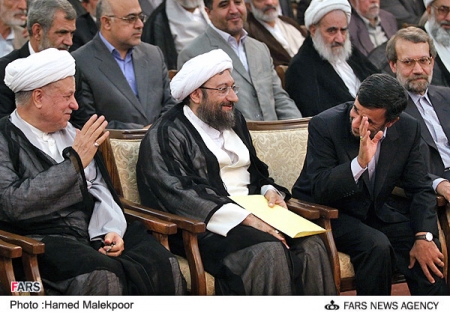
Did Rafsanjani Cave?

WhenRafMetAhmadi

by Patrick Appel

Two Enduring America writers debate the former Iranian president's role. Writer one:

I think that Rafsanjani has been giving up his “Godfather” role within the Green movement progressively. If you add up his non-reply to [Mehdi] Karroubi’s letter [on abuse of detainees], his embarassing retreat from Friday prayers, and today [appearing with President Ahmadinejad], you get the impression of someone who is deeply distressed but does not feel secure enough to embark on a major confrontation with the state power. It is unnerving in the sense that, as the Mehr photos show [of the Rafsanjani-Ahmadinejad encounter], it is actually Rafsanjani that is adopting a body language geared towards subordination, and not the other way round. The gesture is the single most important “frame” to have come out of elite circles in Iran afte the shoulder kiss of Ahmadinejad to the Supreme Leader during his inauguration.

Writer two:

I’m not sure his “Godfather” role was anything but a superficial and transitory collision of interests. Now Rafsanjani is unsure how his interests are best served and is thus “pausing”. This also coincided with the emergence of the Majlis [Parliament]hmin challenging Ahmadinejad, a dynamic in which Rafsanjani was less involved. I think when he does get around to speaking at Friday Prayers, we will have a much better understanding of his peace of mind and tactical re-appraisal.

(Image via NIAC)

Civic Duty

by Peter Suderman

A reader responds to my post on the problem with politics:

As citizens, we have a responsibility to politics. Putnam fails to take into account that Americans, particularly, have been socialized by a self-preserving elite to see the world of public affairs as “alien”, taught that a trip to the polling place once every four years fulfills one’s civic duty.  With the rise of community organizations of the type in which our President was educated (and you’ll understand that I don’t mean Harvard), we are beginning to see a change in that socialization.

Today, those who argue against political involvement are swimming against the tide.

It's not that I don't think we have any sort of civic duty. But I wonder: How do you have political involvement without the sort of ruckus we're now seeing? As far as I can tell, the health-care protesters at town halls are "politically involved." Lobbyists soliciting favors from Congressmen is "political involvement." Politicians who know better (or should) cynically spreading rumors about "death panels" is political involvement too. It's not all pleasant, community-minded folks peacefully and sensibly arguing in policy-smart bullet points. I don't think it's possible to have a politically involved citizenry and avoid the sort of nuttiness we've seen. This — the chaos and absurdity of competing interests fighting for what they want and believe — is what politics looks like.