Branded Boycotts

by Patrick Appel

A reader writes:

The rush of boycotts and counter-boycotts is testimony to companies' success in selling themselves as lifestyle brands.  This is particularly true in the case of Whole Foods, but also for Wal-Mart and probably any other company whose customers feel a strong affinity with it. Whole Foods and Wal-Mart are successful for the products they sell, but they're also cultural signifiers. 

Are Mac users afficianadoes solely because of the software platform?  Do Whole Foods shoppers patronize the chain solely because they like organic fruits? They're lifestyle brands; they connote status and priorities. The same is true with Wal-Mart: it's Southern-based, suburban, cost-oriented. When companies successfully pitch themselves as part of your identity — often with implications of status and value — it's only natural that a large segment of their shoppers feel a sense of betrayal when the corporation acts against that image. 

The passion behind the boycotters and anti-boycotters is baffling only so long as the brand experience is perceived as a neutral, passionless relationship.  For a lot of people it isn't. It's part of who they are, like a sports team or a college sweatshirt. The outrage over the companies' politically toned actions is just evidence of their marketing successes.
Why Justice Scalia Wants to Execute the Innocent

by Conor Clarke

Let me take the bait and say that I think the liberals who are dumping on Justice Scalia for his dissent in the Troy Davis case (here's ThinkProgress and here's Adam Serwer of the American Prospect) are being a bit harsh. Davis was convicted of murder and sentenced to die, but now many of the witnesses who testified against him have recanted. So the Supreme Court, quite reasonably I think, ordered a federal district court in Georgia to look at the evidence once more. Scalia was not happy about this and dissented, writing:

This court has never held that the Constitution forbids the execution of a convicted defendant who had a full and fair trial but is later able to convince a habeas court that he is ‘actually’ innocent.

Which, yes, certainly sounds like a terrible thing to say. But is this a crazy view? I'm not a lawyer and can't speak to whether the court has "never held" what Scalia says, or whether Davis actually had a "full and fair trial." I hope neither of these things is true. But if they are true, why would it be so surprising? Procedural rights (like the right to a lawyer or the right to avoid self incrimination) do not guarantee a specific outcome (like the correct decision in a case). It is possible to imagine a fair trial that respects everyone's rights but nonetheless reaches the wrong conclusion.

I think procedural rights are useful in large part because they prop up substantive considerations that our society values — like guilt or innocence when guilt or innocence is deserved. But an alternate view of procedural rights — or a view that says, simply, that it's not the role of the Supreme Court to decide these things — doesn't seem like it's molded out of unalloyed craziness.

Why Do More Republicans Hate The Supreme Court?

[A]lthough the Court’s decisions under, say, Rehnquist, were more conservative than its decisions under Warren, that’s not reflected in the cases that get lots of media coverage. A simple way to show this is to ask whether a particular Court decision was on the front page of the New York Times the day after the decision was announced. Call these “salient” cases, knowing that they were likely covered in many other media as well. When Bartels and Johnson looked at civil liberties and civil rights cases and then broke them down by salience, they found that the “salient” cases were more liberal than the “non-salient cases.”

Ryan Sager adds his own commentary.

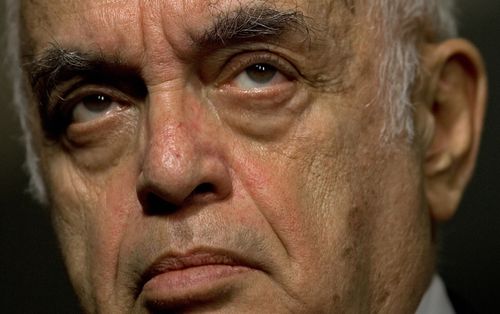
My Interview With Robert Novak

NovakGetty3  

by Conor Clarke

Columnist Robert Novak is dead, from a malignant brain tumor, which by most accounts was a pretty terrible way to go. Just about everyone in Washington has a Novak story — being a Washington institution will do that to you — and I'm no exception. Almost exactly two years ago, I wrote a profile of Robert Novak for the Guardian newspaper. This, naturally, called for interviewing him, so I did.

Novak was, to be perfectly honest about it, the least pleasant person I've ever interviewed. He didn't shake my hand upon entering or leaving his office, and expressed fairly open contempt when I asked him a question about the Valerie Plame affair. His response was: "You can't imagine how tired I am of answering those questions." And then he proceeded not to answer the question.

I don't mean to rag on the guy. It wasn't his job to be pleasant — certainly not to the kind of nervous and uppity young reporter he ate for breakfast — and I didn't get the sense he tried to give anyone an impression to the contrary. I hope it's fair to say that he embraced the reputation that preceded him, and that the face grew to fit the mask. You don't call your memoir "The Prince of Darkness" if you're hoping to make new friends. (And on the day that I sat down with him I remember, distinctly, that he was wearing the same suit and tie that he wore glowering on the cover of his new book.)

There are many people who think, for good reason, that his career was spotted by ethical lapses — like trading access for protection (you were, famously, a "source or a target"), or outing sources after they died. Novak was unapologetic about all of that. About his conduct in the Plame affair, he told me: "It's an irrelevant question to ask what I would do if I could do it all over again, because I don't have the chance to do it all over again. It's done." 

So he was perhaps a bit of a jerk, but an admirably fatalistic one. The first thing he said to me was this: "I don't watch my words very closely. I'm 76 years old, and I don't have that much time on this earth. There's very little people can do to hurt me, and so I say what I want to say." And, to his credit or not, he did just that.

(Photo by Paul J. Richards/AFP/Getty)

Buying An Education Along With A House

by Patrick Appel

Mike Konczal makes a point I haven't seen raised very often with regard to the housing bubble:

There’s a lot of focus on the interest rate deduction that is embedded inside a mortgage. I think the most obvious embedded option inside a mortgage that isn’t discussed is the option to educate your children at the local school district. If sending 3 kids to a private high school at your old houses costs $5,000/year, and if the new house’s public high school is free and equally good then taking a $60,000 bath on the house is break-even. Completely rational.

The value of this option has increased, both with the returns to education but also with a general worry about the robustness of our educational meritocracy. The amount of money and energy that goes into securing access to high-end education has skyrocketed over the past decade, and part of that budget, though it isn’t treated as such, is in your house. And though we often think of educational inequality as a function of a Kozol-narrative of the poorest against the richest, this bidding may be most driven by inequality between the middle and the highest parts of the inequality curve. I’d really like to see some hard research into how much our desire to educate our children in the best way possible has driven subprime and the housing bubble.

Why Wal-Mart is Boycotting Glenn Beck

by Conor Clarke

As you probably know, Fox host Glenn Beck has been losing lots of advertisers — about 20 so far, including Wal-Mart, CVS and GEICO — for calling Barack Obama a "racist" with a "deep-seated hatred for white people or the white culture." I clicked around to see what people on the right were saying about the donnybrook, and found this page from RedState.org, which appears to be organizing a counter boycott, or is at least offering the sinister warning that "there will be repercussions from our side if [these companies] are so willing to become pawns of the left."

I find all of this a bit funny.

What's the logical conclusion here? Do we boycott and counter-boycott, until we've whittled ourselves down to country of red and blue companies as well as red and blue states? There's nothing to stop us. Fox is well within its rights to retain the hosting services of Glenn Beck, and Wal-Mart is within its rights to take its advertising dollars elsewhere, and the readership of RedState.org is within its rights to take its paychecks elsewhere, too. And I suppose I can take my eyeballs to some other corner of the Internet. Three cheers for liberalism!

And yet I cannot help but think there is a crucial difference between GEICO's decision to drop Glenn Beck and RedState's decision to drop GEICO. The difference is this: Wal-Mart has a good reason to boycott Beck, because Beck actually did something idiotic and indefensible. It simply is not true that Obama is a racist. And what's this business about "the white culture," anyway? Tell us a bit more about that, Glenn.

RedState does not have a similarly reasonable claim — or a substantive argument at all — unless they are seriously interested in defending what Beck said on the merits. (Are they? Is anyone? Let's have that argument, pretty please.) The argument for boycotting the boycotters should be more than "free speech is awesome," since the right to free speech doesn't guarantee you the right to massive corporate underwriting.  

Robert Novak, RIP

by Peter Suderman

Washington's journalistic Prince of Darkness has died. My friend Tim Carney, who worked with Novak for years, has posted a remembrance

That Novak would hire a leg-man to go around Washington sniffing out news reflected the virtue at the heart of his work:  His columns, while they resided on the op-ed pages, were built upon previously unreported facts that revealed and explained the machinations of government, the men and women in power, and the politics behind it all.  His job demanded he get a constant flow of new information, but curiosity and a thirst for knowledge were natural traits for him. 

Bob Novak was, above all, a reporter. Watching him work was a delightful education in reporting.