by Patrick Appel
Alex Massie tires of the perennial fear that Muslims are taking over Europe.
by Patrick Appel
Alex Massie tires of the perennial fear that Muslims are taking over Europe.
by Patrick Appel
Joe Klein is not optimistic about the election in Afghanistan:
This is another terrible legacy of the Bush Administration, which figured that the appearance of democracy was all that mattered–while flagrantly neglecting the factors on the ground that create an environment where democracy can actually take hold. Elections are only one aspect of democracy; they do not define it. They can easily be exploited by the powerful and the corrupt, if the proper conditions for a ballot don't exist. In this case, an election is standing in the way of developments–security, the rule of law, education, the creation of a viable middle class–that could make democracy possible in Afghanistan, after a time. Make no mistake, I'll be thrilled if the election comes off credibly and Taliban mischief is minimized. But I'm worried that this vote could turn into a major step backward for our efforts in Afghanistan.
by Conor Clarke
Former Colleague Ross Douthat writes, over at his new perch at the New York Times:
Kudos to Ross for pointing out what is indeed quite obvious: The Democratic plans will not, in fact, euthanize your grandmother. And yet I can't help but feel that there is some irony tucked away in this "inconvenient truth." It is certainly true that Democrats "might" limit the procedures that Medicare will cover. (The real issue here is whether any future limitations will lead to worse health outcomes, which is where the honest debate takes place, or at least where it should be taking place.) On the other hand, I know of at least one valuable medical service that will not be covered by Medicare in the foreseeable future, thanks to the Republicans: An end-of-life consultation. Such a consultation was an obviously and (until very recently) uncontroversially valuable expansion in Medicare coverage that the Democrats were going to include in the Senate bill. No longer. But America's senior citizens can't always get what they want.
by Patrick Appel
Reulf from Charlesque on Vimeo.
by Peter Suderman
Drug manufacturing and distribution is too dangerous to remain in the hands of unregulated criminals. Drug distribution needs to be the combined responsibility of doctors, the government, and a legal and regulated free market.
That's the conclusion drawn by two veteran police offers in a Washington Post op-ed today as they underline "the drug war's clear and present danger toward men and women in blue." Recognizing the radical nature of the proposal, the writers don't suggest a wholesale reinvention of the nation's drug policy, but, instead, argue for allowing individual states to implement different drug policies as they see fit.
My Reason colleague Jacob Sullum adds:
Federalism would not only allow instructive experimentation; it would allow national politicians to avoid taking positions on emotionally charged local issues that the Constitution leaves to the states. Californians should not have to worry about the president's views on medical marijuana, and the president should not have to worry about the political ramifications of coming down on one side or the other.
Saner, safer, more humane drug policy? Smart cops want it. So does a majority of the American people. When will America's political class?

by Patrick Appel
The Unorthodox Chef posts on butter sculptures:
The Minnesota State Fair showcases butter sculpture in the Princess Kay of the Milky Way contest. A 90 lb block of butter is taken and carved with their likenesses. It’s so bizarre really. I had the opportunity to see this several years ago with my sister. It’s funny that pageant finalists spend their whole lives avoiding fat, and at the fair their faces are full of it.
(Hat tip: Buzzfeed)
by Patrick Appel
A reader writes:
Patrick Appel quotes a Prospect article hailing GM crops. In fact, according to this Scientific American article, research on GM crops to date seems highly likely to be biased towards the interests of GM seed developing companies:
To purchase genetically modified seeds, a customer must sign an agreement that limits what can be done with them. (If you have installed software recently, you will recognize the concept of the end-user agreement.) Agreements are considered necessary to protect a company’s intellectual property, and they justifiably preclude the replication of the genetic enhancements that make the seeds unique. But agritech companies such as Monsanto, Pioneer and Syngenta go further. For a decade their user agreements have explicitly forbidden the use of the seeds for any independent research. Under the threat of litigation, scientists cannot test a seed to explore the different conditions under which it thrives or fails. They cannot compare seeds from one company against those from another company. And perhaps most important, they cannot examine whether the genetically modified crops lead to unintended environmental side effects.Research on genetically modified seeds is still published, of course. But only studies that the seed companies have approved ever see the light of a peer-reviewed journal.
In addition, most of the corn and nearly all the soybeans in the US are GMOs that have been engineered to survive application of Monsanto's herbicide Roundup. (68% of corn (stacked gene + herbicide-tolerant) from and 91% of soybeans) The claim that GM crops "reduce reliance on agrochemical sprays" is just plain false; the entire point of their use is to *increase* use of herbicides with them. Certainly an excellent business move because Monsanto and Dupont (the two biggest corporations in these areas) then make money from the sale of seed and the sale of herbicides. I'm not particularly concerned with whether the organic food I purchase has more nutrients than conventional products, but there's just no way anyone is going to convince me that coating millions of acres of the US in Roundup is good for humans or the environment.
That Prospect article I cited seems to have a number of problems. That post was written not because I was shilling for the big agriculture companies, but because I'd seen contradictory information and wanted to get my facts straight. I spent a good part of my weekend reading research papers on organic agriculture and synthetic fertilizers. This paper by Rodale Institute, a pro-organic policy shop, makes a strong case for organics as a solution to global warming. Here is an important bit about using soil as a carbon sink:
During the 1990s, results from the Compost Utilization Trial (CUT) at Rodale Institute—a 10-year study comparing the use of composts, manures and synthetic chemical fertilizer—show that the use of composted manure with crop rotations in organic systems can result in carbon sequestration of up to 2,000 lbs/ac/year. By contrast, fields under standard tillage relying on chemical fertilizers lost almost 300 pounds of carbon per acre per year. Storing—or sequestering—up to 2,000 lbs/ac/year of carbon means that more than 7,000 pounds of carbon dioxide are taken from the air and trapped in that field soil.
I seem to have dissed soil micro-organisms too readily. As far as I can tell, the main benefit of non-organic produce has to do with greater yields (though some pro-organic authors will argue otherwise). Here is an excerpt from a book by Vaclav Smil, Professor in the Faculty of Environment at the University of Manitoba in Canada, on nitrogen-based fertilizers. After doing some math, he writes:
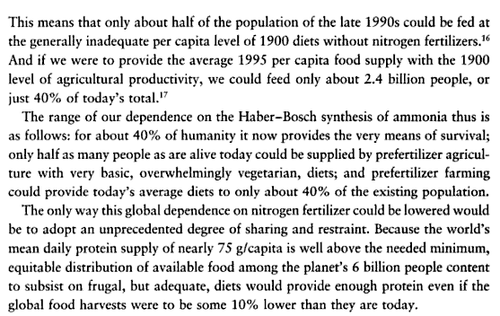
My big problem with organic agriculture is the organic/inorganic divide is an imprecise way to determine what food is sustainable. The big GM food companies might not be saints, but I'm wary of writing off all GM technology. The challenges we face agriculturally, especially if you factor in crop disruptions due to global warming, are going to require us to use every trick up our sleeves –and to invent a few new ones. If you only read one paper on the conflict between increasing yields and sustainability, this 2002 Nature article is on the money, as far as I can tell:
There is a general consensus that agriculture has the capability to meet the food needs of 8–10 billion people while substantially decreasing the proportion of the population who go hungry, but there is little consensus on how this can be achieved by sustainable means. Sustainability implies both high yields that can be maintained, even in the face of major shocks, and agricultural practices that have acceptable environmental impacts. The main environmental impacts of agriculture come from the conversion of natural ecosystems to agriculture, from agricultural nutrients that pollute aquatic and terrestrial habitats and groundwater, and from pesticides, especially bioaccumulating or persistent organic agricultural pollutants. Agricultural nutrients enter other ecosystems through leaching, volatilization and the waste streams of livestock and humans. Pesticides can also harm human health, as can pathogens, including antibiotic-resistant pathogens associated with certain animal production practices.
How can such costs be minimized at the same time that food production is increased? In one sense the answer is simple: crop and livestock production must increase without an increase in the negative environmental impacts associated with agriculture, which means large increases in the efficiency of nitrogen, phosphorus and water use, and integrated pest management that minimizes the need for toxic pesticides. In reality, achieving such a scenario represents one of the greatest scientific challenges facing humankind because of the trade-offs among competing economic and environmental goals, and inadequate knowledge of the key biological, biogeochemical and ecological processes.
by Patrick Appel
A reader writes:
It was only last year that the The Paul Wellstone and Pete Domenici Mental Health Parity and Addiction Equity Act of 2008 mandated that insurance companies treat mental illnesses with the same coverage as physical health. This was after a 12-year fight to get it through Congress, and after being wrapped up in tax cuts to make it more palatable to lawmakers. But for years and years, mental health care was even more disgraceful than physical health care, only less talked about. In yesterday's New Hampshire press conference, Obama responded to a question about mental health care in the current bill by saying that such care is "under valued" in the insurance market. The president said that serious depression is as bad as a broken leg, and that he wants a "mental health component" in the ultimate package.
I have had bipolar disorder ever since puberty.
When I'm off my medications, I will alternate spells of tearful anxiety fits with depressive episodes of 14 hours of sleep, the inability to concentrate, and near-constant suicidal thoughts. When I was kicked out of college (the first time) for bad grades, I was turned down by several private insurers for my pre-existing condition. And when my dad changed jobs, I was left in the lurch again. I've seen close to 12 doctors about it in the past four years, and believe me, as hard as it is to find a primary care physician, it is even more difficult to find a therapist that you like, trust, can afford, and who can treat your condition. And when you have a mental illness, you often have to switch prescriptions, dosage, and cocktails until you find a mixture that works for you. Sometimes, pills will stop working for no good reason, and it takes a quality professional to realize it and pull you out of a tailspin that you thought was being treated. And I'm sure your readers can tell even more stories about being turned down for jobs, being denied coverage, being hospitalized, and struggling for decades through the red tape, secrecy, and shame.
I attribute the reason why I am now healthy, sane and well treated to how incredibly lucky I am. My time in the wilderness was only three years long, mostly because my parents could afford to pay for therapist and psychiatrist bills out of pocket. I'm still young, and largely healthy, so I responded well when finally treated. My access to quality treatment kept me from self-destructive behavior and self-medicating that bipolar patients are prone to, and the fact that my mother is a doctor keeps me from ever running out of medication. I also had the good fortune of having my nervous breakdown when the economy was still good, so now that twice-weekly therapist meetings have tapered down to monthly ones, the family finances can manage.
I'm back in school now, and it breaks my heart over and over again to see friends of mine with the same or similar conditions be denied insurance through their work or privately, be forced to meet with bad therapists, and go weeks without their pills because of gaps in the system. And it's all invisible to most onlookers. I'm open about my syndrome, mostly because I have to be, but I know I'm going to have trouble when I graduate two Mays from now, and have to go off student insurance and my parent's insurance. (I don't want my mother to have to commit prescription fraud, as well). And anybody who's been following the recent Salon series on the dearth of good mental health care in the military knows that untreated mental illness and addiction is a plague on society and on families.
Section 14 of the current bill mandates that mental health and substance abuse problems will be treated equally as any other physical problem, continuing the work of the 2008 bill. The Mental Health Liaison Group(MHLG) (which includes The American Psychological Association, The American Counseling Association, The American Psychiatric Association, and The National Association of Social Workers) signed off on the bill in July. And Obama's words yesterday are heartening, if vague. And I know that I'm being rather long-winded and lingering too much on personal history to make my point. But in the larger health care debate, I would be happy just to get mental illnesses and addictions to come to the table as legitimate diseases, not personal failings.
by Conor Clarke
Reader Marshall Eubanks, of America Free TV, emails about my earlier post on the irrationality of voting, and makes the argument that I overlook the expected value of one's vote. (Andrew Gelman, the lead author of the paper in question, also emailed to make a similar point.)
$1 trillion times 1/ 60 million is $ 16,666. In a close state, the probability of being decisive is (according to the article) more like 1/10 million, for an expected value of roughly $100,000. By this standard, voting has a much higher expected value than most lottery tickets (where the expected value is almost always significantly below the cost of the ticket).
Well, a couple of points about this standard. (Aside from the fact that something like the Iraq War would be hard to predict on election day.) First, the cost of casting an informed vote — one that distinguishes rationally between a variety of complicated public policy positions and sifts through a lot of campaign lying — is much, much higher than the cost of buying a lottery ticket. Casting an informed vote requires hundreds of hours of attention, often to highly trivial and/or highly tedious subjects.
Second, the monetary value of avoiding the Iraq war is not $1 trillion for an individual voter. That benefit is spread across the present and future taxpaying population! Even if the expected social value of your swing-state vote is $100,000, the individual value would be that divided by several hundred million. So the individual expected benefit would probably be less than a cent.
Of course, one might have strong moral reasons for opposing the Iraq War, and those are difficult to quantify. But that was also the point of the original post: that we don't vote for our "rational" individual benefit. We vote for plenty of good reasons, though.
by Patrick Appel
Chris Geidner parses the new DOMA brief.
 The Dish