by Patrick Appel
Tom Smith wonders what Tarantula Wasps say about God. Bainbridge answers.
by Patrick Appel
A reader writes:
My mother died on March 4, 2009.
I was right there with her, holding her hand. Because she had an Advance Health Care Directive, she died in her bedroom, with a few family members kissing her and telling her how much we love her.
It sickens me (sorry about the unintended pun, but I don't have a better word) that many moms and dads will die in hospitals hooked up to machines, drawing out the intolerable and the inevitable, because Advance Health Care Directives have turned into Death Panels. I want to die–when it's my time–just like Mimi did. It's pitiful that so many will be deprived of understanding this option because of Sarah Palin.
by Patrick Appel
Jonah Lehrer sprinkles a few caveats throughout Emily Yoffe's article on information addiction:
I think it's worth qualifying this "information equals crack" meme. The brain, as we all know, is not an indiscriminate curiosity machine. Most people don't want to know more about quantum mechanics, or the actual details of health care reform, or what's happening in the Afghanistan presidential campaign. In other words, our craving for news tends towards the local and the personal – our curiosity is circumscribed. Why might this be? The answer, I think, has to do with the molecular details of how information triggers rewards.
This isn't the post for another summary of computational models of dopamine activity – see here and here, if you're interested – but suffice to say that our brain cells are finely tuned to want more information about stuff which they already know. In essence, these cells work by constantly striving to reduce their "prediction-error signal," which is the gap between what these cells expect to happen and what actually occurs. If a monkey has been trained to get a squirt of juice everytime a bell is rung, then these dopaminergic cells quickly learn that the bell predicts the sweet reward. As a result, they want more information about that specific rewarding stimulus. What, for instance, predicts the bell? Maybe the scientist flicks a switch before ringing the bell? Or maybe he scratches his nose? Or maybe he simply enters the room? What numerous experiments have found is that our dopamine neurons aren't interested in responding to the reward itself – instead, they want to find the first reliable bit of information that predicts the reward. This is why we crave new facts: they are means of updating our old facts, of extending our cognitive models forward in time.
I read Lehrer's new book, How We Decide, a few weeks ago. I highly recommend it to anyone interested in metacognition or the tension between reason and emotion.
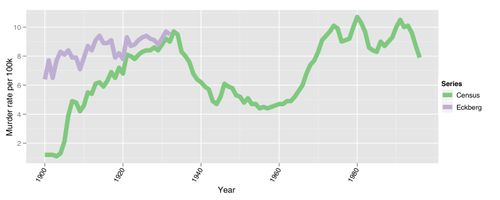
by Patrick Appel
The Edge Of American West posts a chart on the murder rate. Matt Steinglass has some questions about that dip in the middle.
by Patrick Appel
A reader writes:
Here's the very first South park, made as a video Christmas card. It was later remade with better production value. These led to the pilot you linked to.
by Patrick Appel
A reader writes:
Just wanted to quickly respond to/distinguish your reader who loved his HSA–specifically, I want to point out that he had *employer-provided* health care. He writes that "the insurance company got the employer contributed portion," so his employer was paying his premiums (a large enough premium that he only had to make small co-pays for doctor visits, as opposed to paying for the entire visit out-of-pocket, which makes it much more attractive and affordable than it is for the self-employed to whom HSAs are primarily targeted. And the reader had a choice–he could have opted for a PPO or HMO at no greater cost. There are obviously significant differences in the HSA experience when you're self-employed or an entrepreneur vs. being an employee.
On the other hand, I agree with him that his current insurance situation is less than ideal. A $3500 deductible, on top of $400 monthly payroll deductions and the need to be clairvoyant about your FSA spending, is a nightmare. So my conclusion remains the same: our system is clearly in need of reform.

A reveler looks on as the 40th anniversary of the Woodstock music festival approaches August 14, 2009 in Bethel, New York. On August 15-17 in 1969 an estimated 400,000 music fans gathered on Max Yasgur's farm in Bethel, N.Y. for the most celebrated music festival ever. The 40th anniversary concert will take place in Bethel tonight. By Mario Tama/Getty.
Anyone wanting to buy a book attacking consumerism is faced with an embarrassing range of choices. There are so many different tracts, using so many different terms, saying more or less the same thing. The differences between competing brands of soap powder are more significant.
by Chris Bodenner
The Dish makes the list:
[T]he film will be broken up inexplicably by photographs taken from people’s windows
by Chris Bodenner
Chris Orr non-reviews G.I. Joe: The Rise Of Cobra:
Sometimes, a film defies conventional narrative and artistic standards so utterly that it seems unfair to judge it by them. G.I. Joe is such a case, a movie that has, through its own inverse accomplishment, earned the right to speak for itself. Consider this a tone poem in 40 scraps of dialogue.
Rotten Tomatoes gives it 38%. Like I needed to check.
 The Dish