The Devil Is In The Lack Of Details

by Chris Bodenner

Conor Friedersdorf explains why his grandmother and other conservatives are afraid by Obama's healthcare plan:

Theirs is ultimately a fear of rapid, sweeping policy shifts, especially those brought about by lengthy, amorphous legislative proposals that leave unclear exactly what might change the month after next. […] Is Social Security facing long-term insolvency problems? Is our immigration system broken? President George W. Bush responded to those widespread beliefs by advocating sweeping, “comprehensive” reforms that failed largely because they freaked out too many Americans. Even worse, the policy problems he failed to address still exist, but are unlikely to be readdressed for some time—among the many downsides to comprehensive reform is that its failure renders every facet of an issue politically radioactive.
Jonah Goldberg Bait

by Patrick Appel

David Bernstein makes a strained argument:

Various articles, such as this one, accuse conservatives of "paranoia" for thinking that health care "reform" will lead, for example, to Trig Palin being denied medical care. I agree that it's a bit paranoid, but not nearly as irrational as the critics suggest. Eugenics enforced by government dictate once had strong support on the Progressive left, more recently than some might imagine….If liberals can understand the fallout from the Tuskegee experiment and how it has affected African-American trust of the government with regard to health care, they should be able to understand why religious conservatives–whose intellectual ancestors were the primary, and practically the only, opponents of eugenics during its heyday in the 1920s–might get overly paranoid when modern liberals talk about saving money on health care by making tough choices and so forth.

His post has more strawmen in it than all the cornfields of Iowa.

Saving Newspapers: The Coke Classic Strategy

by Robert Wright

I like the new online look of the Los Angeles Times. It reminds me of….. the old offline look. And that’s the point: Newspapers may need to stick with what will increasingly seem like a retro aesthetic if they’re going to remind/convince people that they carry more reportorial authority than, say, the blog item I’m now writing in my pajamas with no actual knowledge of the subject under discussion. 

This is what the New York Times has long understood (note that the new LAT looks more like NYTimes.com, complete with the serif body font) and the Washington Post hasn’t. But the Post seems to have seen the light; witness its switch a couple of months ago from that bloodless sans-serif logo back to its classic, all-the-president’s-men logo. Now about those cheesy blue sans-serif headlines….

In The Weeds

by Patrick Appel

Mike Lillis tries to understand why the debate over Medicare Advantage is so muffled:

Despite promises that private plans operating under MA could eventually save money, the cost to treat the average patient in the MA program is 14 percent higher than the cost to treat the average senior under traditional Medicare…Kathleen Stoll, deputy director of Families USA, a health care consumer group, said the relatively tepid nature of this year’s MA debate is some indication that even the most adamant defenders of the program recognize that the 14-percent discrepancy is too large.

Chart Of The Day

Wellbeing

by Patrick Appel

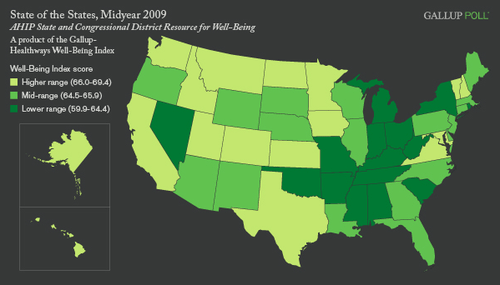
Gallup just put out a new well-being index (lighter green is better). The bottom line: "The overall well-being of the nation has thus far trended down 0.4 points in 2009, representing a modest decline from 2008 in Americans' collective well-being." Catherine Rampell summarizes the findings:

The index attempts to “measure what it is that people believe constitutes a good life, who is feeling good about life, and who is in need of a helping hand.” It is an average of six sub-indexes (life evaluation, emotional health, work environment, physical health, healthy behaviors and access to basic necessities). The January through June 2009 index numbers are based on more than 170,000 interviews conducted among national adults, age 18 and older. For the first half of 2009 Hawaii was followed closely by Utah, which had previously had the highest happiness level. The states with the lowest well-being levels were West Virginia and Kentucky, which had also held the bottom slots in 2008.

It's somewhat surprising that Hawaii fares so well considering much of their economy depends on tourism and they have seen a big drop in visitors.

Cutting The Fat, Ctd

by Chris Bodenner

A reader writes:

George Lundberg seems to be an intelligent, pragmatic, sensible man. But… ouch. I think suggestions like his are the petri dish from whence comes the stuff of Death Panels. He wants people to stop getting tests and treatments they don't need and probably won't ever – I get that. But hasn't one of the big acknowledgments of this whole brouhaha been that preventing health problems is cheaper than fixing them once they've nearly killed you? How much is a mammography as opposed to a mastectomy?

Another writes:

Ending mammogram screenings for women under 50 with no clinical inclination may be cutting the fat to some, but this policy would have likely resulted in my mom's death. My family had no history of cancer. My mom was fit, active, and ate a healthy diet. She was diagnosed with stage two breast cancer shortly after turning 48. She was diagnosed as the result of a routine mammogram. She has been cancer free for 6 years now. If she had to wait until a lump was noticeable or until she was 50 for that mammogram, who knows if she would have survived.

The Smearing Of Emanuel

by Patrick Appel

Michael Scherer explains how medical ethicist Ezekiel Emanuel, Rahm Emanuel's brother, became a health reform boogyman:

In her Post article, [Betsy] McCaughey paints the worst possible image of Emanuel, quoting him, for instance, endorsing age discrimination for health-care distribution, without mentioning that he was only addressing extreme cases like organ donation, where there is an absolute scarcity of resources. She quotes him discussing the denial of care for people with dementia without revealing that Emanuel only mentioned dementia in a discussion of theoretical approaches, not an endorsement of a particular policy. She notes that he has criticized medical culture for trying to do everything for a patient, "regardless of the cost or effects on others," without making clear that he was not speaking of lifesaving care but of treatments with little demonstrated value. "No one who has read what I have done for 25 years would come to the conclusions that have been put out there," says Emanuel. "My quotes were just being taken out of context."

(Hat tip: Drum)

Cheney Spills The Beans?

by Patrick Appel

Barton Gellman in the WaPo reports today that Cheney has uncorked his frustration with the former president:

“In the second term, he felt Bush was moving away from him,” said a participant in the recent gathering, describing Cheney’s reply. “He said Bush was shackled by the public reaction and the criticism he took. Bush was more malleable to that. The implication was that Bush had gone soft on him, or rather Bush had hardened against Cheney’s advice. He’d showed an independence that Cheney didn’t see coming. It was clear that Cheney’s doctrine was cast-iron strength at all times — never apologize, never explain — and Bush moved toward the conciliatory.”

Worth reading in full.

Against Sanctions

by Patrick Appel

Alex Massie argues for easing sanctions against Burma:

I'm not as convinced as Thomas Bell is that trade can open up Burma to the world and that economic liberalisation must lead to political liberalisation but I hope he's right. Alas, I think we've seen that the rise of autocratic capitalism, especially in asia, means that the supposed link between trade and democracy is weaker than we once thought. Nonetheless, it seems pretty clear that the current sanctions regime and, for that matter, the policy of isolating the junta are not working. More to the point, while greater economic freedoms for the  Burmese people might not topple the generals, greater economic opportunity would at least leave the Burmese better off, even if their liberty remained curtailed by international and even regional standards.

Agreed.

Maciel’s Children Sue

by Patrick Appel

Dreher comments on a new wrinkle in a story the Dish has long followed:

Who in the order knew that the hero-worshiped Padre had impregnated several women? Who signed off on this "hush money"? Who in the Vatican knew what Maciel had done? Did Pope John Paul II know — and did he approve of the cover-up? (You will note that despite ample evidence that something was very wrong with Maciel and his scheme, the Vatican made no moves against him until Cardinal Ratzinger became pope).