Tipping Point

by Chris Bodenner

A reader writes:

After four waiting jobs, I never tip below 20%.” The irony of that statement: while it tries to state an empathy towards ‘real’ working people, you’d be hard pressed to explain why the waitperson at your $100 meal deserves $20+, the one serves you a $20 meal deserves $5 (or even $10 for a 50% tip). I’ve heard all kinds of rationalizations for this disparity, but as also having had a number of jobs that were ‘tip’ oriented, I know it really is BS, as in the end the one person gets paid significantly less for the equivalent work. And which person do you think generally ‘needs’ the money more: the person working at the diner, or the person working at ‘Le whatever’?

Good point. To offer an example: I was tipped about $90 a night at a North Carolina diner and about $140 a night at a West Village restaurant, but they were equally exhausting. Then again, the standard of living is much higher in NYC, and one can typically turn over more tables in less-fancy eateries. And as far as “real” working people, keep in mind: the more you tip your “Le” waiter, the more they tip out bussers and dish washers.
Stop Smoking, Or Juarez Gets It, Ctd

by Patrick Appel

A reader writes:

As a former medicinal marijuana dispensary employee in California, I can tell you a thing or two about the market, at least in the Bay Area. As it turns out, the domestic/imported split is a somewhat classist affair.

For the most part, our 'high-grade' wares were entirely locally-grown. There is fierce competition among local growers to develop and refine more potent boutique strains, and to coax them to maximum profit-margins. So if you're buying good weed in California, it's almost a sure thing that it was grown in-state. On the other hand, if you can only afford the 'medium-grade' offerings, you may very well be buying product that came from Mexico or – equally likely – Canada. This is the bud that is grown hastily and in volume, then quickly dried and pressed into bricks, stuffed into tires, etc. So it's more likely that those pursuing a 'cheap' high are "helping to finance a particularly vicious and rapacious industry."

It's also worth remembering that a lot of 'Mexican' weed – the production of which is controlled by Mexican cartels – is actually grown domestically, often in remote area of state parks, in highly destructive operations. Decriminalization would dis-incentivize much of this market.

Menial Work v. Unemployment Checks, Ctd

by Chris Bodenner

A reader writes:

This reader clearly doesn't understand the purpose of unemployment. He was not eligible for unemployment in either scenario, regardless of whether it crossed his mind. You don't get unemployment just because you're not working. You only get unemployment when you lose your job through no fault of your own. If you're fired for cause, you don't get unemployment. If you just left school and are looking for a job, you don't get unemployment.

Another writes:

In both instances, he was a full time student prior to being unemployed. I don't know how it works in other states, but in California, they base the amount you collect in unemployment insurance on a percentage of the salary you made Six Months before you were requesting benefits. As a student, he had no income. He may have been eligible for other types of government assistance, but not unemployment benefits.

Another:

He talks about difficulty in paying rent but not paying tuition. A full scholarship is doubtful since that would likely include a fresh baked job upon graduation. My guess his parents cover his tuition. He basically has been living on student loans, parents/brother's money, for the past 8 years.

Another:

He was a starving college then law school student. He *knew* he was in precarious financial condition so was not likely to have invested in a house, car, etc. Contrast that with the worker who has been earning a paycheck for years, has been paying on a mortgage and car and who suddenly finds his employer laying him off. It is for these people that unemployment insurance was created.

Another:

While I know it's fun for some people to play the contest–"Who walked the longest through the most snow, up hill, both ways"–crowing about not using unemployment insurance is kind of like saying, "sure I have vacation, but I never use it, because I'm so bad ass, and you're just a pu**y if you use it, and don't be surprised if you get fired, cause you are obviously not a hard worker." Finally, one point that hasn't been expressed yet in this thread is the fact that if an over-qualified person takes a "menial" job, then there is one less "menial" job available for someone who truly may need it.

Afghan PD

Afghanistan

by Patrick Appel

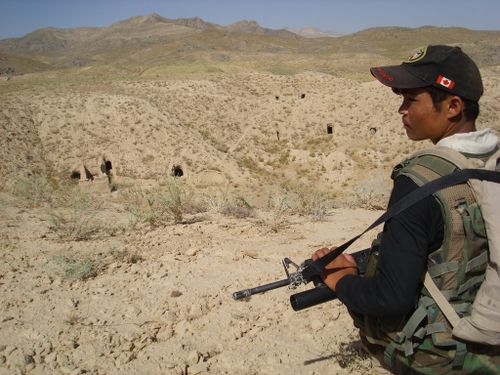
Graeme Wood has a pair of postings (one, two) from Afghanistan that give a sense of the the Afghan police force. From the first one:

Numerous journalists in Afghanistan, in reports dating from long before the current unpleasantness, have remarked on Afghans' yak-like ability to scamper over mountains and leave foreign companions breathless behind them. A group of Pathans reduced me to a wheezing mess in 2001 on the Afghan-Pakistani border, and shouldered my backpack in hopes that I would quit lagging. Life in the mountains, and at high altitude, has prepared them for hikes like this. I asked them how they all came to be such good hikers, and they rolled their eyes as if to say that to them, the question phrased itself differently: Why are you foreigners all so out of shape?

I am surprised, then, on this trip to be at least as spry and caprine as the Afghan soldiers — despite being flabbier than eight years ago, and now laden with a bulky rifle vest and a helmet that looks and feels like a bowling ball with its center scooped out to make room for my cranium. The Afghans sweat, just as I do, and they take regular breaks, lounging on mountainside rocks in full view of the village below, as well as any Taliban up the mountainside who might be watching. They take off boots and rub their feet, and they grouse a little when told to keep walking.

The View From Your Sickbed

by Patrick Appel

A reader writes:

Your ongoing series of "Sickbed" posts is truly plumbing the depths of ignorance.  I'm used to that in the healthcare debate, but not from a blog I respect. To wit:

1) The reason the CPT codes exist is to standardize billing practices and allow insurance companies (and Medicare) to create standard fee schedules.  It has also, coincidentally, allowed one of the worst creations in the last twenty years — RBRVS — to try to properly allocate fees to resources consumed.  No one in their right mind would use a prose procedural description to bill as it would result in six thousand mails between insurer and provider clarifying exactly what was done.  The CPT codes allow the insurance company to know precisely what was done and to bill accordingly.  It's never as simple as "we delivered a baby" or "we took out his appendix".  Every procedure has variants that need to be clarified.  CPT allows this.

CPT is opaque to an outsider.  But the thing is that the patient should never have to see these codes.

I have been provided estimates by providers numerous times.  I have provided them myself when I worked in medicine.  Sometimes those estimates can be off due to complications (and people frequently forget that they have multiple providers).  But every practice in America uses some electronic system to punch up those codes and match them to prices they bill the insurance company.  That can provide a maximum charge, at least, and possibly a fee schedule charge.

2) Your e-mailers are clearly unaware that insurance companies aren't the only ones who can negotiate prices.  Uninsured patients can do it too.  Indeed, one of the beauties of HSAs (about which your blog says conspicuously little) is that has allowed patients to get back into the practice of negotiating lower prices with providers.  When I worked in medicine, I frequently reduced charges or wrote off charges while working with patients in financial trouble.  The only patients we ever turned over to collections were the distressingly large fraction that wouldn't even talk to us despite numerous letters and phone calls offering to help them set up a payment plan.

Speaking of Health Savings Accounts, Alex Tabarrok posted yesterday on a favorable review of consumer driven health care plans. Conservatives tend to focus on patients as consumers of health care dollars while liberals by and large focus on doctors as the primary decider of health care expenses. Obviously, the incentives for both doctor and patient are out of wack. Market-based reforms can work in some instances –I'd like to see doctors provide approximate costs and likely benefits to patients before performing most procedures– but markets don't do very well when consumers have bad information or are in a panic.

Release The Photos

by Patrick Appel

The White House is still stalling on those torture photographs Obama promised to release in April and subsequently flipped on:

[T]he administration faces a dilemma. When it released the Office of Legal Counsel memos written by the now-infamous John Yoo authorizing the administration to torture prisoners abroad, it wasn’t prepared for the media firestorm that erupted — and the growing public pressure to prosecute. Reluctant to face that again, Obama and senior officials in his administration are trying hard now not to stoke the fires. (Even if they can go along with a limited prosecution along the lines of what Holder has described, they certainly don’t want to face calls for prosecuting senior Bush officials.) But it looks like they can’t legally stop this release. Sill, they can delay it. Supreme Court review could delay the case months or even years, depending on what the court decides to do.

Officials Fleeing Iran?

by Chris Bodenner

A reader writes:

I'm thankful that you are still so intensely reporting on everything going on in Iran. I thought you might be interested in this little tidbit. My uncle came back from a 3-month trip to Iran yesterday and told me of this story of money being sent into Turkey via Iran. (An interesting fact omitted by this piece, but reported by Iranian media outlets in the West, is that the smugglers made a run for it when they were discovered.) Another interesting fact that my uncle relayed was regarding his flight back to the States. Despite having booked a flight in advance, he was delayed in Iran for about a week because Lufthansa airlines booted him to make room for reserved seats they hold for government officials to flee should a revolution erupt. They're scared and that gives me hope, but in the most unsettling way…

No Backlash?

by Patrick Appel

Gallup just released a poll that shows independents are not being turned off by the town halls. Josh Marshall is puzzled:

[The poll internals] do not seem to show any of the backlash against the craziness that many reformers are hoping for. And at a minimum they seem to be hardening opposition among Republicans and right-leaning independents.

Nate Silver says not to take the poll too seriously. However:

the real upside to the protests is that they perpetuate misinformation about the Democrats' bills. Forget the birthers — I want to know how many Americans believe in the "death panels". (I also want to know whether Chuck Grassley, since he seems to be one of them, would accept the following trade: Democrats will drop the "death panels" if you'll drop your opposition to the public option.)

Ultimately, the message that Democrats need to be getting across is not that the protesters are protesting in the wrong way or for the wrong reasons, but that they're protesting, in some substantial measure, about the wrong things: that what they seem to think is contained in the health care package doesn't necessarily match the reality.