by Chris Bodenner
A little dog trains.
by Chris Bodenner
A little dog trains.
by Patrick Appel
Philip Giraldi of The American Conservative feels that many health care reform opponents are out of touch with victims of the current system. He's self-employed and unable to afford decent insurance:
E.D. Kain follows up.
by Chris Bodenner
A reader writes:
I can relate to much of the sentiment behind the "milking the system" email. When I graduated from college in 2001, I took my degree in English and Theology from the Boston-area liberal arts school back home to Dallas, expecting to find temporary work as a clerk while I applied for law school. Before long, I had gone the surprisingly short distance between seeking work in a law office to desperately hoping that my lack of restaurant experience wouldn't prevent me from getting a job as a waiter. After several rejections I finally I got a job at a Tex-Mex restaurant. My tips were horrible, and I had trouble paying my rent. One month I had to borrow money from my younger brother to make ends meet. But it never even occurred to me to seek unemployment assistance.
Fast forward to 2006. I had graduated from law school, passed the bar exam, and had moved to DC to be with my fiancée. Not only could I not find any jobs at law firms, I couldn't even get temporary legal work reviewing litigation documents on a contract basis, because, even though I had passed the bar exam, I still had to wait 4 months to get formally sworn in as an attorney. I was rejected from a job at Whole Foods and eventually ended up doing temp work for a staffing agency that put me behind the front desk at several DC-area apartment and office building lobbies. Again, unemployment never crossed my mind.
The lesson I took from both experiences is that you do what it takes, you don't let your pride in yourself be determined by what job you happen to be doing at any particular moment, and, most importantly, you don't take yourself too seriously.
by Patrick Appel
A reader writes:
The story of $15,000 for a needle in a thigh touches a nerve with me. As a surgeon, I'd have tried to find it using local anesthetic, in my office, before escalating to an operating room. With luck — and since it was an insulin needle it couldn't have been very deep and would have been near the entry hole — it'd have been a couple hundred bucks or so, including my fee and the use of a few sterile instruments. It's possible, of course, that it would end up requiring xray guidance; even then, it's hard to figure where the $15,000 went.
But here's the thing: no one would have recognized the savings, or even cared, much less rewarded me for it in any way.
Likewise, when I did breast biopsies in my office, with local anesthesia and comfortable patients, happy at not having to go through the hassles of surgery at a hospital or surgery center, I saved thousands of dollars each of the many hundreds of times I did it. Again: no recognition, no reward. I just did it because it seems right.
This is part of what gets lost in the screaming rhetoric of the right, the death panels of Palin. Some doctors know how to save the system lots of money, and do so, every day. Establishing a means to discover them and to spread their wisdom is central, as I understand it anyway, to Obama's plan. Not rationing. Discovering why some methods are more successful and less expensive than others. Hard to understand, maybe; and very easy to demagogue. Which is exactly the problem.
by Robert Wright
Over at Slate, Will Saletan just published a piece that foreshadows an emerging argument over the genetic basis of religion. The question isn’t really whether religion is in the genes, but in what sense it’s in the genes. Is a human proclivity toward religious belief a biological “adaptation”—that is, did natural selection favor religious impulses because religious belief helped preserve genes? Or is religious belief, while in some sense grounded in the genes, more of an accidental byproduct of evolution (a “spandrel” as Stephen Jay Gould used to say)?
I buy the latter scenario, and I explain here how an “accidental” religion could have gotten off the ground back in hunter-gatherer days. The alternative, “adapationist” case will be made by New York Times science writer Nicholas Wade in a book he's publishing in November.
I’m looking forward to hearing how Wade handles something that you’d think is inconvenient from his point of view. If religion was preserved by natural selection because of its cohesive effect on society, as I gather he believes, then why is it that, so far as we can tell, early religion had no real moral dimension?
by Patrick Appel
David Frum mostly praises Michael Pollan:
Pollan lives in Berkeley, teaches journalism, and used to edit Harper’s. That’s a biography demarked with with red flags for the conservative reader. Pollan cannot resist the occasional grand pronouncement about “capitalism” and its machinations. That’s an irritatingly unconsidered remark. Pollan’s hopes for a different kind of agriculture rests exactly and wholly upon the wealth generated by free markets. It demands a very high level of per-capita income to afford milk at $3.79 per half gallon.
Unconsidered remarks aside, however, Pollan’s work ought to appeal to the market-minded reader.
Pollan does some of his best work identifying the wasteful externalities concealed by agricultural subsidies. The corn that feeds Walmart’s cows may be genuinely cheaper than the grass that nourishes the cows yielding my expensive milk. But it’s not quite so much cheaper as the Walmart shopper thinks. The price of a bushel of corn averaged $2.74 between 2002 and 2007. But the federal government guarantees a price closer to $4. The difference comes in the form of a check from the federal Treasury.
by Chris Bodenner
A reader writes:
The letter you posted complaining about individuals "milking" unemployment rather than taking undesirable jobs is absurd. For most of the letter, I disagreed with the writer but sympathized with his or her attitude. When I was laid off in 2002, I had too much pride to apply for unemployment benefits, and ate up my savings while looking for work. In retrospect, that was idiotic; I had paid into the system, I was legally entitled to the benefits, and taking advantage of them would have been no more disreputable than requesting my annual income tax refund.
So now that I am laid off again, I am actively looking for work, but I am also taking full advantage of unemployment benefits. Not only am I simply entitled to these benefits, but they enable me to look for work in the field I am actually trained in, to spend time gaining new skills, and, yes, spend time with friends relaxing after getting royally boned by the job market.
Another writes:
Even as the reader attacks those receiving unemployment he confesses to working "under the table." So here we have someone attacking those who receive benefits from a government program even as he defrauds that and other government programs avoiding legally-mandated contributions. Perhaps the post should have been titled "Bilking the System."
Another:
I'm sympathetic to the idea that one needs to do scrappy in this environment, and that may involve cutting some corners in order to put food on the table. But if that's the case, please don't throw stones, particularly if you're the one who's actually breaking the law. People drawing unemployment are receiving benefits from insurance paid for with premiums taken out of their wages–premiums which will only go up when employers employ people under the table rather than pay their share. A person not legally employed, like the reader, will probably be more likely to have to fall back on government assistance if laid off, funded by taxes the person hasn't been paying. A little more perspective and a little less knee-jerk libertarianism, please.
Another:
I understand the idea that possibly some laid off people are "milking the system" to seemingly enjoy the things that make life better. However, there is often another side to that same coin. When I was laid off, I was unable to get a job at my salary level, and to take one with much less pay would be less than unemployment was paying. Another thing one should realize is that with modern technology one can job hunt literally 24 hours a day. So while you may see your out of work friend "Joe" during the day, please realize that there are plenty of hours a week that you're not seeing that friend.
Another:
I spent years on and off unemployment, being denied jobs because I was “overqualified,” being passed over because I was a college grad and would leave the factory for an office job before my employer could recover the cost of my training, etc., ad nauseum. I spent 5 years working at jobs ranging from janitor to welfare examiner, before finding my current professional position, a job I never dreamed I’d find, distantly related to my degrees in liberal arts and chemistry.
You don’t “milk the system” on unemployment. The money is barely enough to subsist, and it’s cut off as soon as you get a job, even if you won’t get a paycheck until after you complete two weeks of work. You spend your time alternating between worrying whether you’ll ever get anything and questioning your worth as a human being. Don’t tell me how easy it is, how it’s a free ride—I’ve been there a few times, and each time it’s been hell!
Another:
I guess I get the point about how the non-virtuous unemployment recipients are taking their fellow citizens' tax dollars, but really, isn't there something more fundamentally humane about the notion that it's okay, given the opportunity, to just take a breather for a scant few months out of what is likely to be, for most of us, a pretty long hump of a hard working life?
by Patrick Appel
Eric Martin hits the nail on the head:
Rory Stewart wrote a few weeks ago about how a failed Afghanistan might be less dangerous than a developed one. There are no good choices, only less bad ones.
by Patrick Appel
Pam Spaulding summarizes a new HRC report on race, sexuality, and gender:
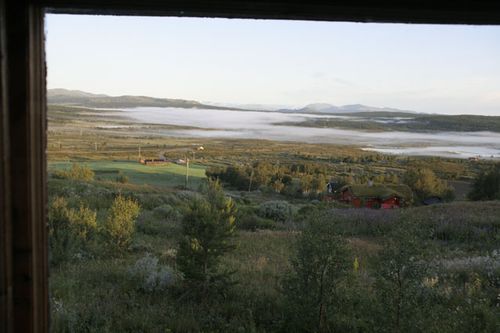
Gala in Gudbrandsdalen, Norway, 5 am
 The Dish